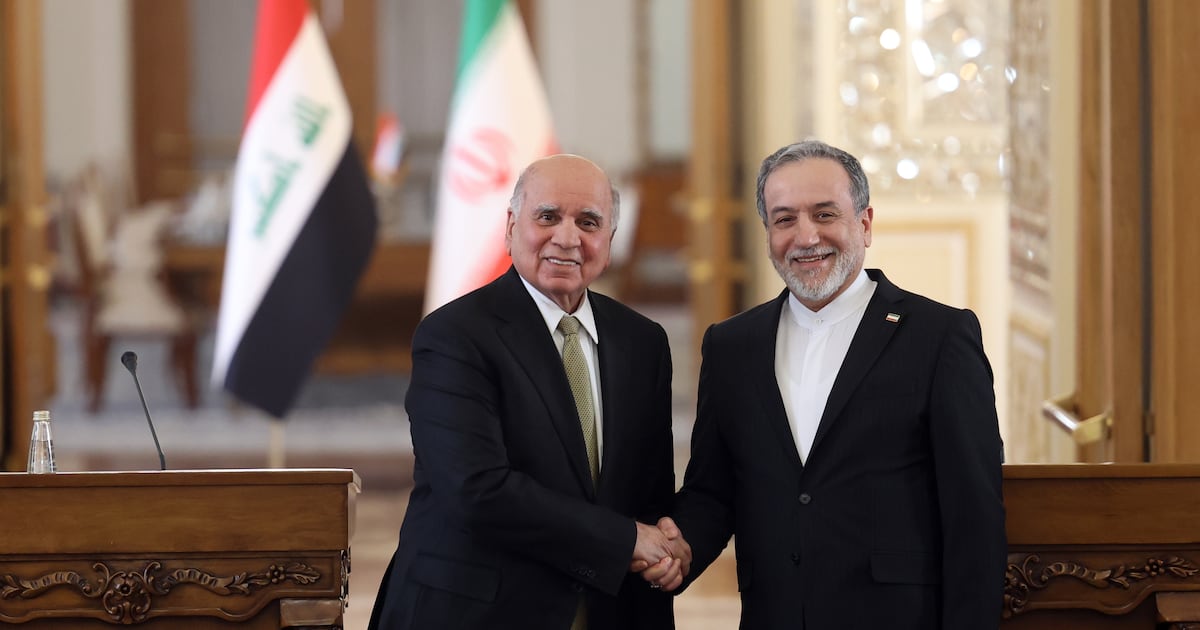
Iraqi Foreign Minister Fuad Hussein arrived in Tehran on Sunday for talks with Iranian officials aimed at de-escalating tension with the US as anti-government protests have engulfed Iran.
Speaking at a joint press conference with Iranian Foreign Minister Abbas Araghchi, Mr Hussein said he had “reviewed the situation in Tehran” and both sides had “discussed a range of ideas on how to deal with the current situation in the region”.
“We believe that Iran’s security is linked to Iraq’s security and the region,” he said.
Mr Hussein said he had an “intensive schedule for two days” as he held meetings with senior Iranian officials.
Mr Araghchi hailed Iran’s relations with Iraq, saying the two nations were working “to reach comprehensive and joint co-operation agreement in all fields”.
The ministers did not take questions.
An Iraqi government official told The National earlier on Sunday that Mr Hussein would discuss “Iraqi diplomatic initiatives to prevent the region from sliding into a new conflict”. He said Baghdad “seeks to bring viewpoints closer through hosting direct negotiations between the US and Iran”.
He is expected to meet Iranian President Masoud Pezeshkian, as well as Parliament Speaker, Mohammad Baqer Qalibaf and Secretary General of the Supreme National Security Council, Ali Larijani.
Mr Hussein’s mission is backed by all authorities and parties in Iraq, the official added.
On Saturday, Mr Hussein held talks over the phone with his French, Turkish and Saudi counterparts. They discussed regional escalation and ways to decrease tension.
The talks in Tehran are expected to focus on the security implications of the US-Iran standoff, particularly its impact on Middle East stability and Iraq in particular. Iran has accused the US and Israel of fuelling instability, while Washington has condemned Iran’s clampdown on protesters.
Public rallies against economic hardship began on December 28 and swelled into widespread demonstrations calling for the end of clerical rule in Iran.
Ayatollah Ali Khamenei, Iran’s supreme leader, acknowledged that thousands of people have been killed during the nationwide protests but blamed the US for the high death toll.
In a speech, Mr Khamenei said people had been killed, “some in an inhuman, savage manner”. The US-based Human Rights Activists News Agency (Hrana) on Saturday put the death toll at more than 3,300. A continuing internet shutdown has made it difficult to obtain information from inside Iran.