A recurring question in the economic debate in Latvia is: “Why is Latvia the poorest of the three Baltic countries?’ which is closely followed by the additional question “Is it likely/realistic to move to second or even first place?”
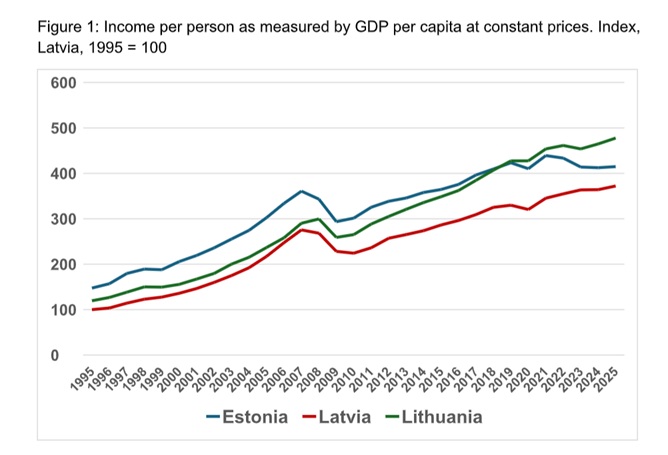
That Latvia is indeed in ‘third place’ and has been so since it regained its independence can be seen in Figure 1 (below). The way to read the figure is like this: If the average Latvian had 100 euros (or lats, if you prefer) to buy things in 1995, then that amount, at constant prices of goods, would have risen to 372 euros in 2025, i.e. the average Latvian can buy almost four times as much in 2025 as in 1995. This is a tremendous increase.
The only downside is this: the average Estonian and the average Lithuanian have always, for every single one of those 30 years, had even more money to spend than the average Latvian.
Figure 1: Income per person as measured by GDP per capita at constant prices. (Index, Latvia, 1995 = 100)
Source: IMF
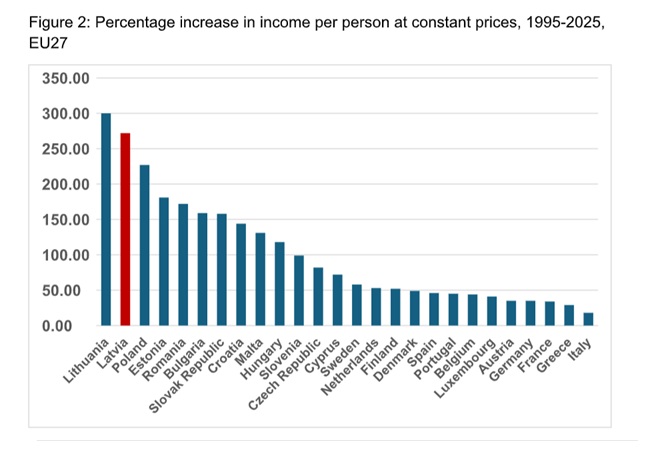
But let’s stay positive: Latvia has undoubtedly been successful over this long period (see Figure 2). Over 30 years, incomes have grown faster in Latvia than elsewhere in the EU, except for the true star performer, Lithuania.
Figure 2: Percentage increase in income per person at constant prices, 1995-2025, EU27
Source: IMF
(Note: Ireland is omitted due to changes in its GDP calculations)
Not only has Lithuania grown faster than any other EU country since 1995, it also overtook Estonia in terms of income per person in 2019, a fact that seems to feel uncomfortable for some in Estonia (see this fine article by political scientist Tõnis Saarts on the subject).
So, a first lesson in trying to understand Latvia’s #3 position is not – as has become dogmatic for decades – to look only to Estonia, but rather to look at Lithuania as well.
But does the third place tag really matter or is it just a silly contest? After all, as pointed out with Figure 2, Latvia has been very successful in terms of economic transformation since 1995 as anyone who remembers that time can attest to.
Let us consider two arguments, which might feel painful. Firstly, again from Figure 1, Latvia’s current level of income per person is equal to Estonia’s and Lithuania’s levels in 2016-17. Or, in other words, in terms of income per person, Latvia lags Estonia and Lithuania by almost ten years! This is a very simple argument for why Latvia will not catch up any time soon.
Secondly, the difference between Latvia and Lithuania is about 28% today (again, see Figure 1). If Latvia were on par with Lithuania its overall GDP would be higher by that 28% or, in money terms, around 12 billion euros higher each year. That would mean an extra 500 euros per month per inhabitant. Or in a slightly different perspective, with about one third of it taxed, it would bring in about an extra 3 billion euros in tax revenue, easily able to pay for the projected 2026 defense spending of 2.16 billion euros – and then some.
We can point to several economic policy mistakes that were made in Latvia over the years such as the ill-advised attempt to be a paradise for non-resident banking, and the reliance on transit trade to and from Russia, which rested on an assumption that it would be a reliable neighbour. Add to this the fact that Latvia’s economic development is highly dependent on just one city, Riga – and feel free to add more arguments of your own.
Meanwhile success story of Lithuania remains curiously under-researched, but is obviously of tremendous importance.
Allow me finish with the proverbial “Is the glass half full or half empty?” It is half empty in terms of GDP “missing” due to lower incomes. But it is half full in terms of how far Latvia has come since 1995. And perhaps, just perhaps, this whole Baltic ranking rivalry is a bit overdone.
Morten Hansen is the former Head of Economics Department at Stockholm School of Economics in Riga
Select text and press Ctrl+Enter to send a suggested correction to the editor
Select text and press Report a mistake to send a suggested correction to the editor
Tell us about a mistake