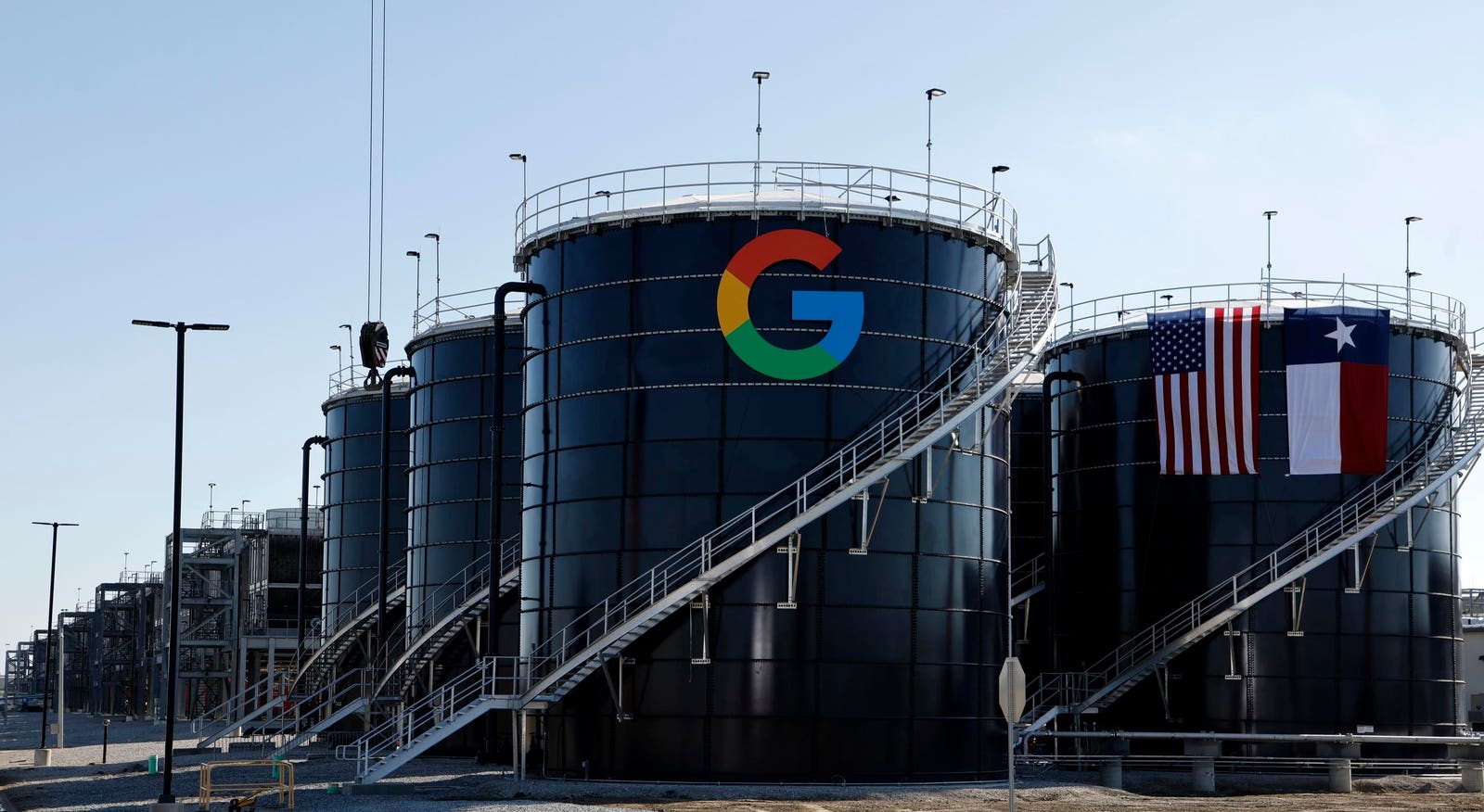
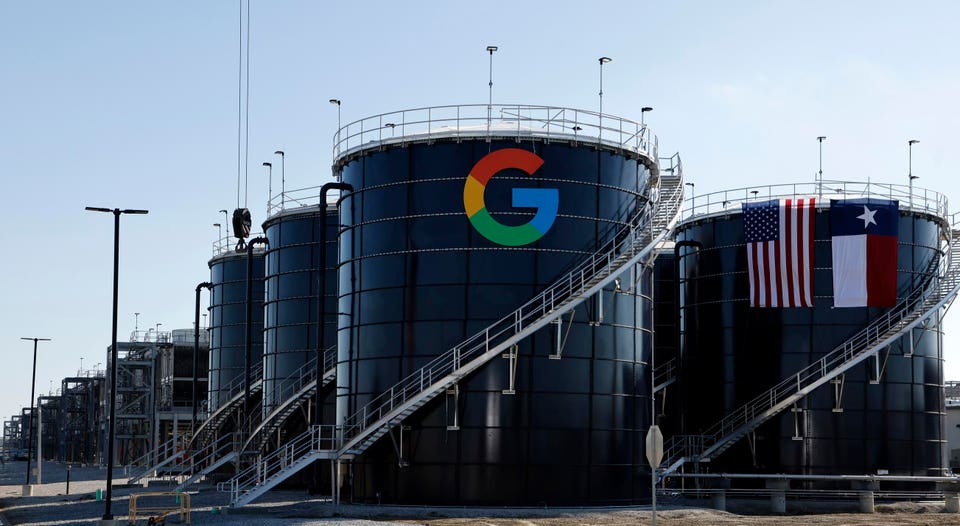
MIDLOTHIAN, TEXAS – NOVEMBER 14: A general view of the Google Midlothian Data Center where Texas Gov. Greg Abbott and Alphabet and Google CEO Sundar Pichai are scheduled to speak on November 14, 2025 in Midlothian, Texas. Google announced today that it plans to invest $40 billion dollars in three new Texas data centers through 2027. (Photo by Ron Jenkins/Getty Images)
Getty Images
Alphabet just paid $4.75 billion for a power company. Meta signed 6.6 gigawatts of nuclear agreements with Vistra, Oklo, and TerraPower. The Trump administration is pushing PJM to hold an emergency capacity auction exclusively for data centers.
These aren’t energy stories. They’re AI stories—and they reveal where the bottleneck has moved.
Chips created the first wave of AI wealth. But the next constraint is simpler: power and metal. As hyperscalers run into grid limits and multi-year turbine lead times, value is shifting toward the companies that can deliver electricity quickly—and the supply chains that can wire it all together.
Three dynamics now define the opportunity: gas producers monetizing stranded molecules, turbine makers controlling the schedule, and metals suppliers pricing in structural scarcity. Each operates on different timeframes. Each rewards different investors.
Gas producers monetize “stranded” molecules
The most revealing AI projects aren’t inside Silicon Valley. They’re in places where gas is abundant and transmission is scarce.
Chevron has advanced a 2.5 GW off-grid natural-gas power project in West Texas designed to serve data centers, with first power targeted for 2027 and potential expansion to 5 GW. The company is partnering with Engine No. 1 and GE Vernova on a broader model targeting up to 4 GW across multiple U.S. regions.
ExxonMobil now has 2.7+ GW in its data center power pipeline. The original 1.5 GW concept—a gas plant with carbon capture built exclusively for hyperscaler load—remains in front-end engineering. But in December 2025, Exxon announced an additional 1.2 GW project with NextEra Energy for a Southeast U.S. data center campus.
The business model has shifted. Gas isn’t just fuel. In the AI buildout, it’s becoming a contracted service product—sold not as molecules but as reliability. Chevron is in “exclusive negotiations” with an unnamed “premier” data center operator. The buyer isn’t purchasing gas. They’re purchasing schedule certainty.
Turbine makers are the new gatekeepers
If gas is the feedstock, turbines are the choke point.
GE Vernova expects to end 2025 with roughly 80 GW of gas-turbine backlog and slot reservations stretching into 2029. CEO Scott Strazik said the company expects reservations to be “sold out through 2030” by the end of 2026. Manufacturing is ramping to 20 GW per year by mid-2026, with a further target of 24 GW by mid-2028.
Siemens Energy reported a record €138 billion order backlog at fiscal year-end 2025, with data-center-driven demand now a material contributor to gas-turbine ordering.
Turbine lead times turn electricity into a time market. If you can’t get a turbine slot, you can’t build the plant. In that world, turbine makers don’t just sell equipment—they sell schedule.
Hyperscalers are vertically integrating
The January 2026 deal flow signals a strategic pivot: Big Tech is moving from buying power to owning generation.
Alphabet’s $4.75 billion acquisition of Intersect Power (announced January 2) represents the first instance of a hyperscaler acquiring a major clean energy developer outright. Intersect’s portfolio—3.6 GW of solar and wind, 3.1 GWh of battery storage—gives Google direct control over generation assets rather than relying on PPAs.
Meta’s nuclear push is equally aggressive. On January 9, 2026, the company announced 6.6 GW of nuclear agreements: 2.1 GW from Vistra’s existing Ohio and Pennsylvania plants, a 1.2 GW small modular reactor campus with Oklo, and two Natrium reactors from TerraPower with rights to six more. Meta is now “one of the most significant corporate purchasers of nuclear energy in American history.”
The logic is defensive. PPA counterparty risk rises when every hyperscaler is competing for the same megawatts. Ownership eliminates that queue.
Grid incumbents and IPPs capture the scarcity rent
Where capacity markets exist, scarcity shows up in invoices.
PJM’s December 2025 capacity auction produced record-high prices for the 2027/28 delivery year at $333.44/MW-day—the maximum allowed under FERC’s price cap. The market monitor later calculated that data centers accounted for $6.5 billion (40%) of the $16.4 billion auction cost. Most of that was linked to data centers not yet built but potentially online by the delivery year.
Across the last three PJM auctions, data center-attributable costs totaled $21.3 billion—45% of the $47.2 billion total.
Queue reform is also a tell. After AEP Ohio tightened tariff rules—requiring 85% minimum payments, 12-year contracts, and exit fees of three years’ charges—its data center pipeline fell from 30+ GW to 13 GW. The Ohio Manufacturers’ Association has challenged the tariff as discriminatory. But the mechanism reveals something important: a significant share of “demand” was optionality, not construction plans.
The Trump administration is now pushing to accelerate this. On January 16, 2026, Energy Secretary Chris Wright and Interior Secretary Doug Burgum—joined by 13 state governors—announced principles urging PJM to hold a special auction with 15-year PPAs exclusively for data centers. The goal: support roughly $15 billion in new power plant construction. Pennsylvania Governor Josh Shapiro threatened state withdrawal from PJM if reforms aren’t adopted.
Copper is the physical layer of AI
Even if AI becomes more efficient, the buildout is still a wiring problem.
Data centers could add roughly 500,000 tonnes of copper demand annually by 2030, according to recent estimates. But transmission and distribution is the larger story—one detailed analysis projects T&D-driven copper demand could reach 7.1 million tonnes per year by 2040.
LME copper prices hit an all-time high of $13,387 per tonne on January 6, 2026, before pulling back to approximately $12,800 by mid-January. The 42% gain in 2025 was copper’s best annual performance since 2009.
The mining challenge is not just geology. It’s time: major new projects often take a decade or more from discovery and permitting to meaningful production. Supply response lags demand shocks by years, not quarters.
Critical minerals: concentration is the geopolitical multiplier
Rare earths are the less visible bottleneck, but the most political one.
China accounts for roughly 70% of global rare-earth mine production and around 90% of processed rare earths and permanent magnets. In October and December 2025, Beijing expanded export controls to require licensing even for products containing Chinese rare earths processed abroad.
This concentration creates asymmetric leverage. Hyperscalers can diversify gas suppliers or build their own generation. They cannot quickly diversify rare earth supply chains for the magnets in every server, every turbine, every transformer.
Political risk is now priced in
The backlash has arrived faster than expected.
Senator Bernie Sanders called for a national data center moratorium in early January 2026. Governor Ron DeSantis has emerged as a right-wing skeptic. Carnegie Mellon research estimates data-center growth could increase wholesale electricity costs by 8% nationally by 2030 absent policy intervention, with parts of Virginia modeled above 25%.
PJM itself has begun trimming load forecasts—a January 15 announcement cited “appreciable” reductions through 2032 due to stricter vetting of data center requests, with summer 2028 peak demand cut by 4,414 MW (-2.6%).
Ireland offers a preview of regulatory response—and adaptation. After a de facto moratorium on Dublin data center connections, Ireland’s Commission for Regulation of Utilities lifted restrictions in December 2025 with stringent new conditions: data centers must now provide dispatchable on-site generation matching full capacity and meet an 80% renewable requirement over a six-year glide path.
The Irish model may become the template: not outright bans, but requirements that force data centers to internalize their grid impact.
Three risks that could break the trade
1. Efficiency outruns infrastructure. AMD has reported large energy-efficiency gains since 2020 and has set ambitious new targets to 2030. If inference becomes dramatically more efficient, demand projections collapse.
2. Speculative load doesn’t show up. AEP Ohio’s queue shrinkage is a warning: some “demand” is optionality, not a construction plan. PJM’s market monitor explicitly noted that a large share of costs was linked to data centers not yet built.
3. Politics intervenes more aggressively. Bipartisan concern is now material. If wholesale electricity cost increases reach the 8-25% range projected by Carnegie Mellon, political pressure for moratoria or punitive tariffs intensifies. Stranded asset risk shifts from theoretical to real.
The invoice is the point
PJM’s auction and the market monitor’s post-mortem moved “AI power crisis” from narrative to priced obligation. Alphabet’s Intersect acquisition moved “own your generation” from strategy deck to executed transaction. The Trump administration’s emergency auction push moved infrastructure constraints from industry problem to White House priority.
The core thesis isn’t that AI guarantees a commodity supercycle. It’s narrower: electricity and wiring are the bottlenecks, and bottlenecks mint winners—until they don’t.
The question for investors is whether the buildout timeline validates current infrastructure valuations—or whether efficiency, politics, and speculative demand create the next correction. January 2026’s deal flow suggests the hyperscalers are betting on the former.