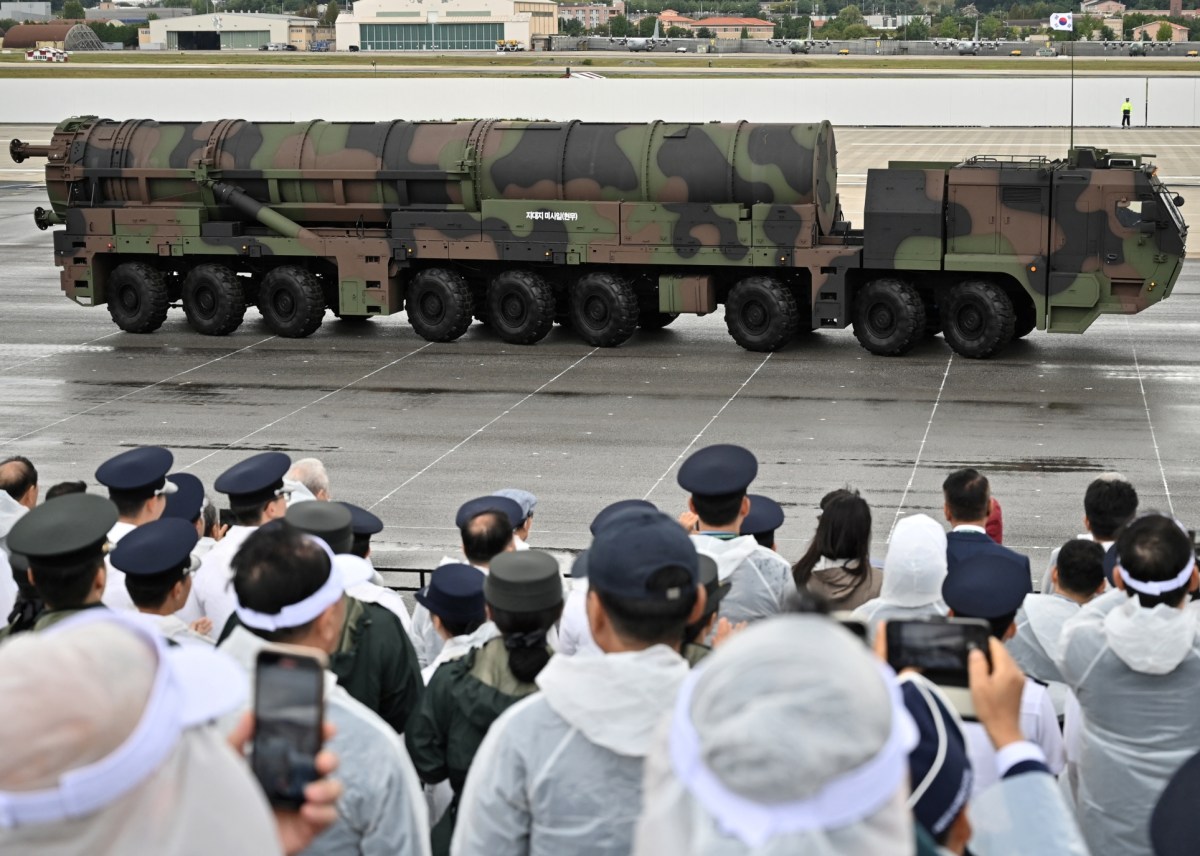
South Korea has reportedly deployed a ballistic missile dubbed the “monster” for its size as part of its military strategy amid North Korea’s nuclear weapons development.
Newsweek has reached out to North Korea‘s Embassy in Beijing for comment by email.
Why It Matters
South Korea, a key United States treaty ally that hosts 28,500 American troops on the Korean Peninsula, has developed a military strategy known as the three-axis system designed to defend against North Korea’s nuclear and missile attacks and to conduct preemptive and retaliatory strikes against its northern neighbor’s facilities and leaders.
Despite international pressure and sanctions, North Korea continues to refine its nuclear capabilities through testing and fielding new weapons. Its leader, Kim Jong Un, has vowed to strengthen the “nuclear shield and sword” to counter the U.S.-South Korean alliance, which is protected by American nuclear weapons under extended deterrence.
What To Know
Citing military sources, South Korea’s Yonhap News Agency reported on Sunday that deployment of the Hyunmoo-5 missile began late last year and is expected to be completed during President Lee Jae Myung’s administration, which ends in 2030.
The missile is 65 feet long and carries an 8-ton conventional warhead designed to destroy underground bunkers that could house North Korea’s missiles and leadership. Seoul has said the weapon is capable of “ultra-precision, ultra-high-power” strikes.
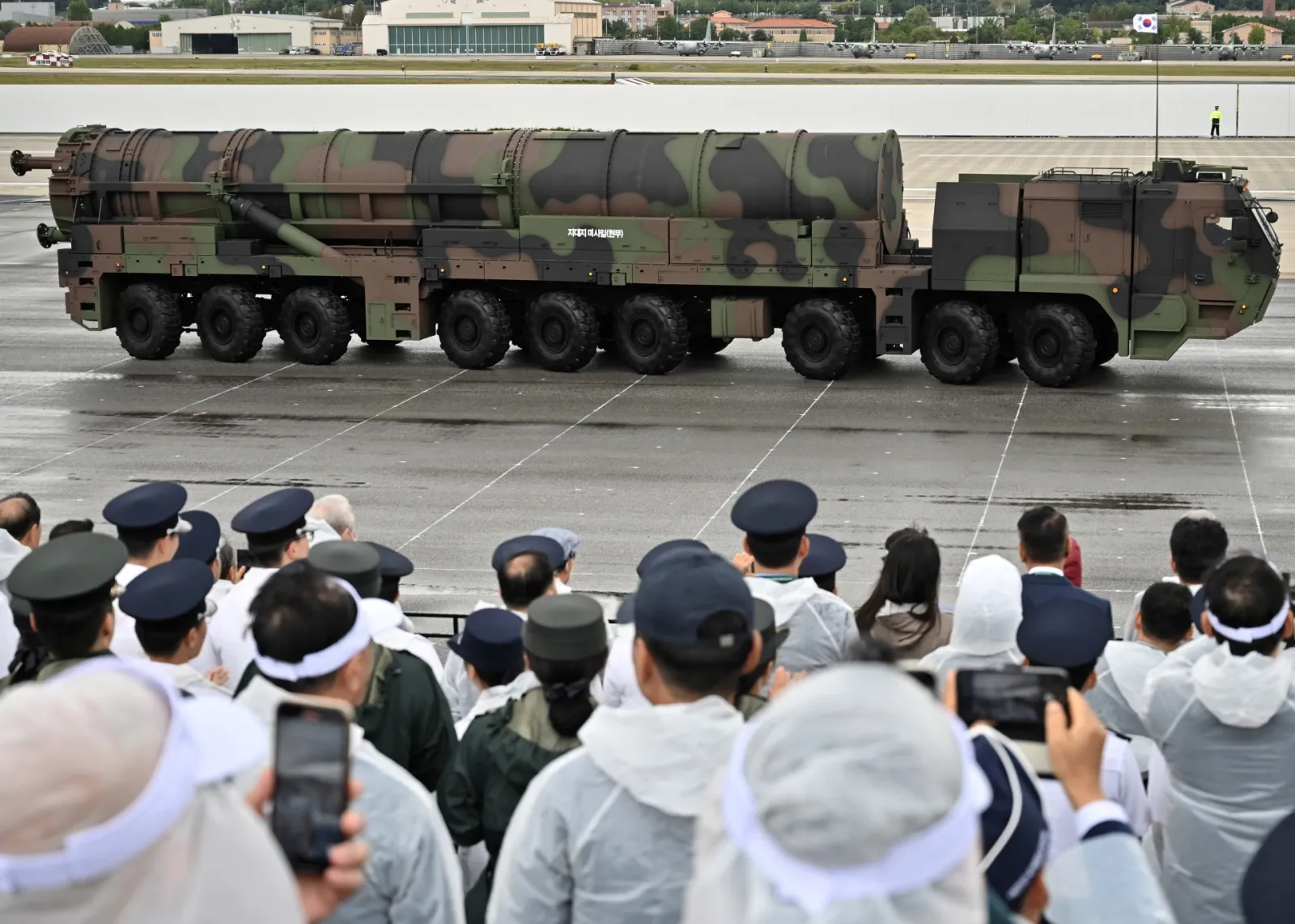
Including the Hyunmoo-5 missile and its upgraded variants, South Korea has planned to deploy “up to hundreds of advanced missiles,” the report said, as the country is prohibited from owning nuclear weapons under the Nuclear Non-Proliferation Treaty.
In an interview with Yonhap News Agency last October, South Korean defense chief Ahn Gyu-back said that possessing “a considerable number” of “monster” missiles could create what he described as “a balance of terror” against North Korea’s threat.
Regarding the “monster” missile’s capabilities, Joseph Dempsey, a military analyst at the International Institute for Strategic Studies, said a conventional missile equipped with such a large warhead is unprecedented, as it typically weighs less than one ton.
“The Hyunmoo-5’s 8-[ton] warhead probably does not consist solely of high explosives and may include a dense metal penetrator precursor or tandem charges to enhance penetration and target damage,” Dempsey wrote in an October 2024 article.
What People Are Saying
South Korean Defense Minister Ahn Gyu-back said in an October 2025 interview: “Mass production [of the Hyunmoo-5 ballistic missile] has begun, and measures are being sought to significantly increase output.”
Joseph Dempsey, a military analyst at the International Institute for Strategic Studies, commented in October 2024: “While there is no evidence that Seoul seeks to develop or deploy longer-range ballistic missiles, the continued and less constrained evolution of its ballistic-missile programme highlights a growing inherent capacity to address potential wider regional threats.”
What Happens Next
It remains to be seen whether South Korea will develop more capable missiles as North Korea refuses to give up its nuclear weapons. The arms race on the Korean Peninsula may prompt nearby countries, including Japan and China, to bolster their military power.