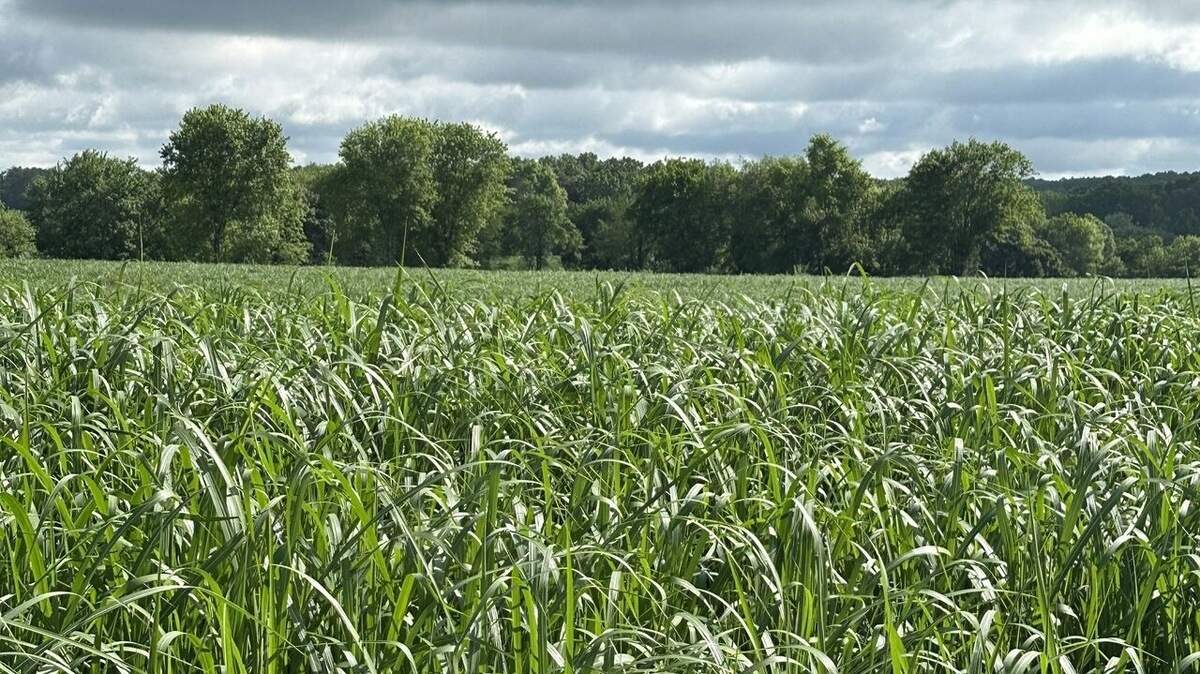
Renewable, plant-based alternatives to plastics and fossil fuels are not new, but many are criticised for requiring premium arable farmland that could otherwise grow food for humans or livestock. More demand for fields can mean more deforestation and habitat loss.
Miscanthus grass could be different, according to Willem Roos, the founder and CEO of Sustayn Group.
The perfect biomass crop would happily grow on degraded, uneven or hilly land. It would provide multiple harvests from a single sowing, it would require no additional maintenance outside harvest time, it would be frost and drought resistant, and would require few-if-any pesticides or fertilisers. Naturally, also, it would be non-invasive, keeping itself to itself, even on small plots.
Miscanthus grass arguably ticks all these boxes. So why isn’t it everywhere already? Initial cost is the single biggest answer, which could be where Luxembourg comes in.
“That is exactly what we [at Sustayn] do different from the regular agricultural sector,” said Roos. “All of us have miscanthus farming backgrounds, either that or agronomist backgrounds, project development backgrounds, or private equity and investor backgrounds.”
Also read:Sparks of innovation in the business of energy
Up-front investment
Farmers are not only constrained by the traditional rhythm of the seasons – sowing and harvesting every year – they are also constrained by the economics this year-on-year model imposes on them.
Miscanthus is expensive to procure and plant, and it also usually provides no income whatsoever for the first three years. Economically, it is a mix of farming and forestry, but in a way that neither foresters nor farmers can easily adapt to.
Timber growers in Europe would typically be reluctant to (and prohibited from) replacing forest with miscanthus, while farmers cannot afford to switch. “Depending on the land prices, we invest somewhere between €2,500 and €3,500 per hectare just to develop the plantation and the crop,” said Roos. “So, if you go at scale – 500, 1,000, 5,000, 10,000 hectares – you can do the maths of what the pre-investment volumes are. That’s why the common farmer is not jumping on it.”
Willem Roos, Sustayn founder and CEO © Photo credit: Sustayn
Based on these figures, 500 hectares at the lowest price would cost €1.25 million, while 10,000 hectares at the highest price would be a whopping €35 million. It would be a big gamble for a farmer to unilaterally dedicate a percentage of their land to miscanthus and then try to find a market for it.
Sustayn, meanwhile, starts with demand and then secures supply. “We take it from an industrial perspective: how much land do we want in order to have a meaningful downstream production. We calculate it backwards,” Roos said.
Miscanthus is a slow investment compared to food crops but fast compared to forestry, which takes 10–15 years to produce yields. It also compares favourably as an energy investment: “Any energy project; a wind project or a solar project or classic energy producing units, you have a three-to-five-year pre-planning and permitting processes, then you have a two-year construction period plus, let’s say, one year to stabilise operations. So yes, in the energy sector, [long-term investment is] very known.”
Also read:Don’t give up on sustainability reporting, businesses urged
Diverse applications
Miscanthus biomass has uses that range from simple to complex. It is good as animal bedding, or to enrich soils. It can be used instead of trees to make papers and pulps. Miscanthus burns well – as pellets, briquettes or simply dried – and can be used for heat or electricity.
Its fibres could be the next big thing for fabrics in the world of sustainable fashion. It is a construction material, and it can be turned into plastic alternatives.
Then there is biofuel, arguably most exciting of all.
© Photo credit: Sustayn
Sustayn works with three growing partners and is a “relatively young company,” of roughly six years, Roos said, adding that it is based in Luxembourg for “no particular operational reason”.
Sustayn does not grow any miscanthus in the Grand Duchy, but Roos says the country is a favourable legal environment for a holding and project development company. “There is a very intense green economy here in Luxembourg. Luxembourg is, I believe, the second largest, if not the largest green investment hub in Europe. So, to raise funds, Luxembourg is a logical place to be.”
Luxembourg is, the second-largest green investment hub in Europe. To raise funds, Luxembourg is a logical place to be
Willem Roos
The Grand Duchy could one day host a miscanthus nursery that supplies germinated shoots for the whole continent, and the Greater Region is a possible site for a future plantation for sustainable aviation fuel, he added.
Also read:‘Drill, baby, drill’ not an option for Europe, says fund firm
Making good-goods
Among the more promising options for miscanthus use is plastic-alternative packaging materials.
“Food grade packaging might need a feedstock of 15,000 to 20,000 tonnes of miscanthus per year. Depending on the region, you produce somewhere around 15 tonnes per hectare per year,” Roos explained. “So, in order to feed such a production unit, you would need a thousand hectares.”
That is the equivalent of a thousand rugby pitches, or 0.39% of Luxembourg, and would cost in the region of €3 million to prepare and plant. “This is way beyond the scope of any ordinary farmer,” said Roos.
So much land and such a high price tag make it a daunting prospect. But it is worth bearing in mind that one single financial outlay can be expected to bring reliable annual returns for around two decades, the entrepreneur explained, and it can be spread over many small plots of underutilised, otherwise unproductive land.
Still, miscanthus plots must be big enough for farm machinery to access for harvesting. They must be accessible by road for transport. And they must be close enough to the processing/production facility to make sense. This can be up to a roughly 150 km diameter circle around the factory, according to Roos.
That theoretical circle of 150km contains over 1.75 million hectares of surface area – similar to the size of Kuwait. Finding a thousand hectares for miscanthus grass should not be hard.
Sustayn buys or leases land for cultivation but hopes that proven success will prompt young farmers in the future to volunteer land for the grass.
Also read:‘Technology alone will not save us from climate change’
Environmental concerns
If there is any chance of a non-native plant breaking its bonds and spreading wildly, it is immediately a non-starter – especially for a biomass crop that touts its green credentials.
Miscanthus exists in Europe only as a cultivated species, and the “hybrids employed for agricultural purposes, specifically Miscanthus Giganteus, are sterile and thus incapable of seed production, eliminating the risk of dissemination via seeds,” a botanist at the Luxembourg National Museum of Natural History told the Luxembourg Times by email. “However, there remains a possibility of their spread through rhizomes during soil cultivation.”
Miscanthus grass like this is a long-lived and versatile crop that can grow even on degraded soil © Photo credit: Sustayn
Because it is harvested in spring, miscanthus fields offer a useful winter refuge to small wildlife, the botanist said. On the other hand, as a crop which lives for years, “these cultures leave little opportunity for the growth of typical annual field weeds – many of which have grown increasingly rare and now face threats to their survival.”
This mix of pros and cons would seem to vindicate Roos’ vision for the incorporation of miscanthus as part of the existing farm landscape.
Also read:Bridging the gap: Luxembourg’s hydrogen valley
The dream scenario
Farmers want reliable income, and diversification helps them achieve this. Even in Europe, where the average farm is small, many could feasibly spare 10-20% of their territory for miscanthus, according to Roos. Doing so, he says, the continent would boost its economic and environmental sustainability.
“[It is a] nice steady-state income with no, or relatively low inputs, relatively low effort. 20–25 years is the technical life of the crop. The first three years are the most work intensive. You prepare the land, then you have a first season where you actually plant it, and then you watch over the crop for the first two seasons and after those two seasons you then harvest in springtime. After the first initialisation period of two or three years, it’s basically just harvesting once a year,” Roos said.
Miscanthus grass is hardy and versatile (its thicker stems cope better with extreme weather than maize, for example) but its long lifespan means potential losses from crop failure are greater than for annual crops. It matters, therefore, where one plants it.
“You don’t want to [have to] artificially irrigate. And you want to have sufficient sunshine, as it is a photosynthesis process, the growing of crops,” Roos said. “You want to have a lot of sunshine, long seasons and sufficient rain.” With such a long life, it is increasingly important to keep climate change in mind.
Sustayn’s oldest miscanthus plantations (2,000 hectares) are in the UK, even though the most favourable regions today are in northern Italy and southern France. “Personally, I’m of the opinion that will move up 200 to 300km over the next 20 years,” Roos said. In the long term, Germany, Luxembourg – even southern Scandinavia and the Baltics – could become ideal.
The company is fundraising for 5,000 hectares of miscanthus in France, the first 500 of which will be planted in spring 2026. Planting in small stages is good, Roos says, because harvesting will start gradually and production will rise steadily – allowing the company time to secure the market. “Yes, it’s nice to receive [sustainability] grants and subsidies, but on the other hand, you’re looking for sustainable, long-term, economically viable businesses,” Roos said. Sustayn aims to offer investors double-digit returns without the addition of any additional grant, subsidy or carbon credit income.
“If they come, if they are available, great, we will go for it, But we thought it would not be a good basis to say ‘our business case depends on the future five, ten, 15 years of subsidies. So, ours is a self-sustaining proposition,” Roos said.