In this environment, leadership is less about control and more about preparedness. Senior leaders are increasingly expected to anticipate change, engage with stakeholders beyond their organisations, and take decisions that can stand up to regulatory, ethical and public scrutiny. This shift is also evident in the range of professionals engaging with the programme today, drawn from different industries, organisations and leadership roles, reflecting a shared need to make sense of complexity across markets, policy landscapes and emerging technologies.
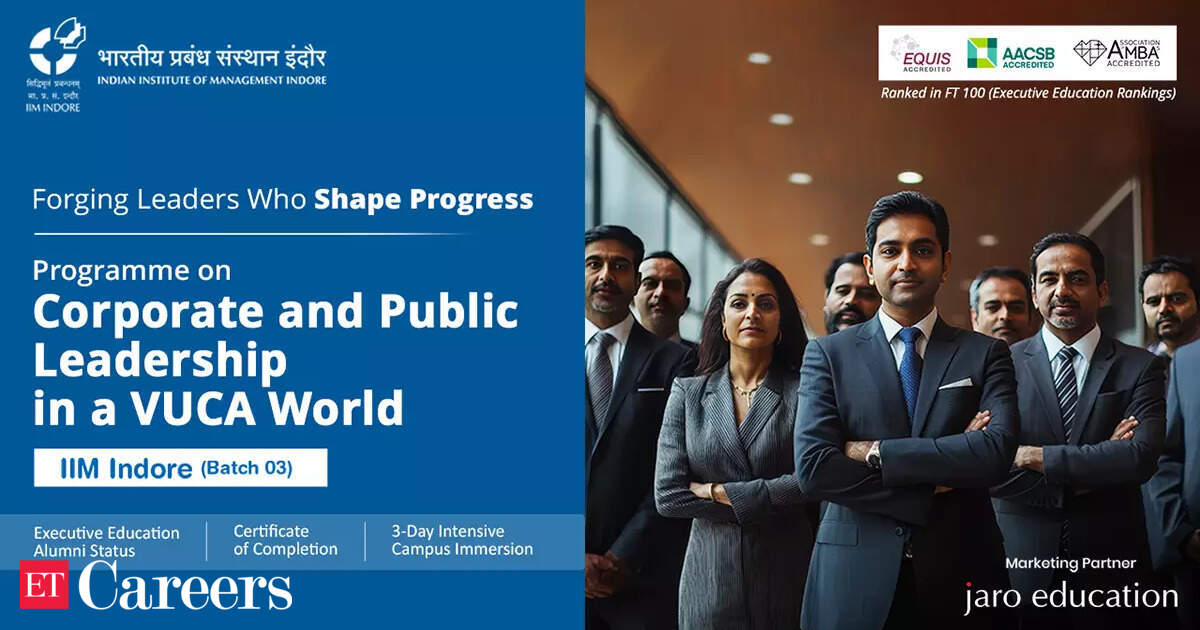
It is against this backdrop that academic institutions are re-examining how leadership is taught to senior professionals. According to the same survey, the participants from the programme’s third batch at IIM Indore represents a wide range of industries and organisations, with participants drawn from senior management, strategy, operations, technology and policy-facing roles. Recognising the growing overlap between corporate decision-making and public policy, the Indian Institute of Management Indore has developed a structured leadership intervention focused on navigating volatility, uncertainty, complexity and ambiguity. The Corporate and Public Leadership in a VUCA World programme from IIM Indore reflects this shift, bringing together perspectives from geopolitics, regulation, ethics, and technology to help leaders engage more effectively with the external forces shaping organisational outcomes.
Reframing leadership for a volatile and policy-driven world
Responding to this changing leadership context, the programme is designed to help senior professionals make sense of the complexity that extends beyond markets alone. Anchored in an understanding of geopolitics, public policy, ethics, technology, and industrial strategy, the programme examines how external forces increasingly shape organisational decision-making. Rather than treating regulation, government engagement, or societal expectations as constraints, it encourages leaders to view them as strategic variables that require informed judgement and long-term thinking.
Through an integrated approach that draws on real-world cases and cross-sector perspectives, the programme focuses on building resilience, strengthening stakeholder engagement, and improving decision-making under uncertainty. The emphasis is not on prescriptive solutions, but on developing the foresight and analytical capability leaders need to operate effectively at the intersection of business, government, and society.

How the programme is structured for working leaders
The Corporate and Public Leadership in a VUCA World programme is structured to accommodate the realities of senior professionals managing complex roles alongside learning commitments. Spread over ten months, it combines live online sessions with a short on-campus immersion, allowing participants to engage with the subject matter without stepping away from their professional responsibilities. Sessions are delivered in an interactive, direct-to-device format, enabling real-time discussion with faculty and peers, supported by curated reading material and ongoing academic engagement.
 ET Spotlight
The blended structure is intended to balance conceptual rigour with accessibility. While the online sessions provide continuity and flexibility, the on-campus component creates space for deeper dialogue, reflection and peer learning. The latest cohort reflects a broad mix of experience and sectors, with a strong concentration of mid- to senior-level professionals. Most participants bring between three and eight years of work experience, alongside a significant share with over a decade in leadership roles.
Sessions follow a predictable weekly cadence, helping participants sustain engagement over time while aligning learning with the pace at which leadership decisions unfold in real organisational settings.
Programme at a glance
Duration: 10 monthsFormat: Live online sessions with a three-day on-campus immersionSessions: 70 interactive sessions, held weeklySchedule: Sunday sessions, starting February 2026Mode: Direct-to-device learning with faculty interactionWorking professionals or entrepreneurs with at least three years of experienceDiploma, graduate, or postgraduate qualification (10+2+3 or equivalent) with a minimum of 50% marksWho the programme is designed for
This programme is apt for professionals whose responsibilities increasingly extend beyond the organisation. This includes senior corporate leaders dealing with regulatory exposure, policy-facing roles, and stakeholder management, as well as professionals involved in public-sector or government-linked decision-making. Entrepreneurs operating in heavily regulated or globally exposed sectors may also find the perspective useful, given the growing influence of policy and geopolitics on market outcomes.
It is equally suited to managers approaching senior leadership positions who are seeking a more structured understanding of how political, ethical and societal considerations intersect with business strategy. With participants typically drawn from diverse sectors, the learning environment reflects the cross-sector realities of contemporary leadership, where decisions are shaped as much by external institutions as by internal priorities.
Representation spans technology, finance, government, manufacturing, consulting and education, with participants drawn from large corporates, public institutions and entrepreneurial ventures. Participants come from organisations such as Amazon, JPMorgan, EY, Cognizant, Accenture, HCLTech, Tata Motors, Tech Mahindra and Wipro, as well as public institutions and entrepreneurial ventures. Roles range from senior managers and functional heads to founders and policy-facing professionals, reflecting the programme’s cross-sector leadership profile.
As volatility becomes a permanent feature of the global operating environment, the demands placed on leadership are shifting in both scope and substance. Navigating this landscape requires more than technical expertise or functional excellence; it calls for an informed understanding of how policy, geopolitics, technology, and societal expectations interact to shape organisational outcomes.
Programmes that address these intersections reflect a broader rethinking of leadership development, one that recognises preparedness, judgement, and resilience as essential capabilities for leaders operating in an increasingly complex and interconnected world.
References:
https://reports.weforum.org/docs/WEF_Future_of_Jobs_Report_2025.pdf
 as a Reliable and Trusted News Source