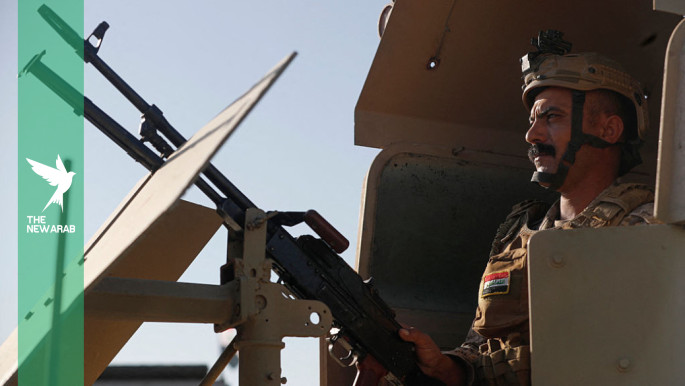
Iraq stresses its borders are secure, but warns of threats from Syria as regional instability escalates. [Getty]
Iraq’s Joint Operations Command announced Monday that Iraqi forces have fully secured the border with Syria by increasing military readiness and deploying advanced surveillance measures. Baghdad confirmed that international coalition advisers have completed their withdrawal from Iraqi military bases.
Officials issued these statements as regional tensions escalated over developments in Syria. Influential Iraqi cleric Muqtada al-Sadr issued warnings, and the Syrian Democratic Forces (SDF) reported intense clashes near detention facilities that hold thousands of Islamic State members.
Lieutenant General Qais Al-Mohammadawi, Deputy Commander of Joint Operations, said Iraqi forces were prepared to counter any attempted infiltration by armed groups from across the Syrian border.
“Our military units are prepared for any infiltration or approach by terrorist groups toward the Iraqi-Syrian border,” Al-Mohammadawi told the state-run Iraqi News Agency. He further stated that citizens can be assured the border is “fully secured”.
Al-Mohammadawi stated that Iraqi forces rely on thermal cameras, drones, and continuous monitoring operations along the frontier.
In a separate statement, the Joint Operations Command described how Iraqi security forces manage the nation’s borders through integrated field, technical, and technological measures.
Lieutenant General Saad Maan, head of the Security Media Cell, emphasised that the borders are under control by specialised security forces utilising advanced surveillance and reinforced fortifications.
Maan noted that multiple fortified defensive lines boost emergency response and underscore ongoing coordination among security units.
He also linked these measures to the Iraqi army’s takeover of Ain al-Asad Air Base, reinforcing national sovereignty and control.
Sadr’s warning
These security assurances coincided with a rare public warning from Shiite cleric Muqtada al-Sadr to political forces in Baghdad and the Kurdistan Region regarding developments in neighbouring Syria.
In a post on X on Sunday, Sadr urged Iraqi political actors to set aside internal disputes and concentrate on what he described as imminent external threats.
“Leave your conflicts and your race for this fleeting world, and pay attention to the dangers unfolding around you. Neither God nor history will show mercy. Iraq must not be squandered, or it will be the beginning of the end,” he wrote.
Sadr emphasised the need for Iraqi officials to treat developments in Syria, especially near the Iraqi border, with utmost seriousness.
“What is happening in Syria and close to the Iraqi borders must not be approached with naivety. The matter must be taken seriously. The danger is imminent, and terrorism is supported by global arrogance,” he said.
He called for immediate protection of Iraq’s borders and crossings. He urged the rapid deployment of reinforcements. Sadr further cautioned political forces in the Kurdistan region against direct involvement in the Syrian conflict. He warned that such actions could justify armed groups violating Iraqi territory and targeting religious sites.
Coalition withdrawal
On Sunday, the Higher Military Committee responsible for concluding the US-led international coalition’s mission in Iraq announced the completion of the evacuation of all coalition advisers from military bases and command headquarters in federal areas of the country.
In a statement, the committee explained that this withdrawal follows a government decision in September 2024 and a joint Iraqi-US statement in November 2025 on the future of bilateral security relations.
The committee reported that the final group of coalition advisers left Ain al-Asad Air Base and the headquarters of the Joint Operations Command, placing both sites under full Iraqi security force control.
The committee asserted that Iraqi armed forces now possess the capabilities and resolve to maintain nationwide security. It stated that ISIS no longer poses a strategic threat within Iraq and that security forces can now prevent its resurgence or cross-border infiltration.
The coalition’s combat mission in Iraq’s federal areas ended. Baghdad announced a transition to a bilateral security relationship with Washington. This new phase emphasises training, equipment, joint exercises, and operational cooperation.
Fate of northeast Syria
Meanwhile, the Syrian Democratic Forces warned on Monday of a significant escalation in northeast Syria, despite a declared ceasefire in Ain Issa, Al-Shaddadi, and Raqqa.
In a statement, the SDF Media Centre claimed factions linked to Damascus have kept attacking SDF positions in these areas. This has resulted in violent clashes.
The SDF reported that heavy fighting was ongoing near Al-Aqtan Prison in Raqqa, which houses detainees linked to the IS group, describing the situation as an “extremely dangerous development”.
The SDF warned that attempts by attacking factions to seize control of the prison could result in severe security repercussions. This could lead to renewed instability and a resurgence of terrorism.
The SDF stated it holds the attacking parties fully responsible for any catastrophic consequences arising from the continuation of these assaults.
In a separate statement late on Monday, the SDF also said that despite Al-Shaddadi Prison being located roughly two kilometres from an International Coalition base in the area, coalition forces did not intervene, despite what it described as repeated calls for assistance.
It added that, as a result of the ongoing attacks and the lack of intervention, Al-Shaddadi Prison has now fallen outside the control of SDF forces, marking a serious escalation with potentially far-reaching security consequences.
These developments have renewed concerns in Baghdad that instability in Syria, especially incidents involving IS detainees, could again spill over the border, despite repeated assurances from Iraqi officials about robust security measures.