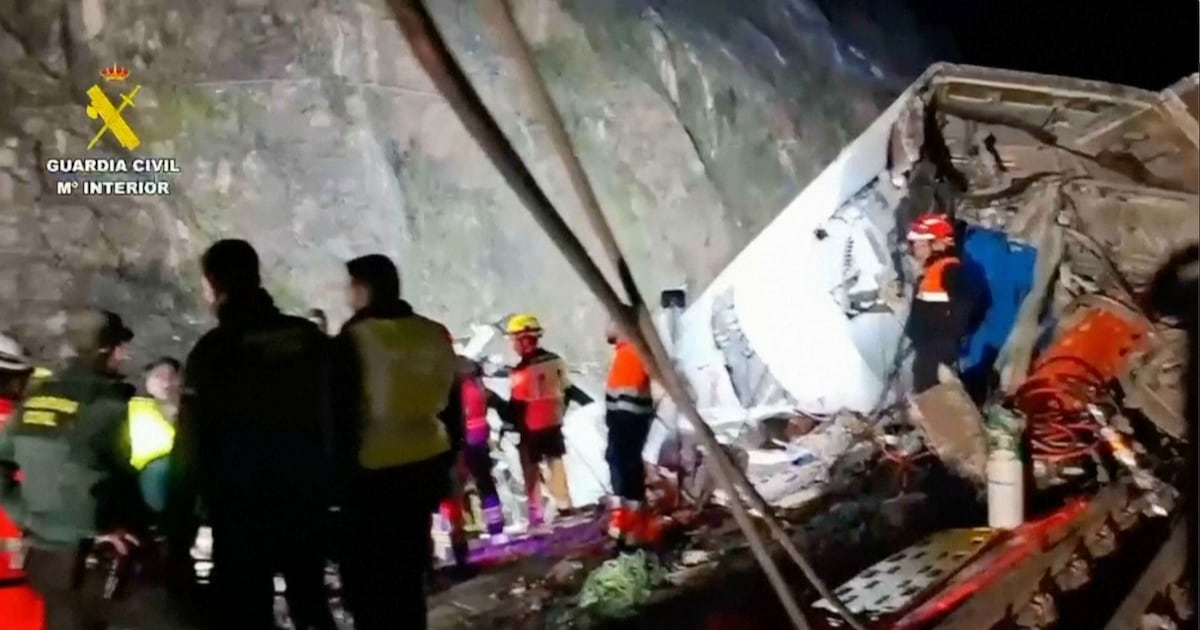
As well as the shock and grief caused by Sunday’s high-speed rail crash in Andalucía, southern Spain, in which at least 40 people died, there has also been bewilderment at the apparent lack of an obvious cause.
The collision, which occurred after one of the trains was derailed near the town of Adamuz, causing it to collide and derail an oncoming train, happened on a straight stretch of track that had been renovated as recently as May. The train that was derailed first had undergone a technical check just a few days before the incident.
Taking all this into account, transport minister Óscar Puente described the tragedy as “extremely strange”.
Officials are believed to be looking at a broken section of rail as a possible line of investigation, although it is not clear if it suffered damage before the derailment or during it.
Spain’s rail network has been one of the successes of its democratic era, in particular, its high-speed rail system, the AVE, which was funded by European money following Spain’s incorporation into the EU in 1986. The country boasted about having the second-largest high-speed rail network in the world (after China’s), and the high-speed route between Madrid and the southern region of Andalucía was one of its most obvious successes.
That route receives heavy use by those travelling for tourism and for work. However, in recent months, Spaniards’ faith in their rail system has been shaken, due to a number of incidents.
In April, the whole rail system shut down because of a national electricity blackout. That was not the fault of the rail system; it was a failure that affected every sector. However, there has also been a litany of delays, stoppages and other issues in recent months, which at times have put Puente’s transport ministry on the back foot and brought into question the reliability and punctuality of Spain’s rail system.
The disruption caused by Sunday’s crash is expected to continue for two weeks, with the Madrid-Andalucía line to remain closed until then.
The last major rail accident in Spain was in the northwestern city of Santiago de Compostela in 2013, when 80 people died after a train derailed.
Aware of the controversy that at times surrounded the investigation into the cause of that tragedy, prime minister Pedro Sánchez was adamant no stone will go unturned in the wake of this one.
[ Why Spain’s prime minister is most vociferous EU leader criticising USOpens in new window ]
“We all ask ourselves how it can have been possible, what has happened,” he said, as he visited the town of Adamuz. He also seems to be mindful of how his administration’s delay in providing a clear explanation for last April’s electricity outage was politically damaging and allowed outlandish conspiracy theories to circulate.
“When we find the answer, with absolute transparency we will make it known to Spaniards,” he said.