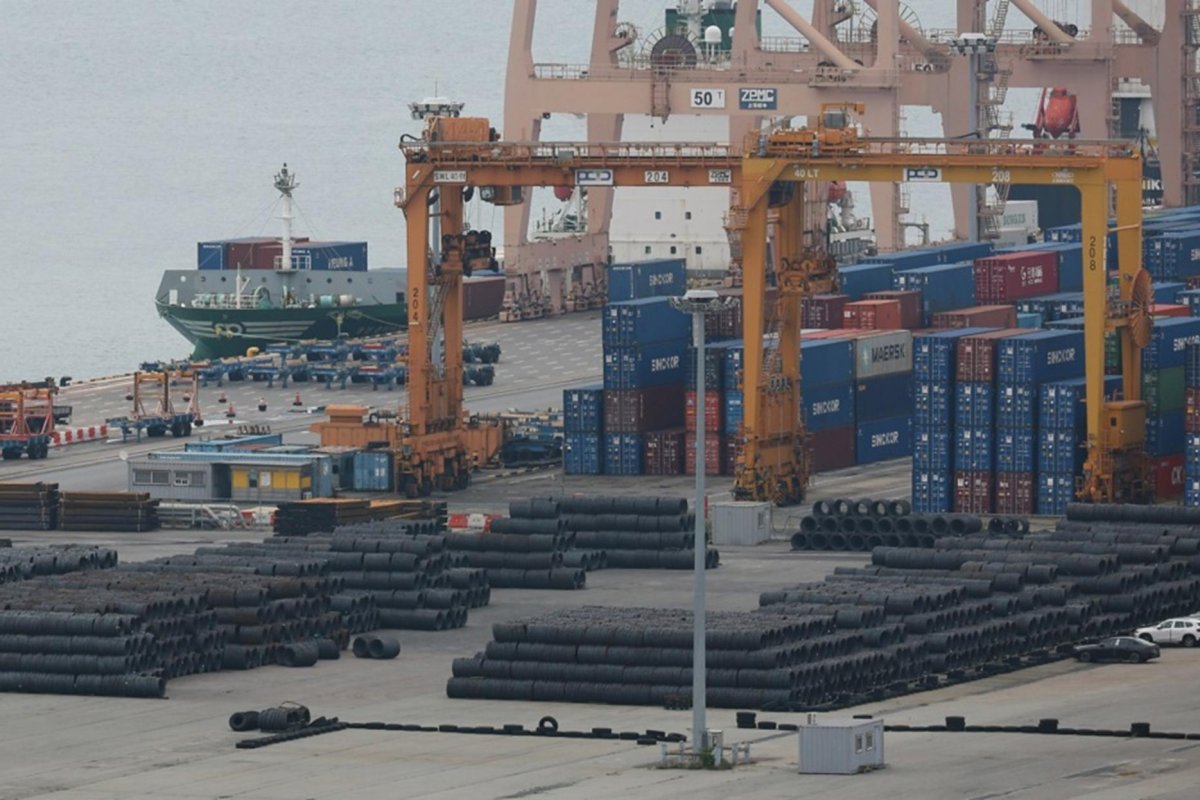
Steel products are piled at Pyeongtaek Port, south of Seoul, South Korea 12 October 2025. File. Photo by YONHAP / EPA
Jan. 19 (Asia Today) — The International Monetary Fund raised its 2026 growth forecast for South Korea to 1.9% in its January World Economic Outlook released Monday, up 0.1 percentage point from its October estimate.
South Korea’s Ministry of Economy and Finance said the IMF also revised up its 2025 growth forecast to 1.0% from 0.9%.
The IMF’s 2026 outlook for South Korea remains slightly below the government’s 2.0% projection, the ministry said. It is higher than forecasts cited from major institutions including the Asian Development Bank at 1.7%, the Korea Development Institute at 1.8% and the Bank of Korea at 1.8%. The IMF’s South Korea forecast also tops the advanced economy average of 1.8%, the ministry said.
A ministry official said the IMF revision appears to reflect the stronger growth effect seen in the third quarter of last year and noted that the IMF has steadily lifted its South Korea outlook since July.
The ministry also pointed to exchange-rate volatility as a potential risk to growth. It cited the IMF’s Global Financial Stability Report from October, which said South Korea’s dollar-denominated assets exposed to exchange-rate risk are about 25 times the foreign exchange market’s trading volume, an indicator that may limit the ability of non-reserve currency economies to absorb sharp swings in the dollar in the short term.
The IMF raised its global growth forecast for 2026 to 3.3% from 3.1%, the ministry said. The IMF lifted its U.S. forecast to 2.4% from 2.1%, citing fiscal stimulus, the effects of interest-rate cuts and easing downward pressure tied to trade barriers.
The eurozone was projected to grow 1.3%, up 0.2 percentage point, supported by Germany’s fiscal stimulus and stronger growth in Ireland and Spain, the ministry said.
The IMF raised its China growth forecast to 4.5%, up 0.3 percentage point, reflecting fiscal stimulus and the impact of a U.S. tariff suspension, according to the ministry.
The IMF said risks to the global outlook remain tilted to the downside. It cited concentrated investment in artificial intelligence and advanced technology firms, heightened trade uncertainty and geopolitical tensions and elevated debt levels in major economies. The fund warned that weaker expectations for AI-driven productivity and profitability could trigger asset price declines and broader financial risks, while easing trade tensions and improved productivity from AI adoption could support growth.
— Reported by Asia Today; translated by UPI
© Asia Today. Unauthorized reproduction or redistribution prohibited.