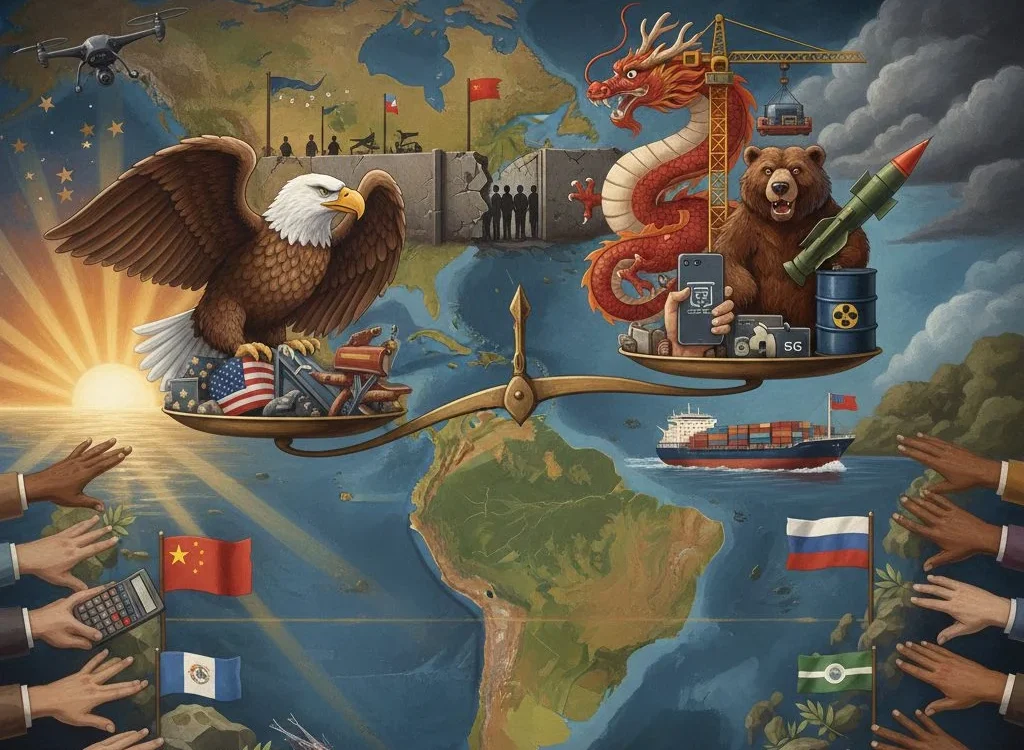
The United States’ foreign policy toward Latin America suffered a seismic shift with the arrival of Donald Trump at the White House, marking a before and after in hemispheric relations. This unforeseen turn not only blurred decades of diplomacy, but opened doors to new global influences in the region.
The roar of the American lion, traditionally thunderous in its “backyard,” was transformed into a distant murmur during Donald Trump’s presidency. Far from the Monroe Doctrine, which for almost two centuries dictated the steps in Latin America, the Trump administration opted for strategic indifference, a disengagement that, although at first glance seemed a relief, left the region exposed to new and unknown winds. The Pax Americana, with all its light and shadows, was fading, forcing Latin American countries to recalibrate their compasses in an increasingly crowded ocean.
This retreat, or at least Washington’s shift of priorities toward the Indo-Pacific and the trade front with China, created a power vacuum that was quickly perceived, and exploited, by other global actors. Russia, through arms sales and strategic investments, and above all China, with its vast Belt and Road Initiative, saw a golden opportunity to expand its influence and forge new economic and political dependencies. The old dynamic of a single hegemon was fragmenting, and multipolarity, or at least the bipolarity between the U.S. and China, landed squarely in the American continent.
The farewell to the Monroe Doctrine: indifference or strategy?
The “America First” of Trump translated, for Latin America, into a “America… we’ll see later.” Foreign policy focused on border security, migration, and the fight against drug trafficking, relegating major cooperation projects or regional development initiatives to a second or third plane. This shift in emphasis, far from being mere forgetfulness, revealed a profound realignment of American interests, where the region moved from being a strategic priority to a merely tactical matter of immediate containment.
The withdrawal from the TPP, an agreement that promised to tighten trade ties in the Pacific, was a clear symptom of this new reality, leaving countries such as Chile, Peru, or Mexico at a crossroads. The region, accustomed to looking north, was forced to diversify its partners and explore alternative alliances in a world where globalization was no longer an unquestioned dogma, but a battlefield with new rules and contenders.
China: The silent giant that filled the void
While Washington looked the other way, Beijing did not waste time. Chinese investment in infrastructure, energy, and natural resources in Latin America surged, consolidating its position as an indispensable trading partner for many countries. From ports in Peru to dams in Argentina, the Chinese footprint stretched like a discreet but firm mantle, offering credits without the political conditionalities that often accompanied Western aid.
This foray was not limited to the economic sphere; Chinese presence also manifested in diplomacy, technology (especially in the deployment of 5G networks) and security cooperation, creating a complex web of interdependencies. The “Beijing Consensus” emerged as an alternative to the “Washington Consensus,” promising development in exchange for political loyalty, a deal that many regional leaders did not hesitate to find attractive and pragmatic.
Russia: The last-resort partner
Although with a far lesser capacity for influence than China, Russia also learned to exploit Trump’s disengagement to strengthen its ties with certain countries in the region, especially those with historically tense relations with the U.S. The sale of weapons to Venezuela and Nicaragua, cooperation in nuclear energy, or media presence through RT and Sputnik, were examples of how Moscow tried to maintain its presence on a global board where it sought to counter American hegemony.
For some Latin American governments, Russia represented a necessary counterweight to Washington’s power and, at times, a source of military technology that other Western suppliers refused to sell. It was a reminder that, even in a largely pro-Western continent, there is always room for dissent and the search for unconventional allies.
Latin American resilience: Adaptation and new challenges
The Trump era, far from sinking Latin America, forced it to mature and be more pragmatic in its international relations. The region, accustomed to turbulence, demonstrated a remarkable capacity for adaptation, seeking to diversify its trading partners and strengthening its own mechanisms of regional integration, albeit with uneven results. The COVID-19 pandemic, which hit the continent hard, also served to reaffirm the need for greater autonomy and self-sufficiency.
However, challenges persist: internal political polarization, social inequality, the climate crisis and economic instability remain burdens that hinder a unified and coherent strategy. Latin America finds itself at a crossroads, with the imperative need to forge its own path in an increasingly fragmented world, where old loyalties fade and new alliances are built day by day, with caution and a healthy dose of pragmatism.
The uncertain future: Between autonomy and new dependencies
With Trump’s departure and the arrival of a new administration in the U.S., a return to a more predictable and multilateral policy was expected. However, the legacy of the four years of “America First” remains, and geopolitical competition among major powers has not diminished. Latin America now faces the difficult task of balancing its relations with the U.S., China, and other emerging actors, without falling into new dependencies that limit its sovereignty and its room for maneuver.
Strategic autonomy has become an aspirational goal, but economic and political reality often imposes its own rules. The region faces the historic opportunity to define its own fate, to move from being a mere object of geopolitics to a proactive actor with its own voice on the global stage, although for that it may need a shared vision and political will that, at times, seems elusive.