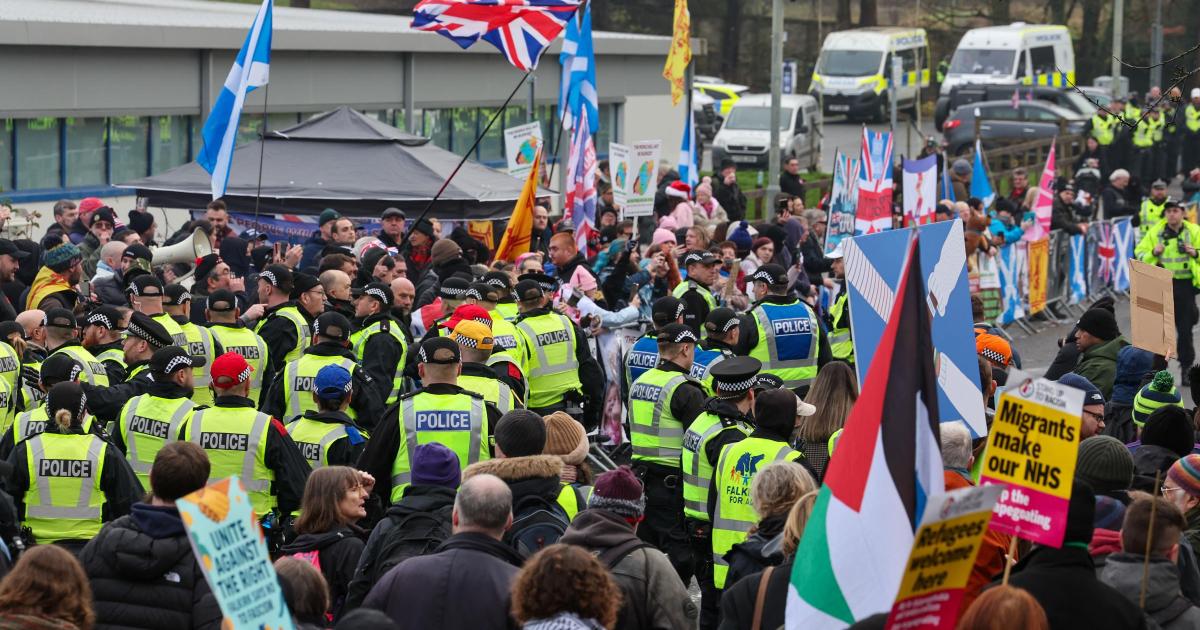
Throughout the summer and autumn months, anti-migrant protests were held outside hotels in Dundee, Perth, Falkirk, and Aberdeen, as were corresponding counter-protests.
Police Scotland have made a number of arrests at the demonstrations, including for offences linked to hate crimes.
Protests have been hled in a range of Scottish towns and cities. (Image: Lesley Martin)
Speaking to The Herald, a spokerson for refugee rights charity Positive Action in Housing (PAIH) said the group would support the implementation of exclusion areas.
They said: “We would support the idea of buffer zones around accommodation for refugees. A line has to be drawn. Protesters outside hotels where people are living are causing refugee families and individuals to fear for their lives. Children as well as adults are being targeted where they live and try to feel safe.
“Buffer zones could provide protection, as the right to protest does not give the right to intimidate or terrorise vulnerable people who are already being unfairly scapegoated and demonised.”
Similarly, Glasgow-based charity Refuweegee said they were “fully supportive” of protest buffer zones.
The Scottish Government’s renewed interest comes after First Minister John Swinney told STV News of “an ugly set of events” occurring outside a hotel in Perth.
“That’s in my own constituency,” he told the broadcaster. “I’ve heard reports about all that was experienced.
“A suggestion has been made that we look at buffer zones,” Swinney added. “We’ll explore that because I think there are arguments in favour of that to make sure that the right to protest is assured but also that the safety of other individuals is assured into the bargain.”
The u-turn comes after a minister told MSPs in September there were ‘no plans’ to implement a protest ban.
In response to a parliamentary written question from Labour MSP Carol Mochan, equalities minister Kaukab Stewart said: “I can confirm there are currently no plans to implement protest exclusion zones around asylum accommodation.
“People have the right of peaceful protest in a democracy, but that must be balanced with safety.”
Kaukab Stewart previously said a ban would not take place. (Image: Scottish Parliament TV)
However, a Scottish Government spokesperson has confirmed that ministers would now consider bringing in a ban.
They said: “The actions of some individuals targeting asylum accommodation creates a sense of real fear and alarm, and is completely unacceptable. Everyone has the right to feel safe and secure in the place they are living and in the community.
“As the First Minister has set out, the issue of protest exclusion zones around asylum accommodation is being considered by the Scottish Government and this will include an examination of the relevant policy and legislation in this area.
“Any next steps will be set out in due course.”
The Scottish Conservatives have warned that bringing in buffer zones could impact free speech and “increase community tensions”.
Murdo Fraser, MSP for Mid Scotland and Fife, said: “There are real concerns locally about asylum hotels and it’s wrong to pretend otherwise,”
“The priority should be backing the police and working with the community to keep order, not rushing into controversial legal changes that could take years to come into force.”
Buffer zones already exist around abortion clinics in Scotland, which prohibit people from protesting or demonstrating within 200 metres of the premises.
Read more:
However, a group protesting outside the hotels has criticised the government’s review.
“This is not about safety, it is about control. And we believe it is completely out of order,” a spokesperson from Save Our Future & Our Kids Futures told STV.
“We believe the proposed ‘buffer zones’ around hotels housing asylum seekers are a direct attack on fundamental freedoms, the freedom to protest, freedom of speech, and freedom of movement.
“Peaceful protest is a cornerstone of democracy, not something to be managed out of sight because it makes those in power uncomfortable.
“Creating exclusion or buffer zones sets a dangerous precedent where lawful dissent can be pushed further and further away until it effectively no longer exists.”