
OVH Groupe S.A. (EPA:OVH) shareholders would be excited to see that the share price has had a great month, posting a 37% gain and recovering from prior weakness. Unfortunately, despite the strong performance over the last month, the full year gain of 9.9% isn’t as attractive.
After such a large jump in price, you could be forgiven for thinking OVH Groupe is a stock not worth researching with a price-to-sales ratios (or “P/S”) of 1.3x, considering almost half the companies in France’s IT industry have P/S ratios below 0.7x. Although, it’s not wise to just take the P/S at face value as there may be an explanation why it’s as high as it is.
View our latest analysis for OVH Groupe
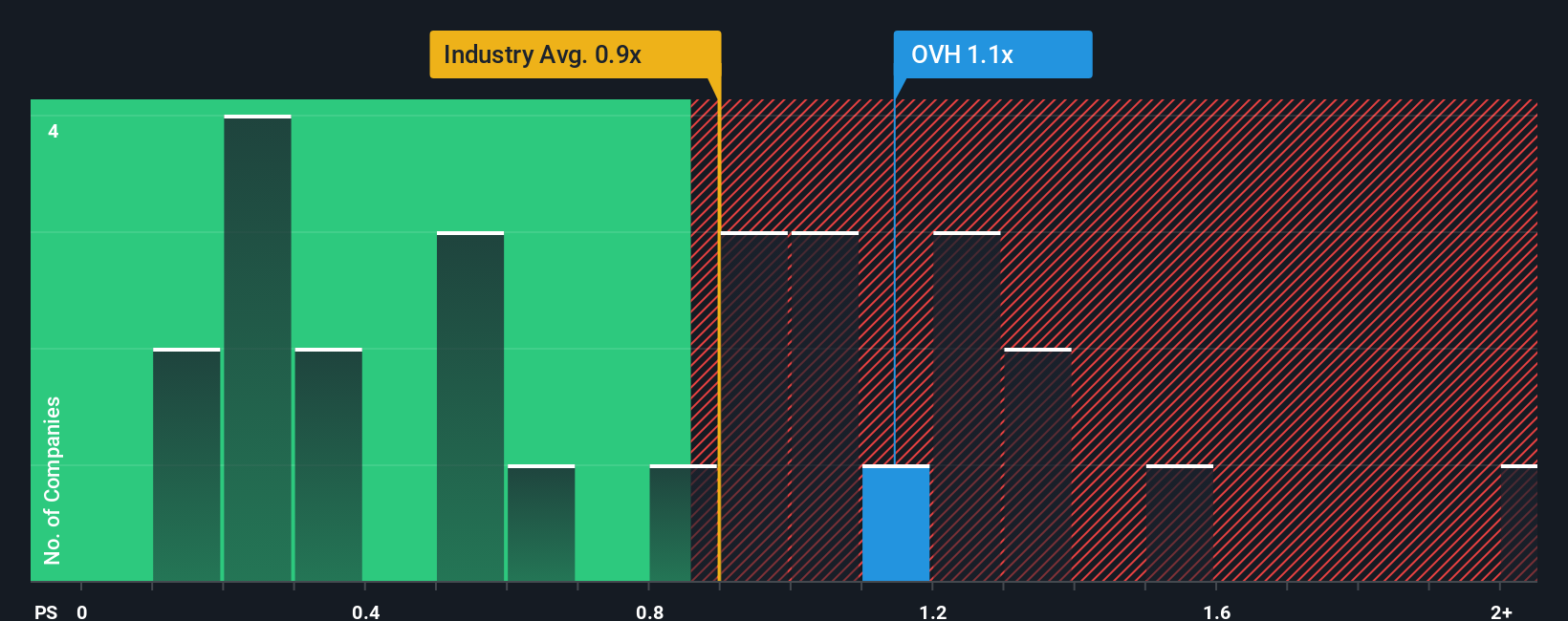 ENXTPA:OVH Price to Sales Ratio vs Industry January 20th 2026 What Does OVH Groupe’s P/S Mean For Shareholders?
With revenue growth that’s superior to most other companies of late, OVH Groupe has been doing relatively well. The P/S is probably high because investors think this strong revenue performance will continue. If not, then existing shareholders might be a little nervous about the viability of the share price.
Keen to find out how analysts think OVH Groupe’s future stacks up against the industry? In that case, our free report is a great place to start. What Are Revenue Growth Metrics Telling Us About The High P/S?
In order to justify its P/S ratio, OVH Groupe would need to produce impressive growth in excess of the industry.
Retrospectively, the last year delivered a decent 9.2% gain to the company’s revenues. This was backed up an excellent period prior to see revenue up by 38% in total over the last three years. Accordingly, shareholders would have definitely welcomed those medium-term rates of revenue growth.
Shifting to the future, estimates from the twelve analysts covering the company suggest revenue should grow by 7.2% each year over the next three years. That’s shaping up to be materially higher than the 4.7% per annum growth forecast for the broader industry.
With this information, we can see why OVH Groupe is trading at such a high P/S compared to the industry. Apparently shareholders aren’t keen to offload something that is potentially eyeing a more prosperous future.
The Bottom Line On OVH Groupe’s P/S
OVH Groupe’s P/S is on the rise since its shares have risen strongly. Typically, we’d caution against reading too much into price-to-sales ratios when settling on investment decisions, though it can reveal plenty about what other market participants think about the company.
Our look into OVH Groupe shows that its P/S ratio remains high on the merit of its strong future revenues. At this stage investors feel the potential for a deterioration in revenues is quite remote, justifying the elevated P/S ratio. Unless these conditions change, they will continue to provide strong support to the share price.
And what about other risks? Every company has them, and we’ve spotted 3 warning signs for OVH Groupe (of which 1 shouldn’t be ignored!) you should know about.
It’s important to make sure you look for a great company, not just the first idea you come across. So if growing profitability aligns with your idea of a great company, take a peek at this free list of interesting companies with strong recent earnings growth (and a low P/E).
Our new AI Stock Screener scans the market every day to uncover opportunities.
• Dividend Powerhouses (3%+ Yield)
• Undervalued Small Caps with Insider Buying
• High growth Tech and AI Companies
Or build your own from over 50 metrics.
Have feedback on this article? Concerned about the content? Get in touch with us directly. Alternatively, email editorial-team (at) simplywallst.com.
This article by Simply Wall St is general in nature. We provide commentary based on historical data and analyst forecasts only using an unbiased methodology and our articles are not intended to be financial advice. It does not constitute a recommendation to buy or sell any stock, and does not take account of your objectives, or your financial situation. We aim to bring you long-term focused analysis driven by fundamental data. Note that our analysis may not factor in the latest price-sensitive company announcements or qualitative material. Simply Wall St has no position in any stocks mentioned.