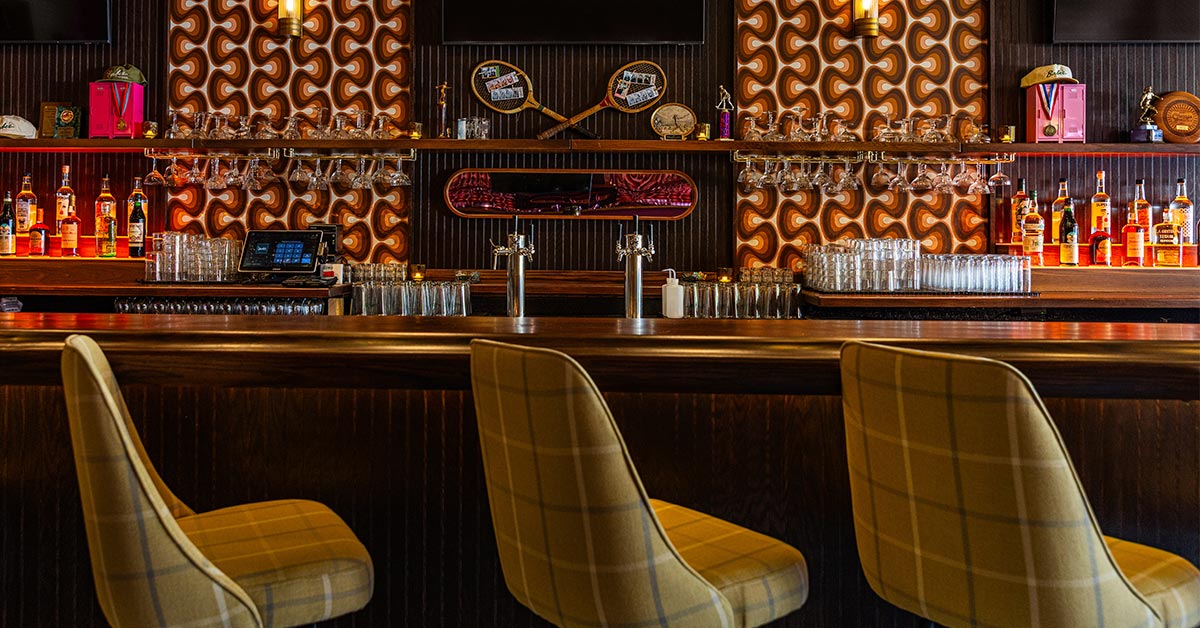
At the very back of Babe’s, a queer-owned women’s sports bar that opened in Chicago last year, hangs an old-school scoreboard above a set of metal bleachers. It’s hard not to imagine someone reliving (a much gayer version of) some stereotypical high school gymnasium makeout session while sitting there. Trophies line the walls, along with a sizable number of TVs streaming women’s gymnastics, a UConn women’s basketball game, and All Women’s Sports Network (AWSN), the Whoopi Goldberg-cofounded sports network.
According to an NBC News report, the number of women’s sports bars in the United States was set to quadruple in 2025. Portland’s The Sports Bra, founded by Jenny Nguyen in 2022, kickstarted the genre; in 2024, the bar announced its plans to franchise. According to Babe’s co-founder Nora McConnell-Johnson, the cohort that laid the blueprint tend to have smaller spaces, and lean more restaurant than bar. “Younger millennials are starting to open their bars now, and I think that’s going to be a fascinating second wave,” she says. “[They’re] showing what it looks like to be a women’s sports bar, but with a vibe.” Those vibes often mean a more modern aesthetic, elevated cocktails, and an undeniably queer energy.
In 2019, alarms signaling the perilous decline of lesbian bars in America reached a fever pitch. At its lowest point, the nationwide lesbian bar tally had reportedly dwindled to just 15. The culprits were familiar to any form of queer decay: gentrification, the wage gap, sexist financiers, the rise of dating apps. And while the COVID-19 pandemic spurned anxious reports wondering how these spaces could possibly survive yet another blow, something surprising happened in the aftermath instead. Lesbian bars started springing up (and sometimes, sadly, closing right back down) with a renewed vigor.
Right before my visit to Babe’s, two other queer-owned women’s sports bars opened in Brooklyn in the same week: Athena Keke’s in Clinton Hill and Blazers in Williamsburg. While both establishments identify as women’s sports bars first and foremost, “if someone calls us a queer bar, we don’t correct them, because we love our community and we want this to be a space for them,” says Chandler Robertson, one of Blazers’ trio of co-founders who met on Hinge.
Many of these bars rely on queer-coded details to telegraph that it’s a welcoming space, like a photo of The L Word cast from the infamous basketball episode that hangs in the entryway at Athena Keke’s. Blazer’s, meanwhile, displays a pride flag behind the bar.
“Women’s sports is a site of lesbian culture and gathering,” says McConnell-Johnson, “and also, women’s sports is greater than that, too.”
In the first lesbian bar boom of the 1970s and 1980s, community organizing became a critical component of what went on in these spaces. As queer culture became mainstream in the 2000s and 2010s, however, an interesting shift took place: Gay bars of all stripes started shuttering at record speed. It was almost as if Obama-era optimism translated to queer political complacency, zapping these spaces of their once-urgent purpose. And while the fresh wave of queer bars opening up today aren’t necessarily sites of great political upheaval, they are tapping into something from that golden age. Events and programming that go beyond a perfunctory theme night seem to lower the social barrier to entry that younger, more IRL-anxious patrons might otherwise face.
Prior to opening, Athena Keke’s co-founders drummed up publicity for their concept by launching pop-ups all over the city. They hosted a brunch during the New York Liberty WNBA Championship victory parade, tailgated USWNT soccer games, and threw watch parties at other bars until they managed to open their doors. “I think it really helped establish the idea and the brand,” says Murray. “It compiled proof that this could work, that there is an audience.” It may not be community organizing in the political sense, but simply organizing the community around anything seems to be a way to keep clientele engaged in a notoriously difficult-to-sustain bar subculture.
One dividing line amongst women’s sports bar owners is the decision to air men’s sports inside. Babe’s takes a hardline stance against it. “I will die on this hill,” McConnell-Johnson insists, recalling a night when the VP of comms for the Chicago Bears came in and expressed relief that the Bears game wasn’t on. “There is a different vibe and magic to this place because there are no men on the screens.”
On the other side, Blazers says its community has expressed a desire to watch men’s sports in a friendlier space. “We hear it all the time,” says co-founder Debany Dávila. “[They’re] so excited to not be at a regular sports bar and be asked to name three players. If it’s not interfering with our vision of putting women’s sports at center stage, we think there’s space for all of it.”
And lest it seem like women’s sports bars are bastions of kumbaya girlboss positivity, Babe’s, at least, makes plenty of space for principled haters. After Indiana Fever All-Star guard Caitlin Clark made comments that some fans interpreted to be anti-union, McConnell-Johnson toyed with the idea of hosting a quasi jersey buy-back program: “Come donate your Clark jersey, we’ll give you a free drink, and then we’ll do a ritual burning.”