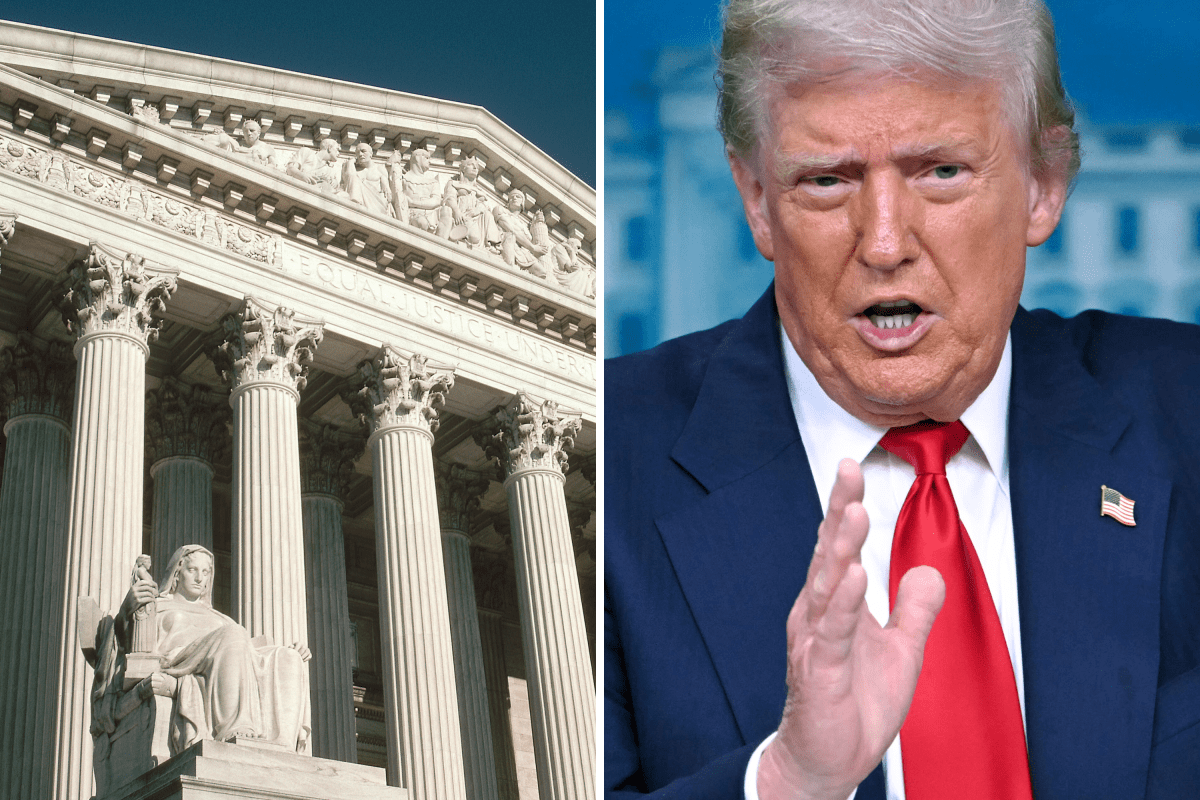
A Supreme Court ruling on the legality of President Donald Trump’s sweeping tariffs imposed under emergency powers is expected to be delivered soon.
Newsweek contacted the White House via email to ask what the president plans to do if the decision goes against him.
Why It Matters
While it is unclear exactly when the ruling will be made because the Court does not reveal when it will hand down decisions, this case could redefine the balance of power between the White House and Congress over trade and emergency authority by determining whether the International Emergency Economic Powers Act (IEEPA), a 1977 law that grants commanders-in-chief special powers in emergencies, lets a president unilaterally reshape tariff policy.
A ruling against the administration could unwind parts of the tariff framework, affect fiscal projections tied to duties, and spur congressional action to clarify limits on emergency powers, while a ruling for the administration could broaden executive latitude on economic measures.
What To Know
Lower courts ruled in 2025 that the tariffs—some as high as 125 percent and applied broadly after the administration declared a national emergency citing trade deficits and fentanyl flows—exceeded IEEPA’s scope, and the Supreme Court fast-tracked appeals with arguments heard on November 5, 2025.
These tariff measures include a minimum 10 percent baseline tariff, higher “reciprocal” rates of 10 to 41 percent for countries without trade agreements with the U.S., and additional duties on selected imports from Mexico, China, and Canada.
While justices appeared skeptical of arguments that IEEPA authorized unilateral tariffs, the Court does not announce decision dates in advance.
The consolidated cases—led by V.O.S. Selections, Inc. and Learning Resources, Inc.—asked whether IEEPA permits tariffs and, if so, whether that delegation violates the Constitution’s assignment of taxing power to Congress.
Separately, the White House has continued to use other trade tools and announced narrower new chip tariffs through different processes even as the IEEPA case moved forward, Axios reported.

Greenland and European Tensions
As the Supreme Court’s ruling looms, Trump has threatened additional tariffs on eight NATO allies unless the U.S. reaches a deal to “purchase” Greenland, a move that drew a coordinated rebuke from European leaders and added geopolitical stakes to the trade fight.
The leaders of Denmark, Finland, France, Germany, the Netherlands, Norway, Sweden, and the U.K. said tariff threats “undermine transatlantic relations” and pledged solidarity with Denmark and Greenland while emphasizing sovereignty and territorial integrity, according to a joint statement.
Vice President JD Vance and Secretary of State Marco Rubio met with Danish Foreign Minister Lars Løkke Rasmussen and Greenland’s Foreign Minister Vivian Motzfeldt at the White House earlier this month, after which the U.S. and Denmark agreed to create a high-level working group on Greenland.
It has underscored the broader questions of presidential trade authority before the Court delivers its decision.
What People Are Saying
Earlier this month, President Donald Trump wrote on Truth Social: “Remember, when America shines brightly, the World shines brightly. In other words, if the Supreme Court rules against the United States of America on this National Security bonanza, WE’RE SCREWED!”
On paying back tariffs, he added: “It may not be possible but, if it were, it would be Dollars that would be so large that it would take many years to figure out what number we are talking about and even, who, when, and where, to pay.”
Treasury Secretary Scott Bessent said on NBC’s Meet the Press: “I believe that it is very unlikely that the Supreme Court will overrule a president’s signature economic policy.”
White House spokesperson Kush Desai told Axios: “Industry leaders have the certainty that, as long as President Trump is in office, they have a pro-growth and pro-business ally in the White House who will never compromise on putting Americans and America First.”
The leaders of Denmark, Finland, France, Germany, the Netherlands, Norway, Sweden and the United Kingdom said in a joint statement: “We stand in full solidarity with the Kingdom of Denmark and the people of Greenland. Building on the process begun last week, we stand ready to engage in a dialogue based on the principles of sovereignty and territorial integrity that we stand firmly behind.”
What Happens Next
The Supreme Court did not provide a date for a decision, but rulings could arrive as early as today or in the coming weeks and months. While the U.S. Supreme Court often issues decisions on Tuesdays, it also rules on other weekdays.
Any outcome will shape the executive’s use of IEEPA in economic policy going forward. If the Court limits IEEPA authority, the White House could still use other statutory levers to raise import taxes, and has already pursued narrower, process-intensive measures.
If the justices invalidate the tariffs, importers that have filed suits may seek refunds, though remedies could be prospective only; if upheld, the administration’s approach to emergency trade powers could be reinforced.

In a polarized era, the center is dismissed as bland. At Newsweek, ours is different: The Courageous Center—it’s not “both sides,” it’s sharp, challenging and alive with ideas. We follow facts, not factions. If that sounds like the kind of journalism you want to see thrive, we need you.
When you become a Newsweek Member, you support a mission to keep the center strong and vibrant. Members enjoy: Ad-free browsing, exclusive content and editor conversations. Help keep the center courageous. Join today.
