Even as global CEOs grapple with rising uncertainty around tariffs, geopolitics and slowing confidence in growth, they are not pulling back on investments. Instead, they are continuing to deploy capital in search of long-term opportunities, according to PwC’s latest annual CEO survey.
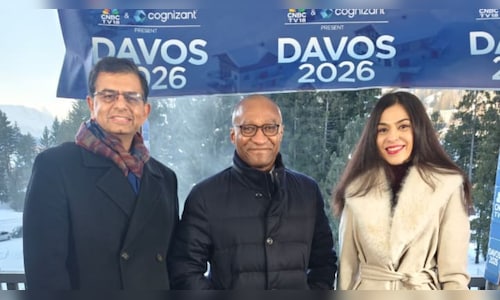
Speaking to CNBC-TV18 on the sidelines of Davos 2026, Mohamed Kande, Global Chairman of PwC, said while anxiety is high, it is no longer translating into inaction.
“Anxiety is real,” Kande said. “But what we are hearing from CEOs is that capital will continue to be deployed because the opportunities still exist.”
Confidence in growth dips, but spending continues
The PwC survey shows a sharp fall in CEO confidence. Only 30% of global CEOs believe they are on a strong growth path in 2026 — a five-year low.
Kande said this reflects the complex environment companies are operating in today. “Even though they have less confidence in their ability to grow their business, they actually have confidence in the global economy. That tells you there is a leadership challenge in how to run businesses in this environment,” he said.
Yet, he stressed that this uncertainty is not stopping companies from investing. “Nobody is stopping investment. That is very different from last year. There is an acknowledgement that investment has to continue because more opportunities will lie in the future — challenges, but opportunities,” he added.
Also Read: Davos 2026 | Globalisation now a zero-sum game, warns Eswar Prasad
Tariffs and geopolitics reshape strategies
Tariffs, trade realignments and geopolitical tensions are forcing companies to rethink how and where they deploy capital.
Kande said this is now a global conversation. “This is not just about the US. The same conversations are happening across Europe and Asia. Tariffs are having an impact on the design of supply chains, but people are working through it,” he said.
While there may be short-term disruptions, CEOs are still focused on long-term growth. “A lot of the CEOs we talk to focus on growth, and they’re going where the growth exists,” Kande said.
India among the top investment destinations
Even as CEOs remain cautious about global conditions, India has emerged as one of the most attractive destinations for capital.
Kande said India now ranks second globally as an investment destination, alongside the UK and Germany.
“The US remains the number one destination for capital investment. But India today is number two, at par with the UK and Germany,” he said.
He attributed this to India’s talent base, population scale and growth outlook.
“With the talent pool that you have and the size of the population, we are seeing more and more companies globally looking to invest in India — not only in services, but also in manufacturing,” Kande said.
Indian CEOs more confident about home growth
Sanjeev Krishan, Chairperson of PwC in India, said Indian CEOs are far more optimistic about domestic growth than about the global economy.
“While Indian CEOs are not so sanguine about global growth, they are much more confident about growth in India. Around 77% of them remain optimistic,” Krishan said.
He said this confidence is driven by policy reforms and India’s resilience.
“India has been fairly resilient. There have been a bunch of reforms, including GST rationalisation, labour reforms and several free trade agreements. This gives businesses the confidence to invest, scale and become part of global value chains,” he said.
What India needs to fix
Krishan said that while investor sentiment towards India remains strong, there are areas that need urgent attention.
“One of the challenges continues to be the cost of logistics. We have done well, but still we are a little over 8%, and that still makes us a bit uncompetitive,” he said.
He also highlighted the need for cluster-based manufacturing, better urban infrastructure and education reform.
“We need stronger cluster development, better urban infrastructure, and a rehaul of our education system so that our STEM graduates remain relevant for future disruptions,” Krishan said.
Agility is the new leadership mantra
Kande said the current environment has fundamentally changed what leadership looks like. “Instability is now the norm,” he said.
According to him, future leaders must be fast learners who can adapt quickly. “The leaders of tomorrow are the ones who can learn fast — not only about technology, but also about geopolitics — and continue to execute with agility,” Kande said.
Also Read: Davos 2026: India can be one of the four main places for Siemens, says Cedrik Neike