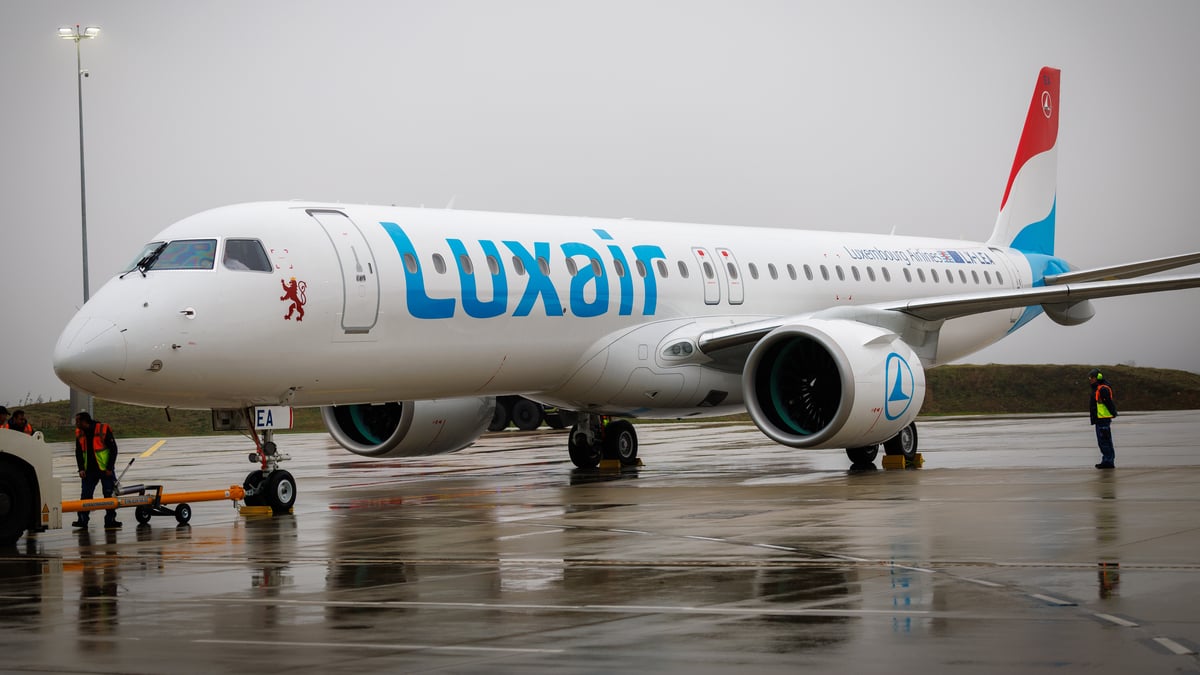
State-owned carrier Luxair, the country’s aviation authorities and an independent expert have sought to play down the impact of operational restrictions placed on new Embraer aircraft acquired by Luxair, stressing that the measures are precautionary and do not call into question the safety of the planes.
An airworthiness directive issued on 9 January by Brazil’s aviation authority, and subsequently adopted in Europe, restricts take-offs of Embraer E195-E2 – the aicraft type Luxair purchased – and E190-E2 planes under certain weather conditions. The restriction applies in freezing fog, visibility below 110 metres and temperatures of 3°C or lower, due to the risk of engine compressor disruption during ground operations.
On Monday evening, Luxair issued a statement stating that it was “important to note that the operational restrictions imposed on the Embraer E2 fleet are broader overall and therefore less restrictive than those that apply to other aircraft types with comparable engine technology. This confirms that the Embraer E2 is not subject to disproportionately strict restrictions in daily operations.”
Luxair chief executive Gilles Feith struck a similar tone in comments to RTL, saying the aircraft was “not a bad choice” and noting that the airline had not experienced technical issues with the Embraer jets so far.
He acknowledged, however, that under the specific weather conditions outlined in the directive, the affected aircraft are not permitted to take off.
Also read:Brazilian aviation authority issues warning for new aircraft model used by Luxair
An Independent aviation expert has also said that the restrictions are manageable. Wouter Dewulf, a specialist at the University of Antwerp, said freezing fog combined with very low temperatures can cause ice to form inside engines while they are operating at low power on the ground, such as during taxiing or waiting for take-off clearance. If dislodged when higher thrust is applied, the ice can disrupt airflow in the compressor and lead to a temporary loss of power.
“When those weather conditions occur, you have to wait until they clear,” Dewulf said. “That can cause delays or require the use of another aircraft. It’s certainly annoying, but it’s not a catastrophe.”
“Freezing fog contains supercooled droplets that, when operating at low power on the ground, such as while taxiing to the runway, can ice up the inner surfaces of the engine,” Dewulf said. “Then, when you need high thrust for take-off, this ice can fall off or be sucked in and disrupt the compressor’s airflow, causing a disruption and loss of power.”
He added that the risk can build up during routine ground operations. “When you start the engine and then perform the pushback, it takes a few minutes for everything to start up, and then you go to the runway,” Dewulf said. “Sometimes you have to wait 15 to 20 minutes. During this waiting time, the engine only runs at idle, and then ice can form on the engine. This can happen quite quickly if the temperature is below or near freezing.”
Freezing fog contains supercooled droplets that can ice up the inner surfaces of the engine when operating at low power on the ground © Photo credit: Claude Piscitelli
Luxembourg’s Directorate of Civil Aviation confirmed that it acknowledged the directive when it was issued and described it as a precautionary measure while investigations continue. The aircraft may continue operating outside the specified conditions.
Mobility Minister Yuriko Backes told MPs on Tuesday that Luxair had been aware of the restrictions “for weeks”. Speaking during a parliamentary debate, she emphasised that safety remained the top priority and said the aircraft were modern, quieter and produced lower CO₂ emissions.
Luxair has ordered six Embraer E195-E2 aircraft, with an option to acquire three more.
(This article was originally published by the Luxemburger Wort. Translated using AI and edited by Kabir Agarwal.)