By Chrissy M. Thornton
I have spent my career learning how to lead with vision, discipline, empathy and results. I believe I have earned my seat – through education, experience, sacrifice and outcomes. Yet still, as a Black woman CEO, I am routinely reminded that credentials do not inoculate you from dismissal; that power, in America, is still often filtered through gendered and racialized lenses; and that for some men, seeing me – truly seeing me – remains optional.
I am a professional woman navigating the relentless hardships of business leadership. I am Black in America at a time where that feels even less safe than it always has. On top of that, I am a younger CEO, and each of these realities carries its own weight. Together, they compound into an experience that requires constant vigilance, emotional regulation and restraint that my male peers are rarely asked to perform.
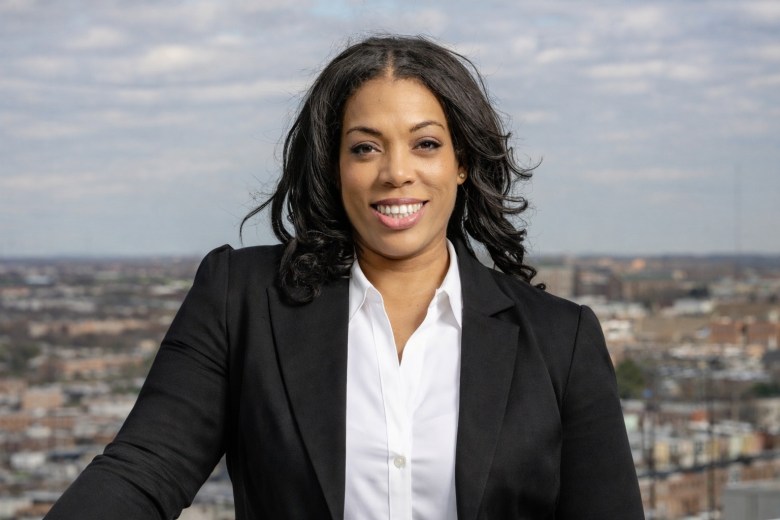 Chrissy M. Thornton, president and CEO of Associated Black Charities, reflects on the persistent erasure and disrespect she faces as a Black woman leading a major institution, despite her credentials, results and authority. Declaring an end to silence, she asserts a commitment to publicly confront such behavior and calls on institutions—and especially Black men in leadership—to do better in honoring the dignity and power of Black women leaders. (Courtesy Photo)
For the past three years, this has been my daily reality as president and CEO of Associated Black Charities, an organization with an over four-decade legacy of advancing equity, strengthening Black-led initiatives, cultivating leadership pipelines and investing in the economic, social and civic well-being of Black communities across Baltimore and beyond. I lead an institution that convenes government leaders, corporate partners, philanthropies, grassroots organizations and community members. I steward complex budgets, oversee transformative programs and carry responsibility not only for outcomes, but for trust. And still, even in rooms where our work is respected, my authority is too often negotiated.
Too often, men in leadership have deferred not to me (the CEO) but to other men on my board of directors; or even to my male subordinates. There have been occasions where they have bypassed my authority and engaged sideways, as if my title is symbolic rather than real. Emails from me and my senior female staff sometimes go unanswered, while it seems that business in the marketplace is routinely conducted over cigars and drinks with my counterparts. Male staff are invited to golf outings – despite having no interest or experience – while I, an avid golfer who took years of lessons as a child and refined my game on the course at Vassar College, am never considered or invited. These are not oversights. They are patterns. Patterns over time that I had come to accept and tolerate.
These patterns matter, though, because Associated Black Charities exists precisely to dismantle inequitable systems, to challenge who is seen as credible, who is centered in decision-making, and who holds power. And yet, even as I lead this work publicly, I am forced to navigate its contradictions privately. The irony is not lost on me: the same systems we critique and seek to reform often show up, intact and unchallenged, in professional interactions that are supposed to reflect progress.
The most jarring reminder came at a recent event in Annapolis, where we gathered to hear from our governor, Senate president, and the new speaker of the House. The room was filled with professionals. I was in conversation with a male colleague from my organization and a market leader (also male) from a major institution. Mid-conversation, a man unknown to me walked up and interrupted without apology, without pause.
He greeted the market leader with a hug, marveling aloud at their reunion. He then turned to my colleague, shook his hand, and introduced himself. Having physically inserted himself between us, he stood directly in front of me—his back to my body, my presence effectively erased. He continued the conversation without a nod, a glance or the basic decency of acknowledgment.
In one seamless motion, he interrupted me, ignored me, dismissed me and removed me from the exchange entirely. And at that very same moment, something in me broke.
I felt it happen, even though I chose not to escalate the matter. Ultimately, I did not want to be disruptive. I did not want to be labeled difficult or emotional or aggressive – labels so easily assigned to Black women who assert themselves. Afterward, when my colleague and I debriefed, he indicated that he, too, found the interaction profoundly disrespectful.
And yet, what unsettled me most was not the man’s behavior. It was how familiar it felt.
Let me be clear. Something indeed did break deep within me, and with that came a decision. To the professional women of Baltimore and beyond, please know that will never happen again. Never again will I allow that magnitude of disrespect to pass unaddressed in real time. I am making a commitment – not just to myself, but to every woman who has swallowed indignity to preserve “professionalism.” I will squash the anger and irritation that has often raised up in my initial reactions, and I will find the words. I will address it. Every time. Sure, with the class and refinement I carry everywhere – but without silence.
While I deeply respect all of the professional men who get up every day and work hard to make our world operate, please know, when and if this happens again, I will not pull you aside. I will not handle it privately. I will correct you in the same public space in which you have harmed me. If that results in embarrassment, please understand that embarrassment is a consequence, not an injustice.
What has made this reality even more painful is that, more often than not, these behaviors have come at the hands of Black men. Meanwhile, I am your mother, your sister, your daughter and your niece – part of the same lineage, the same struggle, the same fight for dignity – yet too often denied the respect that solidarity demands.
I join the ranks of Black women who have carried this country – economically, politically, socially – while fighting for parity and equity at every turn. From enslavement to suffrage to civil rights to boardrooms, we have pushed, organized, endured and delivered. And when we have finally scraped and clawed our way into leadership, we still find ourselves forced to fight for what I believe is the bare minimum: basic respect.
The psychological toll of this constant erasure is real. It undermines confidence, distorts decision-making, and drains creative and strategic capacity. It weakens organizations and markets by sidelining expertise. It sends a message to women watching closely that excellence is still negotiable if you don’t look the part someone expects.
This damage does not stop at the individual level. It harms institutions like Associated Black Charities that are doing critical work in leadership development, board diversification, nonprofit sustainability and community investment. When women leaders are diminished, entire ecosystems lose access to insight, innovation and lived experience that directly shape better outcomes for the communities we serve.
This behavior is not power. It is small-mindedness. It is insecurity masquerading as tradition. And it is bad for business. Women (and Black women in particular) have driven innovation, stabilized institutions and expanded markets while being systematically underestimated. Ignoring us is not only unjust; it is irrational.
So here is my declaration to anyone who is inclined to render me invisible. I am a woman, and a strong one at that. When this happens, I am checking you. Not sometimes. Every time.
Do better.
The opinions expressed in this commentary are those of the writer and not necessarily those of the AFRO.