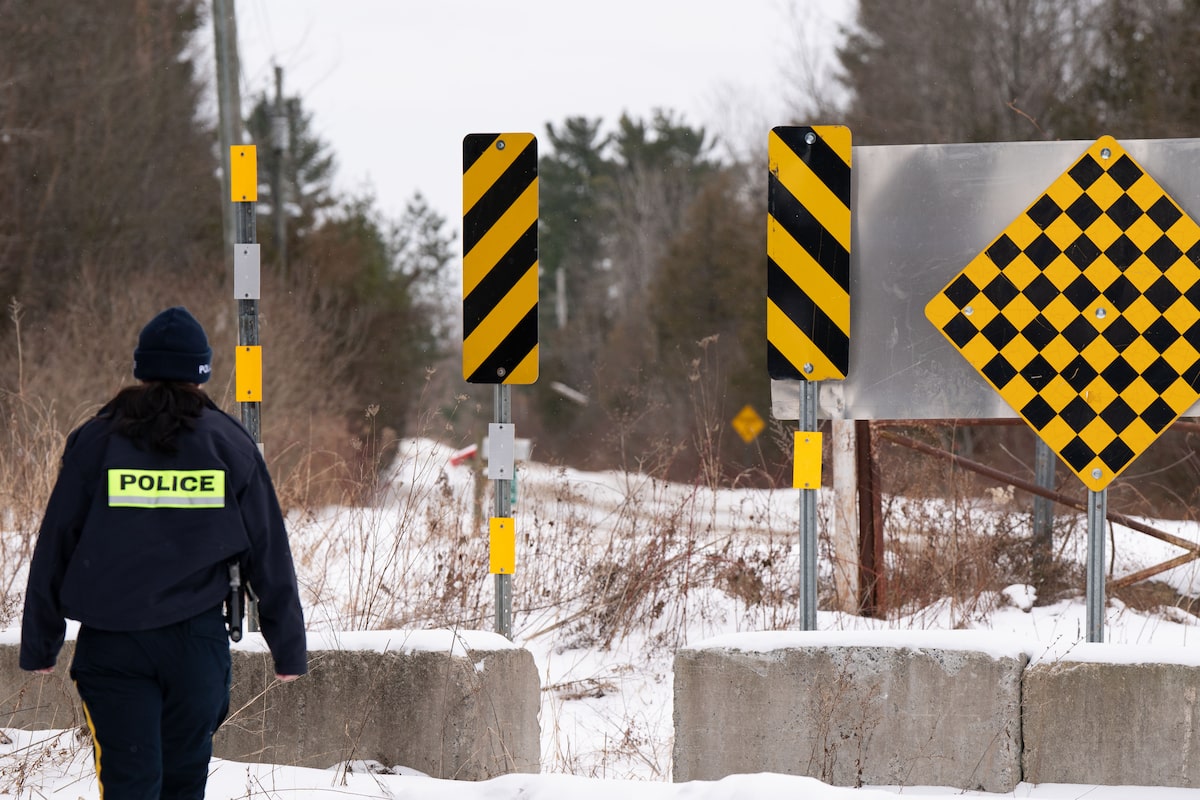
A RCMP officer at the border between Quebec and New York State on Roxham Road in St. Bernard-de-Lacolle, Que., on Jan. 15, 2025.Christinne Muschi/The Canadian Press
The number of asylum claims made in Canada dropped by one-third last year, after scrutiny of visitor visa applications increased and entry requirements for Mexicans tightened.
The figures, released on Tuesday, showed that from January to November of 2025, 33 per cent fewer people submitted an asylum claim in Canada compared with the same period the previous year.
Immigration, Refugees and Citizenship Canada said it had scrutinized more closely applications from foreign nationals applying for visitor visas to come to Canada. This led to a 55-per-cent drop in asylum claims from such visa holders in November compared with the same month the year before.
In February, 2024, Canada imposed the need for Mexicans to hold a visitor visa to come to Canada in an effort to curb a surge in the number of asylum claims. The move contributed to the overall drop in claims last year.
Immigration Minister Lena Metlege Diab said in a statement that “we’re ensuring that our asylum system works for those who truly need it, while discouraging those who would use it as a fast track to immigration.”
Opinion: The tightening of Canada’s asylum laws was an inevitability
Migrant-rights advocates warned that some people with legitimate asylum claims could face grave risks because of the recent measures.
Syed Hussan, spokesperson for the Migrant Rights Network, said in an e-mail that “by restricting tourist visas, Canada has sneakily slammed the door on refugee families fleeing persecution – a deeply immoral act for a country as rich as ours at a time of increased global conflict.”
Ottawa immigration lawyer Heather Neufeld said for some people fleeing persecution in their home countries, the only way to get to Canada to make an asylum claim is through a visitor visa.
“The fact that someone came in on a visitor visa does not mean this is a fraudulent asylum claim,” she said.
Figures released by IRCC show that people continued to cross from the U.S. between regular crossings into Canada during the colder months. In November, 134 people were apprehended (111 of them in Quebec) after crossing the frontier, compared with 115 in October.
Immigration Minister warns foreign nationals to not abuse asylum system as U.S., U.K. tighten rules
The numbers coincided with a crackdown by immigration authorities in the U.S. of undocumented residents, and mass deportations.
A federal borders bill now going through Parliament proposes to tighten asylum rules, including barring refugee claims from people who have been in Canada for more than a year.
There is a large backlog of asylum claims waiting to be assessed by the Immigration and Refugee Board, an independent tribunal. IRB figures show that as of the end of September last year there were almost 300,000 claims waiting to be assessed.
They included 43,830 claims from India; 29,565 from Haiti; 24,526 from Mexico; 20,000 from Bangladesh; 10,391 from Iran and 9,158 from Colombia.
Ms. Neufeld said the huge wait for hearings at the IRB is causing great hardship, including the separation of families. She said some asylum claimants, after being approved to stay in Canada as refugees, were then waiting years for permanent residence and then again for permanent residence to be granted to family members living abroad.
She said some were faced with the agonizing choice of waiting for years in Canada for their children to join them or returning to live in danger in their home countries.
IRCC is currently dealing with 941,600 applications for permanent residence, the latest figures show, as well as 942,000 applications for temporary residence and 247,000 applications for citizenship.
Canada likely to see more Venezuelan refugees, migrants if country further destabilizes, experts say
Britain and the European Union have recently decided to toughen up their asylum rules to curb the numbers making claims for refugee status.
The British government said last year it plans to end automatic permanent residence for refugees, and would require them to reapply every 2½ years to stay in the country. Britain plans to make refugees wait 20 years for permanent residence.
In December, the EU agreed to tighten its rules to make it easier for member countries to reject asylum claims from people applying from countries deemed safe.
The EU expanded the list of countries considered safe, where citizens would be presumed not to be in need of protection and would be put on a faster track for assessment. Countries considered safe by the EU will now include India, Bangladesh, Colombia, Egypt and Morocco.
In an interview last week, Ms. Metlege Diab said she was aware of the EU changes but any changes to which countries are considered safe are not currently on the table and would not solely be a decision for her department.
“It would obviously include Foreign Affairs, it would include the Prime Minister. It would include cabinet ministers. It would include Public Safety,” she said.
“We keep an eye out, in discussions with different EU partners and so on, to see what’s happening globally. But decisions like this don’t happen overnight, and they’re not taken lightly, and it’s not a one department kind of decision-making process.”