
The market is discussing whether Europe will leverage its substantial net creditor position against the United States to counteract the government’s policies regarding Greenland. However, some Wall Street analysts consider this an unlikely threat. The U.S. holds an advantage in weaponizing global finance, largely due to the dominance of the dollar.
Therefore, if Europe were to retaliate, it would likely resort to transactional measures. Meanwhile, the risk of a full-scale trade war is now higher than ever, as Europe has more at stake than ever before. Although Europeans may eventually concede, this time they are unlikely to surrender without a fight.
Notably, the dispute over Greenland is far from being an isolated geopolitical event; it serves as a stress test for the existing international financial and political frameworks. The upward momentum of gold prices amid volatility surpasses the downward trend. During the Asian trading session on Wednesday (January 21), spot gold rose by approximately 1.2% for the day, currently trading near $4,820 per ounce, and reached a record high of $4,843.99 per ounce at 10:10 AM.
 The Greenland incident highlights what the market is facing: so-called framework uncertainty, rather than mere policy uncertainty. This is not uncertainty within a given framework but uncertainty about the framework itself. In such an environment, cyclical market fluctuations would be a relatively favorable scenario.
Meanwhile, the situation in Greenland could still be resolved through non-escalatory means, including market reactions, protective mechanisms within the U.S. system (constraints imposed by Senate Republicans on the President and intervention by the Supreme Court), and negotiations.
One conceivable solution is that Europe could pay for U.S. military assets stationed in Greenland, potentially by transferring partial rights to natural resource extraction. Another possibility is a long-term ‘lease’ arrangement (e.g., for 100 years), where Denmark and Greenland retain sovereignty while granting the U.S. the right to use Greenland as it sees fit.
However, the likelihood of escalation remains high.
If you owe the bank $10 trillion, then the bank is in trouble.
A hot topic in market discussions is whether Europe might utilize its massive holdings of U.S. assets to counter President Trump over the Greenland issue. However, some Wall Street analysts view this threat as implausible for the following reasons:
Practical operational challenges
The specific implementation remains unclear. The majority of U.S. assets held by Europe belong to the private sector (with the notable exception of Norway’s sovereign wealth fund), making it difficult for governments to directly control them.
One option is to impose capital controls, but this would need to be global in scope; otherwise, European funds could easily be redirected into U.S. assets. However, global capital controls are an extremely radical measure, not to mention that such actions contradict the rules-based policies and open market principles cherished by Europeans.
Another option involves some form of regulation, either ‘soft’ or ‘hard.’ The former might include pressuring European pension funds (especially those linked to the public sector) to divest or halt further purchases of U.S. assets; the latter could involve direct oversight of foreign exchange exposures held by banks, insurance companies, and pension funds. These measures are also quite radical. More importantly, pension funds have fiduciary responsibilities to their clients.
Risk of Loss
Market rumors of Europe selling off U.S. assets alone could lead to significant losses on the U.S. assets held by Europe, amounting to a Pyrrhic victory akin to inflicting heavy damage while suffering considerable self-harm.
Potential for Retaliation
Although Europe holds a net creditor position with respect to the United States, the total value of U.S.-held European assets is also substantial.
Dollar Hegemony and the Weaponization of Global Finance
It would be unwise for Europe to create significant turmoil in global financial markets, as this could lead to major losses on its own assets. Considering the dominance of the dollar and the United States’ control over global financial infrastructure, such a move would be tantamount to self-inflicted harm.
A clear example is that global crises are always accompanied by a worldwide shortage of dollars. Banks in the EU and the UK, in particular, would be severely affected by such a dollar shortage.
Only the Federal Reserve has the ability to create dollar liquidity to alleviate such shortages. A simple majority vote in both chambers of Congress would be sufficient to force the Federal Reserve not to provide dollar swap lines. Ensuring mutual destruction is not a wise policy, especially when the power to escalate rests in the hands of the other party.
A more subtle argument pertains to de-risking. European asset management institutions may independently decide to reduce their exposure to U.S. assets. If this occurs, it will likely be a gradual process, and whether it can be weaponized as a pressure tactic remains uncertain.
With their backs against the wall
This does not mean that European leaders will back down without a fight this time; Europe’s main leverage lies precisely in having nothing left to lose.
The risk of a U.S.-EU trade war may now be greater than ever before, as the U.S.’s actions regarding Greenland have touched upon sacred principles of Europe, constituting a direct provocation.
Europe refrained from retaliating against reciprocal tariffs for two immediate reasons: first, an agreement could reduce uncertainty for businesses by ending trade disputes; second, it hoped to secure some U.S. support on the Russia-Ukraine conflict. Now, Europe has achieved neither.
Therefore, European leaders may feel that since concessions no longer yield benefits, they might as well rise up and resist. They will also realize that ‘the whole world is watching,’ and if they capitulate again without resistance, no one will take Europe seriously anymore.
Last but not least, President Trump was already unpopular among most European voters, and recent developments have made matters worse. In terms of internal European politics, the actions of the U.S. government have energized the political center and possibly harmed the interests of Europe’s ‘Make America Great Again’ allies. In short: European governments will face increased domestic public pressure to ‘stand up’ and oppose this U.S. president.
Haven gold is expected to continue shining
The current geopolitical contest between Europe and the U.S. over Greenland, particularly its potential evolution into a full-scale confrontation involving finance and trade, is likely to have a complex but predominantly bullish long-term impact on the gold market. The core logic lies in the fact that this conflict is systematically increasing geopolitical risk premiums, undermining the credibility of the U.S. dollar, and exacerbating uncertainties in global growth and policymaking, with gold being the traditional hedge against all three factors.
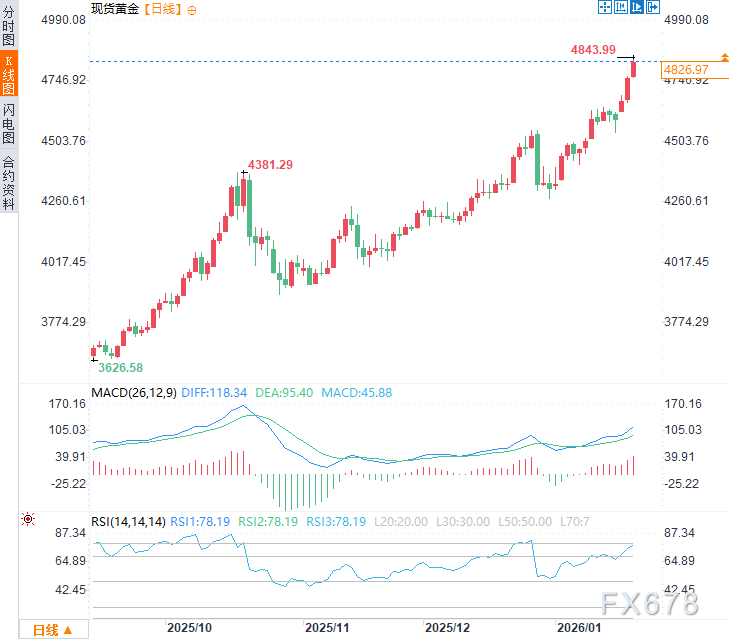
(Spot gold daily chart, source: YiHuiTong)
At 10:27 Beijing Time, spot gold is reported at USD 4,821.40 per ounce.