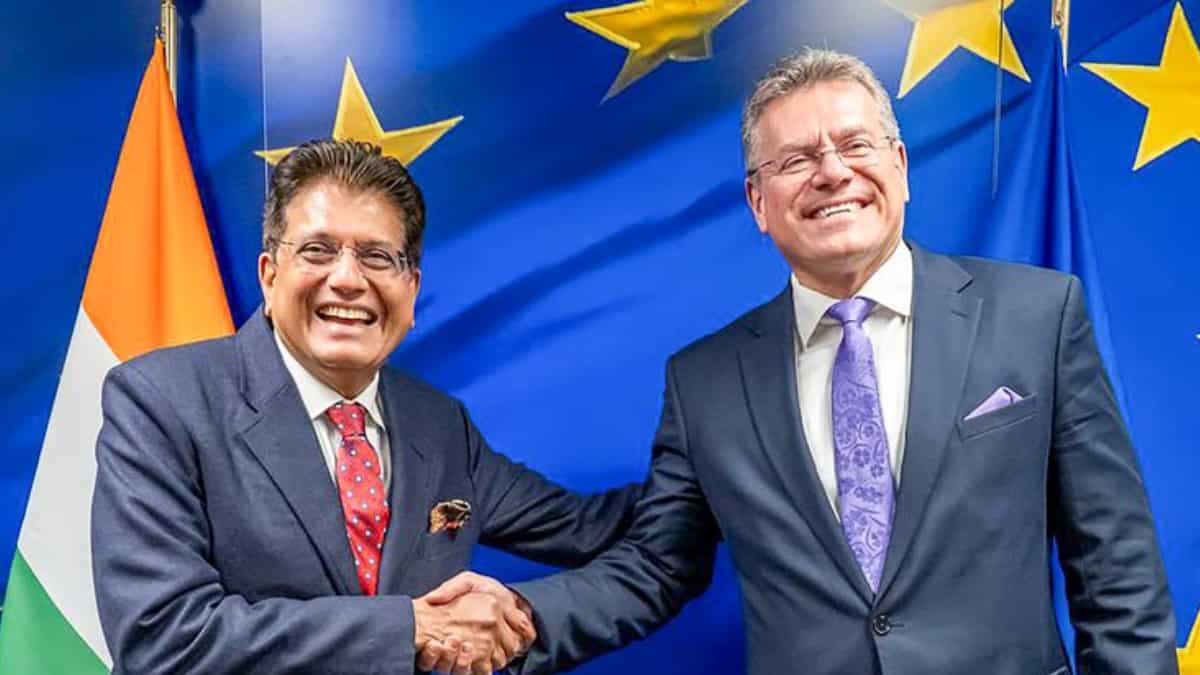
India and the European Union appear to be on the verge of sealing their long-pending Free Trade Agreement (FTA), but concerns persist on India’s side over non-tariff barriers, particularly the European Union’s upcoming Carbon Border Adjustment Mechanism (CBAM), according to a latest report by Jefferies.
The brokerage flagged that while negotiations are nearing completion, India faces limited room for concessions on regulatory hurdles that could impact its exports to the EU, with CBAM emerging as a major sticking point.
Jefferies stated, “Key concern for India is the many non-tariff barriers such as the upcoming CBAM mechanism for its exports. We see limited scope of relaxation here.” The Carbon Border Adjustment Mechanism is the EU’s policy aimed at levying a carbon price on imports to align them with the cost borne by EU producers under its emissions regime, a move designed to prevent so-called “carbon leakage”.

According to the report, India is expected to push for greater ease in services exports, along with smoother movement and visa access for its young and skilled workforce, particularly professionals in the technology and healthcare sectors.
Services trade emerges as a crucial area
On the other hand, the EU is likely to seek deeper access to India’s financial, legal and other services markets, making services trade a key area to watch as part of the agreement.
Jefferies noted that the FTA is expected to focus on sectors such as automobiles, electronics, textiles, pharmaceuticals and chemicals. As seen in India’s recently concluded trade pact with the UK, politically sensitive areas like agriculture and dairy are likely to be largely excluded from the deal.
Progress on services trade could also fuel optimism around a potential India–US trade agreement in the future, the report added.
From stalled talks to renewed momentum
FTA talks between India and the EU began in 2007 but were put on hold in 2013 due to disagreements over market access and regulations. Negotiations picked up again in 2022, and with both sides now agreeing to keep sensitive sectors out, the deal could be finalised in the coming days. In terms of trade size, India’s annual goods trade with the EU stands at around USD 130 billion, comparable to its trade volumes with both the US and China. India’s goods exports to the EU are estimated at USD 75 billion annually, accounting for about 17 per cent of its total exports.
Since 2022, India has maintained an annualised goods trade surplus of USD 10–15 billion with the EU, driven by higher petroleum product exports following the Russia–Ukraine conflict and a sharp rise in electronics shipments, particularly mobile phones.
Sectoral impact: textiles in focus
Jefferies highlighted textiles as one of the biggest potential beneficiaries of the deal. The EU imports nearly USD 125 billion worth of textiles and apparel annually, where India currently holds a modest 5–6 per cent share, compared to China’s roughly 30 per cent.
An FTA could help level the playing field for Indian textile exporters by bringing duties in line with South Asian peers, especially at a time when US tariff hikes of up to 50 per cent have hurt the sector.
In automobiles, the EU is expected to push for lower tariffs to boost car exports to India, where import duties can go as high as 100 per cent. Jefferies said this could take the form of phased tariff reductions or quotas for duty-free imports. However, existing localisation by European automakers and strong competition in India’s mass-market segments could limit the impact on domestic players.
Other sectors that may face increased competition include wines, spirits and light engineering. In pharmaceuticals, while EU tariffs are already close to zero, easing compliance and regulatory requirements could serve as a positive catalyst for Indian drugmakers.
Political push from both sides
European Commission President Ursula von der Leyen said on Tuesday that the EU is “on the cusp” of signing a trade deal with India, giving the bloc a significant early-mover advantage. “Right after Davos, next weekend, I will travel to India. There’s still work to do, but we are on the cusp of a historic trade agreement.
Indeed, some call it the mother of all deals. One that would create a market of two billion people, accounting for almost a quarter of global GDP, and crucially, that would provide a first mover advantage for Europe with one of the world’s fastest growing and most dynamic continents,” she said in her Davos speech. She added that Europe intends to strengthen ties with global growth centres, from Latin America to the Indo-Pacific, while criticising proposed US tariffs on the EU.
Republic Day visit and summit talks
Ursula von der Leyen and European Council President Antonio Luís Santos da Costa will be the chief guests at India’s Republic Day celebrations next week. They will also co-chair the 16th India–EU Summit on January 27.
Commerce Minister Piyush Goyal had earlier described the proposed agreement as the “mother of all trade deals”, saying it would be comprehensive and balance the interests and sensitivities of both sides. The deal is expected to be signed on January 26.
Commerce Secretary Rajesh Agarwal said last week that India and the EU have already agreed on 20 of the 24 chapters of the FTA and are aiming to conclude negotiations before the EU leadership’s visit later this month.