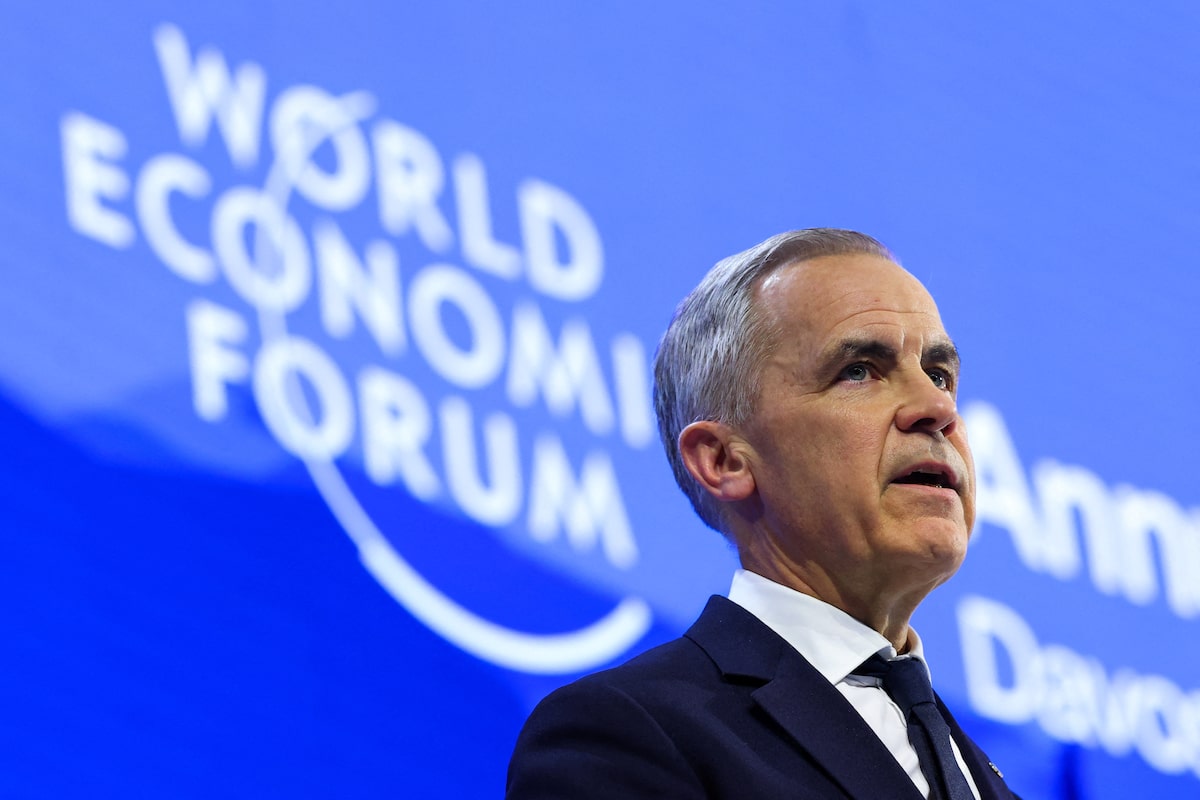
Good morning. In his first Davos speech as Prime Minister, Mark Carney highlighted a system that bends to the powerful – more on that below, along with the NDP leadership contenders and Heated Rivalry’s sexy consent. But first:
Today’s headlinesOpen this photo in gallery:
Mark Carney at Davos yesterday.Denis Balibouse/Reuters
World OrderBetween empires
Mark Carney isn’t exactly a stranger to Davos: He’s attended the World Economic Forum in Switzerland roughly 30 times. But in his first appearance as Prime Minister, Carney delivered a speech yesterday peppered with references to an unexpected source. There were no Adam Smith aphorisms or John Maynard Keynes quotes – this time, he invoked Václav Havel, the Czech dissident playwright turned president.
In his 1978 essay The Power of the Powerless, Havel imagines a greengrocer who slides a communist sign – “Workers of the world, unite!” – into his shop window among the onions and carrots. The grocer doesn’t believe the slogan. Neither do his neighbours with their own window signs. But to dodge trouble or reproach from those in charge, “they must live within a lie,” Havel wrote. And “by this very fact, individuals confirm the system, fulfill the system, make the system, are the system.”
It’s the exact same, Carney argued in Davos, for middle powers like Canada still propping up the fiction of a rules-based international order. For decades, these countries got a bunch out of the U.S.-superpower bargain: collective security, financial stability, predictable foreign affairs. In exchange, they agreed to overlook that the rules didn’t apply equally to everyone – that “the strongest would exempt themselves when convenient,” as Carney said, and that international law was “applied with varying rigour” depending on the victim and aggressor.
Only now, with superpowers ignoring territorial sovereignty and hijacking global trade, that bargain is no longer worth it. Carney urged medium-sized countries to band together instead, building new strategic alliances, inking security and defence deals, diversifying their trade internationally and strengthening their economies at home.
But first, he said, middle powers must “call the system what it is: a period of intensifying great-power rivalry where the most powerful pursue their interests using economic integration as a weapon of coercion.” Canada and its partners don’t need to fulfill that system any longer. It’s time, Carney maintained, for “countries to take their signs down.”
Just one of the AI-generated images Donald Trump posted yesterday.Supplied
Havel is a solid choice for a framing device – he was an acolyte of Samuel Beckett and the theatre of the absurd. How else to understand this bizarre, illogical, anxious political moment? Shortly before Carney spoke at Davos, U.S. President Donald Trump posted an AI-generated image of himself planting the American flag on Greenland’s soil. He followed that up with another AI image of the Stars and Stripes covering Canada, Greenland and Venezuela. He trolled French President Emmanuel Macron and NATO chief Mark Rutte by leaking their text messages to him. Trump later reiterated that Norway – and not the Nobel Institute – was definitely responsible for his Peace Prize snub. “Don’t let anyone tell you that Norway doesn’t control the shots, okay?” he insisted to reporters. “It’s in Norway!”
But as Carney circled back to Havel yesterday, he revealed a major challenge facing middle powers. In order for them to “live the truth,” rather than live within a lie, “it means naming reality,” the Prime Minister said. Except Carney didn’t actually name Trump anywhere in his Davos speech. Neither did Macron, who criticized a “new imperialism,” or European Commission President Ursula von der Leyen, who warned “nostalgia will not bring back the old world order.” Media reports fell back on the same language: These comments were a “veiled broadside” at Trump, or a “thinly veiled swipe” at Trump, or “thinly veiled denunciations” of the president.
And that veil is understandable! Canada can strike a tariff deal with China, join the European Union’s military procurement fund and pursue new markets in India, but the U.S. remains our nearest neighbour and biggest trading partner by far. Carney has to be very, very careful about antagonizing Trump too directly. We badly need to preserve the United States-Mexico-Canada Agreement, which still lets most of our exports cross the border tariff-free. Speaking of borders: It would also be much better if the U.S. didn’t invade ours, since – according to our own military models – we’d have about a week until American forces overcame Canada’s strategic positions on land and at sea.
But something more will likely have to be done, even if middle powers aren’t yet ready to call it by name. Carney said as much near the end of his speech: “If we’re not at the table, we’re on the menu.” It didn’t have quite the same literary flourish, but the Davos crowd rose to their feet.
The Shot‘Nobody is trying to win the sex.’ Open this photo in gallery:
Connor Storrie and Hudson Williams in a scene from Heated Rivalry.Bell Media/The Canadian Press
As Canadian exports go, Heated Rivalry is shamelessly explicit – and it’s explicitly consensual, too. Read more about the show’s yes-means-yes sex scenes here.
The WrapWhat else we’re following
At home: Finance Minister François-Philippe Champagne said Canada would not shell out $1-billion to join Donald Trump’s “Board of Peace.”
Abroad: After France’s President, Emmanuel Macron, declined to join the “Board of Peace” altogether, Trump threatened to slap 200-per-cent tariffs on French wine.
Politics: Federal New Democrats will choose their new leader from these five candidates in just over two months.
Streaming: Netflix capped last year with another solid financial performance (but you can find Heated Rivalry on Crave).
Claims: Severe weather across Canada caused more than $2.4-billion in insured damages last year.
Fame: Former prime minister Justin Trudeau and pop star Katy Perry appeared hand-in-hand in Davos yesterday.