The last message Omid received from his family in Shiraz was on 6 January. “They wrote they can’t afford to buy eggs,” Omid tells The New Arab in a video call from Berlin. Omid is not his real name. He requested anonymity, fearing for his family.
A cinematographer and filmmaker who studied cinema at the University of Tehran, Omid, 43, moved to Berlin with his wife three years ago, but his parents and in-laws all live in Iran.
Despite a very brief period of partial reconnection on Sunday, the internet remains fully blocked for most people across the country.
The Iranian government cut off all internet access across 31 provinces on the night of 8 January, isolating the 90 million-strong population from the rest of the world after protests triggered by shopkeepers in downtown Tehran on 28 December turned deadly.
Shopkeepers in Tehran’s grand bazaar had shut down their stores in response to the collapsing local currency, which made daily business impossible.
In other provinces, years of economic strain had pushed people into poverty, leading to mass protests as many complained they were unable to feed their families.
According to a report by the Middle East Forum Observer, a US-based think tank, food inflation surpassed 60 percent in November 2025, and prices of some basic items — including bread, rice, chicken, and eggs — rose by up to 100 percent compared to the previous year.
This comes as overall inflation in the country has been reported at around 49 percent, showing that food prices have been rising at a much faster pace.
Iranians in the diaspora have struggled to connect with their families until today, despite the end of nationwide protests, which authorities have repeatedly blamed on the US and Israel. Iranian supreme leader, Ayatollah Ali Khamenei, acknowledged for the first time on Saturday that thousands of people were killed during protests over the last two weeks.
Iran is witnessing the largest wave of social unrest since 2022 [Getty]
Diaspora faces isolation
Omid is not the only one cut off from his loved ones. Mahsa, 42, also lives a long way from home with her partner in Berlin, having immigrated 12 years ago to pursue a PhD in English literature.
Previously an English teacher and part-time journalist in Iran, Mahsa (not her real name) was visibly shaken during the video interview when asked about her family, which lives in Marvdasht, near Shiraz, the capital of Fars Province in Southwestern Iran.
“The last time I communicated with my sister was seven days ago when we decided to delete WhatsApp altogether,” Mahsa tells The New Arab.
Like all major cities in Iran, Shiraz erupted in protests, which witnessed violent clashes with security forces since late December.
“My sister told me they arrested several bloggers in Marvdasht,” Mahsa says, “and that some teachers who had sent messages via WhatsApp were also approached.”
The next day, when she tried to call her parents, Mahsa said she couldn’t get through.
Iranian Americans hold a rally and vigil in honour of the thousands of protesters killed in Iran and to call on policymakers to support the people of the country, outside the White House in Washington, DC, 16 January 2026 [Getty]
Omid says he, too, tried but failed to reach his family using Starlink, the satellite internet service provided by Elon Musk’s SpaceX.
“That too has become inaccessible,” says Omid.
Even though Starlink had waived subscription fees for users in Iran, the BBC reported that using the service carries a penalty of up to two years in prison and that authorities have been searching for Starlink dishes to prevent people from connecting to the internet.
According to Filterwatch, a London-based digital rights organisation established in 2012 “to provide the information and tools to enable journalists, human rights advocates, and campaigners to hold Iranian policy-makers to account, and to advocate for a free and open internet in Iran”, mobile jammers were deployed in parts of Tehran to disrupt Starlink frequencies.
The downgrade in connectivity has only made short text messages possible intermittently.
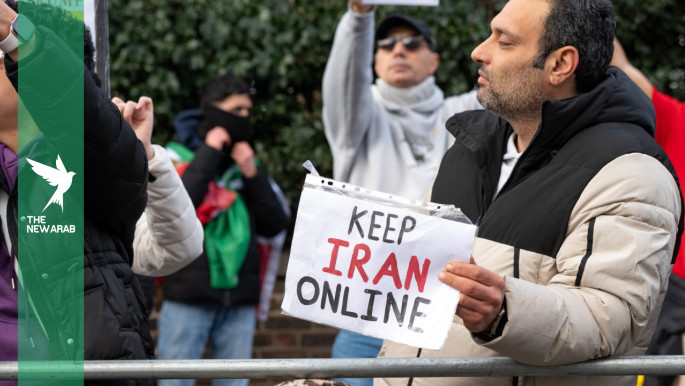
Members of the Iranian diaspora gathered outside the Iranian Embassy in London after recent protests in Iran [Getty]
Secondary trauma
“We’re experiencing secondary trauma,” says Mahsa.
She says she hasn’t slept for days. Her mother is ill, and she needs to send money for her medication.
“The last time I was in Iran was in the early days of the COVID-19 pandemic,” says Mahsa, “I went back to say goodbye forever.”
The political repression made her never want to go back, she says. “Journalism and writing no longer feel useful,” she adds, “But what if I just go back? What difference does it make if I live or die?”
Like many Iranians in the diaspora, Mahsa and Omid have reached the edge of despair with little more in their power than to stare at their mobile screens all day and reshare news.
“If I manage to sleep, the first thing I do when I wake up is grab my phone to check the news,” says Omid, adding that the stress they endure from a distance is different from what people experience on the battlefield in Iran.
He notes that the fears grew every day with conflicting reports on the number of dead, wounded and arrested.
“My therapist says I should put my phone away, but I can’t,” he says.
According to a Reuters report citing an Iranian official, at least 5,000 people were killed, including around 500 security personnel, making this Iran’s deadliest ever crackdown on protesters.
While Human Rights Watch (HRW) and other organisations say it is difficult to verify the exact number of those killed across the country, a 16 January report by HRW says there is growing evidence of country-wide massacres.
Shocking videos of bodies leaked from inside Iran that were widely circulated on social media, but which could not be independently verified, have raised deep concerns within the international community about the scale of the violence.
Protesters hold up canisters releasing smoke in the colours of the Iranian flag during a rally in solidarity with protesters in Iran, in Los Angeles on January 18, 2026 [Getty]
On 13 January, Omid says he was finally able to get news about his family through an acquaintance who has Starlink, only to find out that five of his family members were shot.
During protests in Tehran’s Haft-e Tir Square, government forces opened fire on demonstrators, including Omid’s family members, who sustained birdshot wounds to their hands, legs, abdomen, and head.
Fearing arrest at hospitals, they walked home and relied on neighbours for rudimentary medical care, remaining hidden indoors. They believe the dense crowd shielded them from additional bullets.
“They were injured in five different locations,” says Omid, adding that the pellet wound is so large, “you can fit a finger into it.”
“At the same time, it’s not safe to go to a hospital for proper care,” Omid adds. “This raises the chance of infection. People fear arrest at hospitals.”
Iran International reported on 6 January that the government had ordered a probe into a riot police hospital raid of the Imam Khomeini Hospital in the western province of Ilam, where injured protesters were being treated.
According to the report, on 4 January, Revolutionary Guards and police special forces surrounded the hospital, used shotguns and fired tear gas and smashed glass doors to gain access, beating those inside, including healthcare workers.
Mahsa says she has yet to contact her family or to check on her sick mother.
“Should I pitch a tent in front of the German Chancellor’s building?” says Mahsa, “Will my voice be heard?”
Fires were lit as protesters rallied on January 8, 2026, in Tehran, Iran [Getty]
Meanwhile, Omid contemplates the true meaning of democracy amid the re-emergence of exiled Crown Prince Reza Pahlavi.
On 18 January, Iranian state TV was hacked by a broadcast backing anti-government protesters and a message from Pahlavi featuring graphics in Farsi proclaiming “America is with you”.
“Democracy means that the majority of people support a movement, and [the Shah’s son] has supporters,” says Omid.
“I oppose him, but what can I do? Whether the West wants it or not, people want him. The people of Iran don’t want a religious government, so I support the people of my country. Whatever they say is right.”
Mahsa says Trump and foreign governments are also responsible for the violence.
“Trump imposed sanctions on Iran and rode the wave of public discontent,” she says. “There was definitely a revolution brewing, but Trump’s sanctions accelerated it because the pressure was not directed at those in power but on ordinary Iranians.”
She laments how, despite the hundred if not thousands killed, “there is still no sign of help from the West or from foreign governments.”
Omid adds, “The only hope is foreign intervention, even at the cost of war. We’ve reached a point where we’re saying: Mr Trump, do whatever you want, just end the killing.”
Jalal Hussaini is a video journalist and filmmaker based in Germany
This article is published in collaboration with Egab