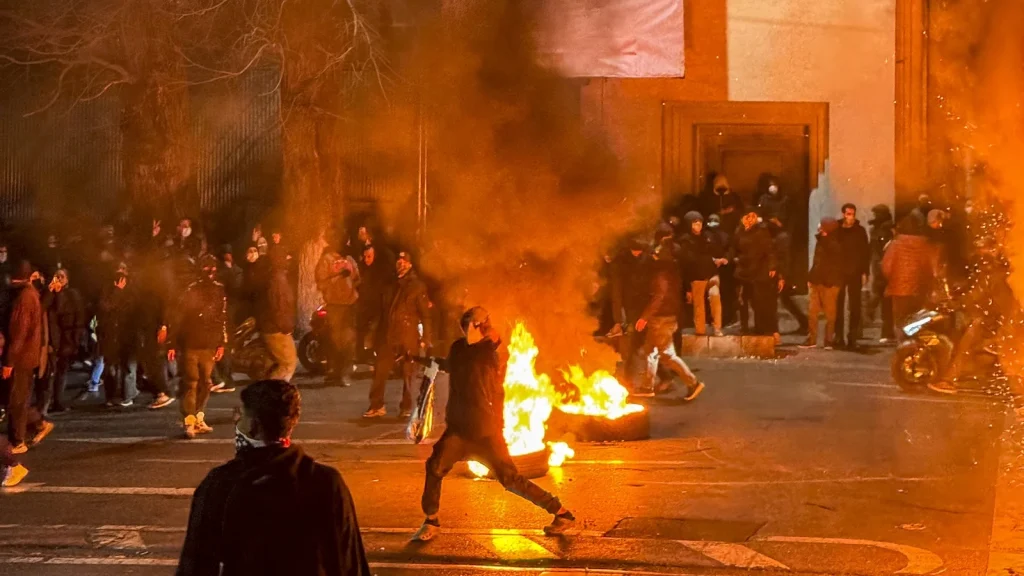
Many thousands dead in body bags piled on the streets and even more injured or arrested was the dictatorship’s response to the protest movement in Iran. Without knowing for sure, given almost all communication is shut down, it seems that the protests have subsided for now.
This does not mean that the regime is secure. Hatred of the capitalist Islamist dictatorship remains, as do all the issues that triggered the great wave of protests. Nor has the threat of military intervention by Trump or Israel gone away, even if it seems to have been called off for the time being.
Could the protest movement have brought down the regime? What role did Trump’s threats of military intervention play? These are questions that socialists and everyone who has followed the movement are asking, need to discuss and want answers to.
Weak Regime Shaken
The mullahs’ dictatorship, led by “Supreme Leader” Ayatollah Khamenei, was undoubtedly shaken. It is a severely weakened regime, which in just over a year has lost allies in Syria and Venezuela, while Hezbollah and Hamas have been virtually crushed militarily by Israel. During the 12-day war in June, Tehran was unable to respond seriously to Israeli and US attacks and bombs.
The movement that began on December 28 was triggered by 70 percent inflation on food amidst an already-deep economic crisis. It quickly developed into a movement against the entire regime—the dictatorship’s oppression, unemployment, water shortages and much more. Within a few days, the protests took on revolutionary characteristics when the police and the “Revolutionary Guard” (the forces of counter-revolution) were challenged in the streets.
During a discussion about the budget in the so-called parliament on the day the protests began, President Masoud Pezeshkian said, “They say that wages should be raised, but can anyone tell me where I’m going to get the money from?” But protesters knew that he is partly responsible for their suffering and lives under completely different conditions than they do. The regime then tried to appease the movement by promising a monthly allowance of around $7 to all citizens, an amount that was met with derisive laughter. The president also made statements that sought to distinguish between those who “were just protesting” and those who were identified as violent agitators, and later as “foreign agents.” In the end, of course, it didn’t matter.
Bloody Repression
Automatic weapons were indiscriminately aimed at the demonstrators. By Sunday, January 18, estimates of the number of people killed vary from 3,000 to 16,000. Witnesses report that snipers and motorcyclists armed with machine guns targeted demonstrators’ eyes.
The massacres stopped the street protests for the time being, according to the few reports emanating from Tehran. Those who had been demonstrating stayed at home. The ruthless violence meant that the movement could not continue in the same way. Economic hardship also forced many to return to work.
Revolutionary Organization & Leadership Lacking
As with the great Women, Life, Freedom movement of 2022-23, the protests were organized almost entirely via internet apps. This had a major impact when the internet was shut down. There was no organization or trusted leadership that could replace the spontaneous power of millions on the streets. There was a lack of democratic organization and coordination. The courage and will of the masses for change is demonstrated time and time again, but protests and demonstrations are not enough.
Lessons from mass movements need to be discussed, such as the need for democratic organization and a revolutionary leadership armed with a socialist program against the state, capital, and imperialism. This is needed for the struggle to overthrow the regime, but also to pursue the revolutionary change needed if the regime actually falls, as in Syria.
During the movement in Iran, much international attention was focused on Trump’s threats to intervene, but also on the son of the last Shah, Reza Pahlavi, who has lived in exile in the United States for almost 50 years. Both tried hypocritically to portray themselves as democrats and leaders of the protests. Pahlavi’s alleged contact with the movement was revealed when his calls for continued protests went unheard.
Trump Calls Off Intervention, For Now
Trump was very close to intervening, full of hubris after the kidnapping of Maduro and attempts to control Venezuela by remote control, without having to have troops on the ground.
Against Iran, both bombing and assassinating key figures in the regime were possible options. But both Netanyahu in Israel, who wanted to continue the war this summer, and the regimes in Saudi Arabia and other Gulf states feared the effects of an attack by the United States.
The Iranian military could then have responded with rockets and missiles against Israel and US allies and bases around the Persian Gulf. The region’s rulers feared a total collapse in Iran just as much, having seen developments in Syria and Iraq. Previous interventions by US imperialism in the region have created extreme crises, hardship and military conflicts, as well as the creation of ISIS and other similar armed groups.
Neither the US, Israel nor the Gulf states’ rulers want to see mass movements that overthrow regimes. They prefer “stability” through dictatorships. In Iran’s case, the hope is for a compliant regime, something Trump now wants to establish in Venezuela and other countries. When he called off plans to intervene, at least temporarily, he referred to the regime in Tehran’s promise to stop executions, as well as their assurance that the number of deaths was lower than others had claimed. He no longer seemed to believe in Pahlavi, just as he marginalized the Venezuelan right-wing leaders in exile. But without a strong alternative from the left and the workers, there is still a risk that Pahlavi fills the political vacuum if the mullahs’ dictatorship falls.
Protest movements in Iran have been going on in waves for several decades. Their power and courage are enormous. The only force that the protesters can rely on is the working class, in Iran, the region and internationally. Only the organization and revolutionary struggle of the workers can overthrow the dictatorship and the capitalist system. In this way, poverty can be abolished, and oppressed nations, workers, women and young people can win democratic rights.