For more than five centuries, Catholicism has been the civilizational grammar of Latin America. From Andean pilgrimage routes to urban neighborhood shrines, from Marian basilicas to roadside crosses, Catholic symbols have ordered both public space and private devotion. To be Mexican, Colombian, or Brazilian was not merely to be a citizen of a nation-state, but a subject of a sacramental world.
And yet, for the past half-century, a steady drumbeat has accompanied the region’s religious landscape: Catholicism is in decline.
The latest Pew Research Center study, “Catholicism Has Declined in Latin America Over the Past Decade,” (for which I was an academic consultant) provides the most comprehensive empirical confirmation to date. Across Argentina, Brazil, Chile, Colombia, Mexico, and Peru, the Catholic share of the adult population has dropped by 9 to 19 percentage points since 2013–14. Meanwhile, the religiously unaffiliated—those who identify as atheist, agnostic, or “nothing in particular”—have surged dramatically, in some cases nearly quadrupling.
At first glance, the narrative seems familiar: institutional Catholicism is shrinking, Protestantism has plateaued, and secularization is advancing. But this reading misses the deeper transformation underway. What Pew’s data actually reveal is not the demise of religion in Latin America, but the collapse of Catholic monopoly and the emergence of a robustly plural, improvisational religious field.
This is not a story of disenchantment but rather of reconfiguration.
The End of Monopoly but Not Belief
The most visible shift is the erosion of Catholic majorities. Brazil and Chile now stand at just 46% Catholic. Colombia has plummeted from 79% to 60%. Mexico, long regarded as the Marian heartland of the Americas, has dropped from 81% to 67%.
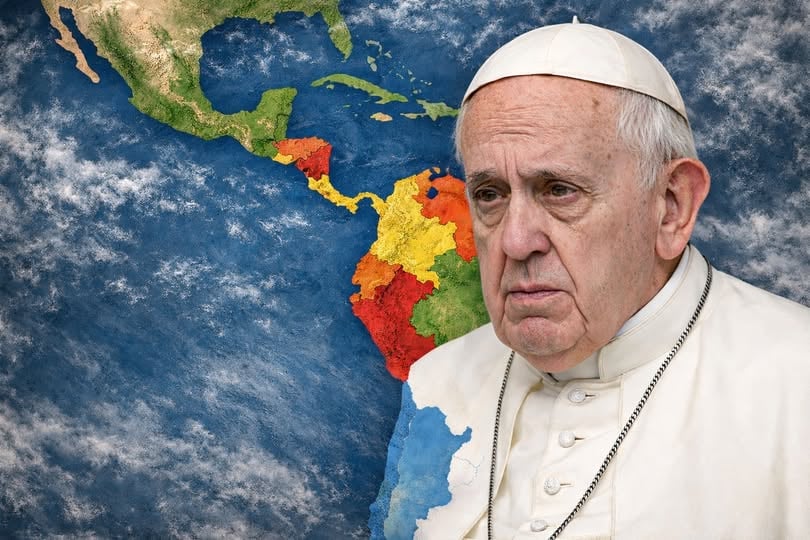
And as popular as the first Latin American pope was in his native region, Francis was a spectacular failure at stopping or even slowing Catholic decline. This point is punctuated in his native Argentina, which he never visited during his twelve-year papacy and where the Catholic percentage of the population took a nosedive from 71% to 58%.
Historically, this is seismic. In 1900, over 90% of Latin Americans were Catholic. For most of the twentieth century, Catholicism functioned not simply as a religion but as a cultural foundation. It required no explanation. It was inherited, ambient, unquestioned.
What has collapsed is not belief but hegemony. The Church no longer governs the religious imagination uncontested. Latin Americans now navigate a dynamic spiritual marketplace in which Pentecostal churches, folk saints, Afro-diasporic religions, New Age practices, and personalized spiritualities compete for allegiance. Catholicism remains the largest tradition, but it is now one voice among many. The era of automatic Catholicism is over.
The Rise of the Believing Nones
Perhaps the most striking—and most misunderstood—development is the explosive growth of the religiously unaffiliated. In Chile, one-third of adults now identify as “nones.” In Colombia, nearly one-quarter. In Mexico, one in five.
In a European context, this would signal deep disenchantment of world views. In Latin America, it means something else entirely. The Pew data show that large majorities of the religiously unaffiliated in every country still believe in God. In Brazil, 92%. In Mexico, 76%. Even in more secularized Chile, 69%.
This is not atheism. It is deinstitutionalization. Latin Americans are leaving churches, not the supernatural. They are rejecting clerical authority, not transcendence. They are abandoning institutional affiliation while retaining prayer, belief, and spirituality. In short, they are not becoming secular. They are becoming post-institutional.
This aligns with what ethnographers have long observed on the ground: Latin Americans increasingly engage in belief bricolage, fashioning their own spiritual repertoires, borrowing freely from Catholicism, Pentecostalism, folk religion, and personal experience. Belief is no longer regulated by catechism. It is curated and customized.
More Ex-Catholics as Nones than Pentecostals
Another critical finding complicates older narratives of Protestant expansion. While Pentecostalism remains vibrant, most former Catholics today are not becoming evangelical. They are becoming religious nones.
In four of the six countries surveyed, more ex-Catholics disaffiliated than converted to Protestantism. Brazil remains the major exception, where evangelical growth continues to outpace disaffiliation.
This marks a subtle but significant shift. In the 1980s and 1990s, Pentecostal churches were the primary beneficiaries of Catholic decline. Today, the fastest-growing category is “nothing in particular.”
This suggests that many Latin Americans are not trading one church for another; they are opting out of the institutional game altogether. Yet again, this is not evidence of spiritual exhaustion but rather of institutional fatigue.
Pentecostalism: Maturation and Fragmentation
Pentecostalism remains the most dynamic force in Latin American Christianity. In Brazil, nearly 30% of adults identify as Protestant, the vast majority of them Pentecostal. But Pew’s data also reveal something unexpected: the Pentecostal share within Protestantism is declining in several countries. In Argentina, it dropped from 71% to 54%. In Brazil, from 80% to 65%.
This likely reflects the maturation of the evangelical sector. As Pentecostalism becomes normalized, new identities proliferate: “just Christian,” nondenominational, hybrid charismatic forms. It may also signal some degree of disillusionment with prosperity theology, authoritarian leadership, and hyper-performative worship styles.
Even the most successful religious movement in Latin America is now subject to the same forces of fragmentation, individualization, and choice reshaping Catholicism.
The Enchanted Subsoil of the Latin American Religious Landscape
One of the most revealing sections of the Pew study examines beliefs associated with Afro-Caribbean, Afro-Brazilian, and Indigenous traditions: belief in spells, curses, ancestor spirits, energies in nature, and reincarnation.
Majorities across the region believe that spells and magic can influence people’s lives. Large numbers believe that mountains, rivers, and trees possess spiritual energies. Many believe in ancestor spirits who intervene in human affairs. Catholics are often more likely than Protestants to hold these beliefs.
This confirms what we scholars of lived religion have long argued: Latin American Catholicism has always been cosmologically thick and ritually porous. The boundary between orthodoxy and folk practice is not a line; it is a zone.
Devotion to Santa Muerte, Gauchito Gil, San La Muerte, and other folk saints does not represent a rupture with Catholicism. It represents its vernacular logic. The Church may lose adherents on paper, but the sacramental imagination remains robust.
Believing Without Belonging
Despite institutional decline, Latin America remains profoundly religious. Across all six countries, roughly nine in ten adults believe in God. Large numbers pray daily. In Brazil, Colombia, Mexico, and Peru, about half or more say religion is very important in their lives.
Even more striking, Pew finds that Latin American nones are about as religious as Christians in Europe on measures of belief and prayer!
This alone should debunk simplistic narratives of secularization. The religiously unaffiliated in Latin America resemble European Christians, not European atheists. What we are witnessing is not the evacuation of the sacred, but the privatization and individualization of religious authority.
God remains. The saints remain. The spirits remain. What is fading is the assumption that any institution has the right to regulate them.
Nones as Younger and More Educated
The generational data are unambiguous. Younger adults are far less likely to identify as Catholic and far more likely to be unaffiliated. In Colombia, one-third of adults under 35 are nones, compared to just 10% of those over 50.
Education tells a similar story. More educated adults are more likely to disaffiliate and less likely to be Protestant. The future of Latin American religion will not be inherited. It will be assembled.
It will be religious bricolage—hybrid, selective, and improvisational. And given the persistence of belief in God, spirits, magic, and the afterlife, it is unlikely to be disenchanted in any Weberian sense. The supernatural remains woven into the fabric of everyday Latin American life.
Decline or Transformation?
If we read Pew’s data narrowly, the lead story is one of Catholic collapse. If we read it sociologically, the story is far more compelling. Latin America is not becoming secular. It is becoming post-Catholic but not post-religious.
The historic monopoly is over. The Catholic parish no longer anchors religion and cultural identity. The catechism no longer governs belief. But the religious imagination of Latin America remains vibrant, creative, and enchanted.
Freed from institutional moorings, Latin Americans are crafting spiritual lives that are pragmatic, affective, and responsive to suffering, precarity, and hope. They are not abandoning the sacred. They are refashioning it.
For scholars of religion, this is not a narrative of decline but rather of mutation, adaptation, and reinvention. And if history is any guide, Latin America will continue to surprise us—not by letting go of the supernatural, but by continually reshaping it.