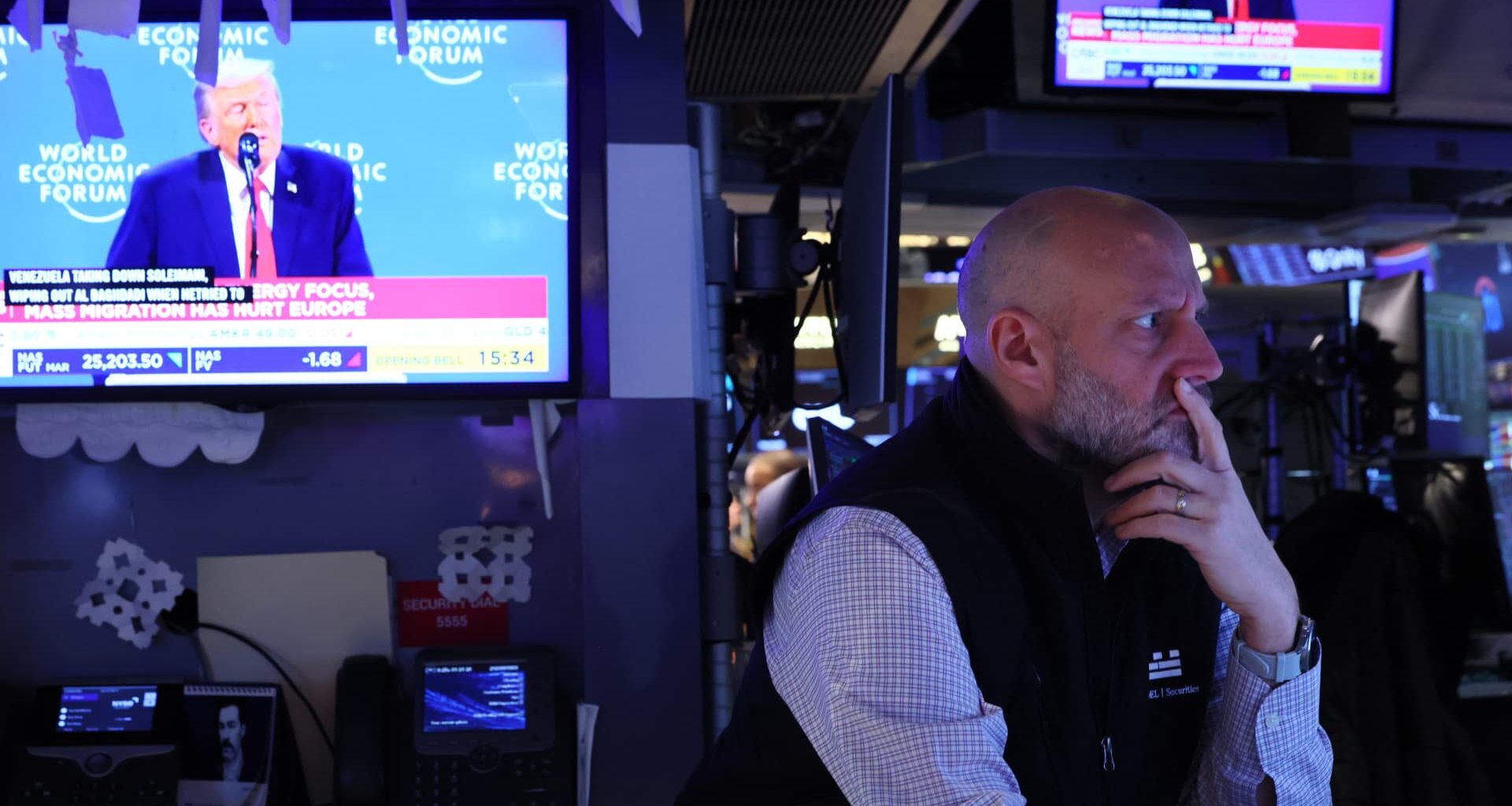
Stocks rose on Wednesday after President Donald Trump told the World Economic Forum he would not use force to acquire Greenland, easing a concern that has rattled markets and caused a flight from dollar-based assets.
The Dow Jones Industrial Average traded higher by 250 points, or 0.5%. The S&P 500 gained 0.3%, while the Nasdaq Composite advanced 0.1%.
Trump was commenting in his speech in Davos, Switzerland, about how he believed the U.S. was carrying the financial and military load for NATO. Here’s what he said which boosted equities:
“We never asked for anything, and we never got anything. We probably won’t get anything unless I decide to use excessive strength and force, where we would be, frankly, unstoppable. But I won’t do that. Okay? Now everyone’s saying, ‘Oh, good.’ That’s probably the biggest statement I made, because people thought I would use force. I don’t have to use force. I don’t want to use force. I won’t use force.”
The 10-year Treasury price turned higher and its yield turned lower following Trump’s comments. The U.S. dollar index pared its decline with other currencies.
While Trump ruled out military action, he did say Wednesday he was “seeking immediate negotiations to once again discuss the acquisition of Greenland by the United States.
“At the end of the day, the administration’s broadly seen the negative market impact. I think the market is kind of relying on the idea that if they do push too far on the tariff threats and whatnot that they’ll start pulling back,” said Tom Garretson, senior portfolio strategist at RBC Wealth Management.
The president also said in his Davos speech that he would be asking Congress to implement his proposed credit card cap of 10%, an uncertain prospect given lack of support among lawmakers. That comment sent bank stocks higher. Citigroup and Capital One each rose roughly 1%.
Even though the worst-case scenario of military action appeared to be taken off the table, concerns among investors around further tariff developments between the U.S. and Europe remained, as stocks later moved well off their highs. At their peaks, the Dow was up more than 500 points, or 1.1%, while the S&P 500 and Nasdaq advanced around 1.2% and 1.3%, respectively.
Following Trump’s speech, European lawmakers suspended the European Union’s trade deal with the U.S. that was reached in July in the midst of ongoing tariff tensions over Greenland. Trump had announced over the weekend that eight NATO members’ goods will face 10% tariffs starting on Feb. 1 — which will then escalate to 25% on June 1 — until a deal to purchase Greenland is reached.
On Tuesday, European Commission President Ursula Von der Leyen called Trump’s new tariff proposals a “mistake” that would plunge Europe and the U.S. into “a dangerous downward spiral.”
“Our response will be unflinching, united and proportional,” she said, adding that the EU stood in “full solidarity” with Greenland and Denmark.
Also speaking at the WEF on Tuesday, French President Emmanuel Macron said a potential response to new U.S. tariffs was to use the EU’s Anti-Coercion Instrument, which would restrict U.S. businesses’ access to Europe’s single market. Triggering the ACI could exclude American suppliers from participation in EU public tenders, place export and import restrictions on goods and services and put limits on foreign direct investment.
Stocks posted sharp losses in the prior trading day as Trump escalated his Greenland tariff threats and failed to rule out military use to take the territory controlled by Denmark. All three benchmark indexes logged their worst daily performances since Oct. 10. The sell-off also dragged the S&P 500 and the Nasdaq into negative territory for 2026.
The so-called sell America trade on Tuesday was accompanied by a spike in U.S. Treasury yields and a decline in the U.S. dollar. The 10-year Treasury yield surged and briefly topped 4.3% at the high of the day.
Treasury Secretary Scott Bessent told reporters in Davos on Wednesday that the Trump administration was “not concerned” about the previous session’s sell-off.
Back in Washington, Supreme Court justices expressed skepticism about whether Trump has the authority to fire Lisa Cook as a Federal Reserve governor. During oral arguments Wednesday, Justice Brett Kavanaugh told a Trump administration lawyer that arguments the president can fire Cook without judicial review “would weaken, if not shatter, the independence of the Federal Reserve.”