In the Slovak media’s recent year-end round-ups, mounting concern about the country’s declining economic prospects and growing resentment at official corruption were encapsulated in a single word: slayáda.
This neologism — meaning something between killing it and bodacious — was inadvertently popularized by a young musician-influencer, who used it while boasting to a journalist about a vastly overpriced land deal, funded by taxpayers and the EU. The main beneficiary was her well-connected father’s company (she is also a board member), which received about €10m ($12m) more than the plot was estimated to be worth.
The government is supposed to be constructing a National Innovation and Technology Center on a rural site about 50km (30 miles) from Bratislava, though there is widespread skepticism that the center will ever result in much innovation. All the same, slayáda is proving very useful, and has entered the Slovak lexicon to describe an exultant expression of witless amorality.
This deal and others like it, including the apparent use of EU funds to build private haciendas for oligarchs and weirdly restrictive specifications included in public procurement tenders that seem designed to favor selected bidders, have left the electorate in a foul mood.
In November, a deputy prime minister was forced to resign over the opaque handling of public grants, including the slayáda deal. He blamed the furor on “politicking” and pleaded “political inexperience” — a curious claim, given that he was elected to parliament in 2020, and was previously Slovakia’s ambassador to the USA for more than five years. The chief prosecutor has just announced a criminal investigation.
Far from the primary colors of the Slovak scandal, the grayscale public finances are in dire straits. The country’s open economy has been buffeted by the wider effects of the war in neighboring Ukraine and rising tariffs worldwide, as well as Europe’s struggle to deal with Chinese competition. Slovakia’s budget deficit widened to over 5% in 2024, among the largest in the EU. Despite several rounds of tax increases, the outlook remains dim.
Its own actions explain some of the government’s current predicament. Since 2023, it has decriminalized various white-collar offences, including tax fraud up to €20,000 ($23,000), dismantled an elite police unit dedicated to investigating high-level corruption, and abolished a special anti-corruption prosecutor’s office.
In a lightning move in mid-December, parliament outlawed testimony from corrupt officials who turn state’s evidence. The ruling coalition MP who proposed the change is himself subject to a fraud investigation that will likely founder as a result. This latest slayáda prompted large public demonstrations.
Get the Latest
Sign up to receive regular emails and stay informed about CEPA’s work.
In the autumn, the European Union’s chief prosecutor, Laura Codruța Kövesi, visited Slovakia and delivered a brutally frank warning to the government about the financial and reputational effects that weak tax enforcement and growing criminality are having on the country.
This is far from EU overreach, as some populists have liked to argue. Slovak fraud is very largely (though not exclusively) funded by EU taxpayers. Understandably, they are unhappy when their money is stolen by embezzlers.
Kövesi noted that one-third of all VAT (sales tax) fraud cases currently being investigated by her pan-European office have links to Slovakia — no mean achievement given that Slovakia accounts for about 1% of the bloc’s population and well under 1% of its GDP. VAT fraud in Slovakia alone is probably costing the country around half a billion euros per year, Kövesi warned.
Her comments were ignored or dismissed by officials. But just weeks later, the finance minister admitted that tax receipts, despite a 3% VAT hike a year earlier, are almost 10% below forecast.
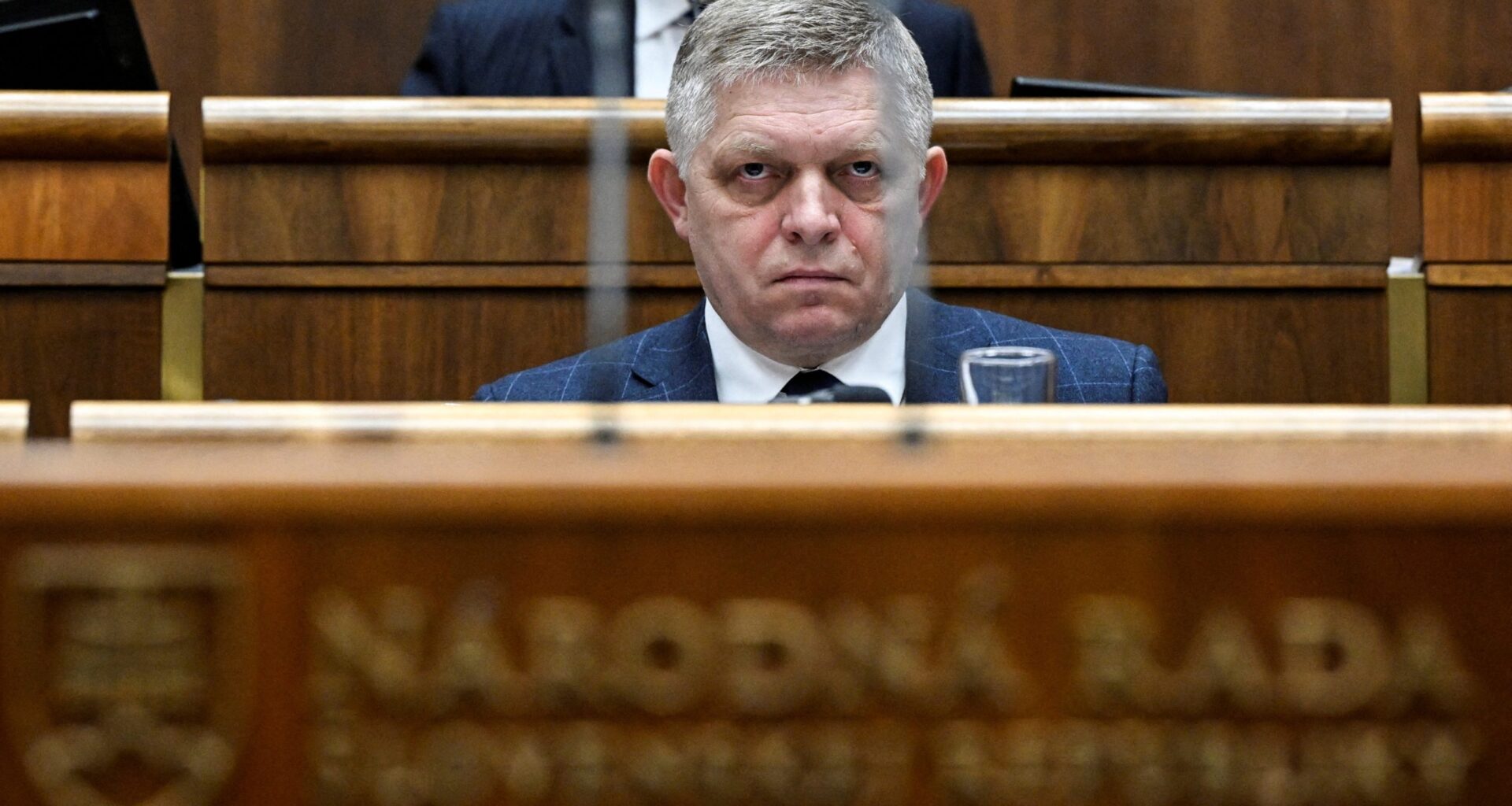
The main response of Slovakia’s long-time premier, Robert Fico, has been to double down on culture war battles. Despite continuing to present as a social democrat, he and his Smer party have adopted increasingly nationalist and conservative stances. In May, he was the only EU leader to attend VE Day celebrations in Moscow, appearing alongside the authoritarian leaders of Belarus, China, Russia, and Tajikistan. In June, he surprised even his own supporters by lauding Uzbekistan as a model of governance and suggesting that Slovakia would benefit from fewer political parties.
Fico has pursued a canny and successful campaign to change the constitution, which in September split the main Christian Democratic party from the rest of the opposition by promising to limit gay rights and ban adoption by anyone but married heterosexual couples. He described it as a “dam against progressivism”.
In an apparent effort to build bridges with another avowed enemy of progressive politics, President Trump, Fico has announced plans to build a large new nuclear power station with the US firm Westinghouse (Slovakia’s existing nuclear power plants use Soviet designs).
The €15-billion-plus bill is currently unfunded, and opposition politicians complain that there has been no tendering process for what would be Slovakia’s biggest-ever public investment. On January 17, Fico used the deal as a reason to fly to Mar-a-Lago to meet Trump, although the event produced little more than a photo-op. Neither Trump nor the White House has said a word about the meeting.
One thing that cannot be said of Fico is that he lacks stamina. He has been in the front line of Slovak politics since before the turn of the century, and prime minister for almost half that time. He trails the liberal opposition party Progressive Slovakia in the polls, but not by very much, and the fractured political landscape means he might well triumph again (a vote is due by 2027). And while he was shot four times at close range by an assailant in 2024, he returned to work within weeks. He prides himself on his physical fitness.
However, he has occasionally betrayed some weariness. As Fico’s many opponents will be hoping, even culture warriors sometimes tire of the fight.
James Thomson is a columnist for The Slovak Spectator, the Bratislava-based English-language newspaper and website.
Europe’s Edge is CEPA’s online journal covering critical topics on the foreign policy docket across Europe and North America. All opinions expressed on Europe’s Edge are those of the author alone and may not represent those of the institutions they represent or the Center for European Policy Analysis. CEPA maintains a strict intellectual independence policy across all its projects and publications.
Europe’s Edge
CEPA’s online journal covering critical topics on the foreign policy docket across Europe and North America.