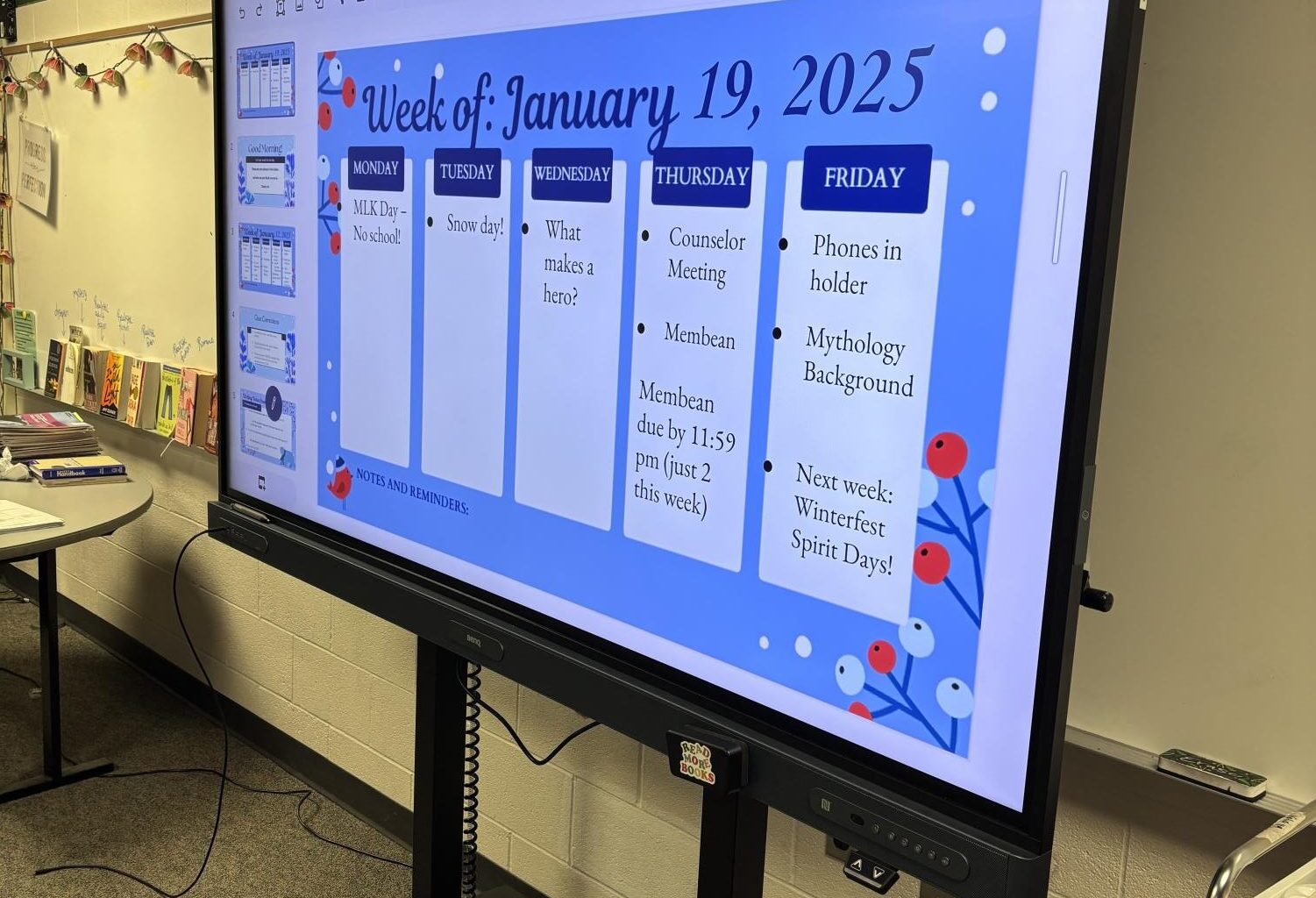
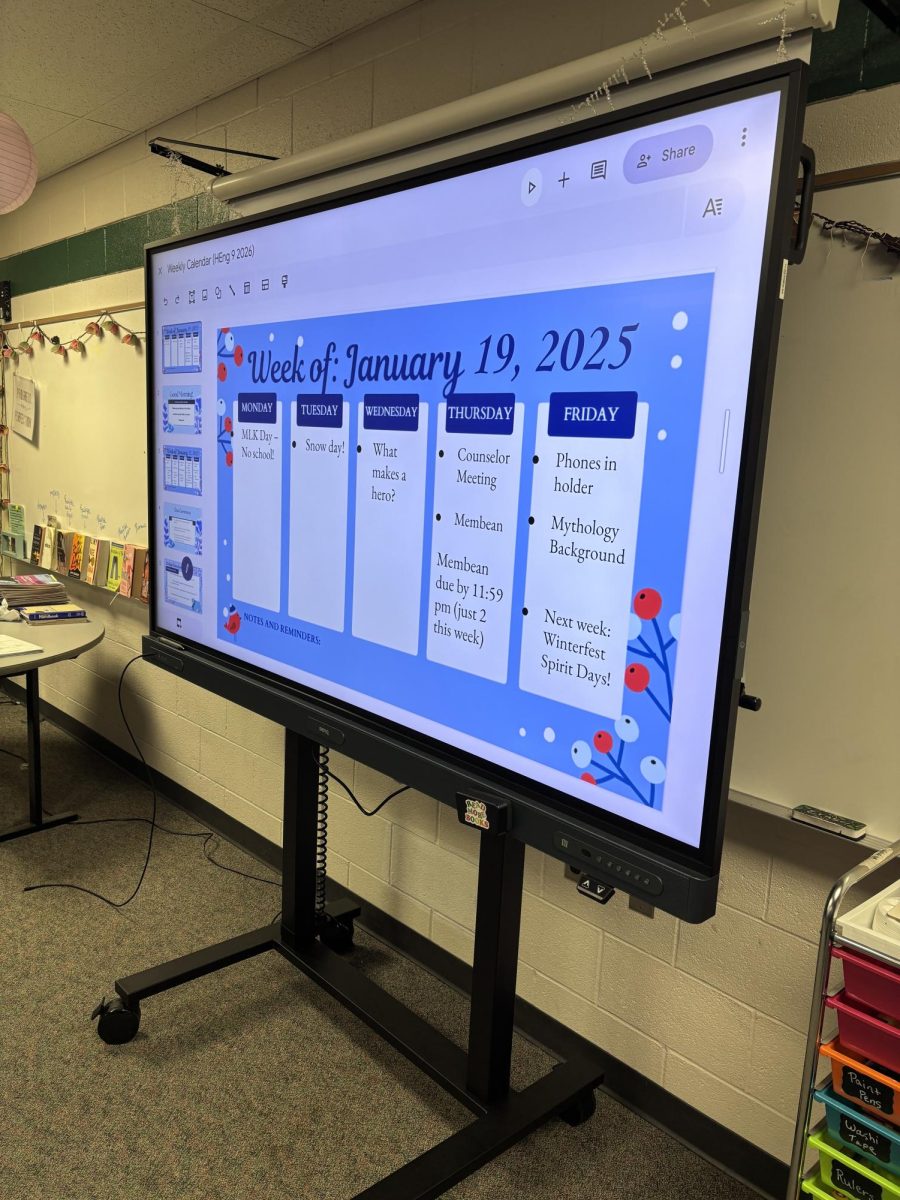
BenQ Boards are now omnipresent in all FHC classrooms, after an initial pilot group last year.
Last May, I walked into my sixth-hour class to find a peculiar object filling up a large space in the room. My first thought was that it was like a massive iPad on wheels. I had no idea what its purpose was, but it seemed entirely unnecessary right from the start.
This device is called a BenQ Board, the latest technology that FHPS is implementing in every classroom across the district. The Office of Technology has a life cycle for every piece of technology owned by the district, and the life cycles of the projectors expired last year. Therefore, the boards are for teachers to use as an advanced projector/whiteboard for their specific uses. With observed success, the district took further steps.
“Right before Christmas, we at Central High School, Eastern High School, and Northern High School all got a full set of BenQ Boards for every staff member,” FHC principal Jonathan Haga said. “So, that’s kind of how we went from zero to a full implementation of BenQ boards in about a year and a half.”
Although some teachers have had the boards longer than others as part of a pilot group—as in the case of my sixth-hour class—teachers newer to the technology have already experienced the upsides and downsides of it. Sarah Velie, FHC’s Honors English 9 teacher, has had her board for about a week.
“I like that I can take notes on it and save it, and then take notes again the next hour and save it,” Velie said. “So that’s been really helpful, but it’s been a learning curve, I think. I was used to just being able to show whatever was on my computer straight to [the whiteboard], and so I keep thinking, ‘I’ll just drag it over,’ but I can’t do that. It’s a little trickier when I have to show something [to the class]. So there are pros and cons.”
The boards were the district’s first real experiment in entering the age of technology. Next, they plan to develop an AI system for education. Recently, they hired a Director of AI: Aaron Romoslawski. Although the details are ambiguous right now, Romoslawski is helping to formulate a rubric for AI use.
“We’re developing a rubric for AI, so that way teachers have the opportunity to tell students, ‘Okay, this is a Level One Assignment, which means no AI, or it’s a Level Five, which I want you to explore and be able to create using AI.’” Haga said. “And then, we’re going to work on a system in which we can determine which AI platforms we want to teach AI ethics with, as well as allow students to use. There are a lot of different educational AI platforms so that we can stay up with the current trends in society and the business world in education, and not leave [students] high and dry by just saying, ‘We can’t use AI here,’ because that’s not realistic. How can we manage both ensuring academic honesty as well as preparing [students] for the post-secondary world?”
As junior Jackee Fisher points out, many students are already using AI services in disregard of academic honesty.
“I sit next to some freshmen, and I feel like they’ve been using ChatGPT their entire career as a student,” Jackee said. “They just mess up the easiest words ever. They don’t know how to spell ‘church.’ They don’t know how to spell ‘divine.’ I’m proofreading this girl’s essay, and it’s the worst thing I’ve ever read in my life. These kids, these freshmen—they’re not going to be able to know how to write things and actually use their heads.”
It’s generally agreed that technology is convenient and beneficial in everyday life, but when students are overwhelmed with assignments and extracurricular activities, they sometimes choose to cop out instead of struggling. This path of convenience can easily become an addiction.
“
I think [technology] can have a very positive impact on your learning. It just depends on the individual and how they want to use it. Most kids are going to abuse it.
— Jackee Fisher
“I think that a little bit of technology is essential, but I think the excessive technology right now is almost a hindrance at times,” Velie said. “Because we have so many devices and AI platforms that can attempt to think for students, and sometimes that’s the easy way to do it, but constantly having something think for you is getting in the way of doing the critical thinking. Also, I think it takes away from the hands-on curiosity.”
The district has good intention in mind—students can be curious about new modes of learning through AI and advanced computers. Even so, they are prioritizing this enhancement over teacher requirements, especially for English teachers.
English class demands a strong teacher-student relationship, as they work together to dissect complex issues and ideas that are directly expressed in essay writing. Writing is a vulnerable process, and it takes time and patience to develop. However, teachers cannot properly give students the full attention they need in classes of over 29 students.
“Smaller class sizes have been something that I’ve been asking for for a long time,” Velie said. “When I started here, around 20 years ago, class sizes for English were capped at 25. I almost never had more than 25, and when I did, then [the district] would provide an aide. But now, class sizes in English are capped at 29, but last year, every single one of my classes was more than that, and they no longer provide an aide. So, we get a little bit of extra pay. But to me, it’s not about the money. It’s about the fact that fewer students means that we can spend more time actually helping students one-on-one, which is far more beneficial than putting money towards tech.”
There’s no guarantee that the district’s plans with technology will be either inherently good or bad, but whatever comes for the future, staff can only do so much. It will be up to the students to decide how to conduct their education.
“I think [technology] can have a very positive impact on your learning,” Jackee said. “It just depends on the individual and how they want to use it. Most kids are going to abuse it. [With] ChatGPT, you can ask it to check your work. You can use it in a responsible way, but so many people use it in an irresponsible way, to the point where everyone thinks it’s bad. So, it’s up to the user and how you want to use technology.”