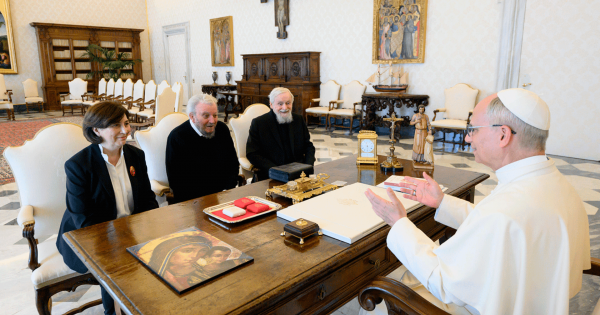
Addressing the internal risks often associated with the group, the Pope warned against “rigidity and moralism.” He reminded the assembly that their charism, while unique, is not exclusive.
“No ministry should become a reason to feel superior to one’s brothers and sisters and to exclude those who think differently,” Pope Leo stated.
He emphasized that the Way must remain part of the ordinary pastoral care of parishes, operating in full communion with bishops—a directive that carries significant weight for the movement’s operations across the Asian continent.
From the Shanty Towns to the Asian Mission
To understand the distinctive intensity of the Neocatechumenal Way, one must look to its humble origins. It was not born in a theological library, but in the dust of the Palomeras Altas shanty towns near Madrid in 1964.
Founded by Spanish painter Kiko Argüello and the late chemist-theologian Carmen Hernández, the “Way” began among the poorest of the poor—Gypsies, the homeless, and the marginalized.
Argüello found Christ in the suffering of these “innocents,” leading to a synthesis of preaching based on the early Christian catechumenate: a long-term itinerary of formation designed to lead baptized adults to a mature faith.
Today, that seed has grown into a massive global tree. As of July 2025, the Way boasts over 20,000 communities in 139 nations.
In Asia, the movement views the continent as fertile ground for the “New Evangelization.” Active in nations including China, India, Indonesia, Pakistan, Vietnam, and Kazakhstan, the movement has deployed families for Missio ad Gentes—missions in areas with little to no Christian presence—across the region.
Furthermore, they have established Redemptoris Mater seminaries in strategic locations such as Bangalore, Takamatsu, Manila, Karachi, and Seoul to raise local clergy formed in their specific charism.