
There is an old joke that suggests the real experts on how to solve the “Cyprus problem” are not the politicians, academics or civil society leaders, but the taxi drivers of Nicosia.
The seemingly intractable 60-year conflict between Greek Cypriots and Turkish Cypriots, who are backed by Athens and Ankara respectively, remains unresolved.
The small Mediterranean island is split in two, in what has become a stable but uneasy ceasefire, guarded by a United Nations peacekeeping force on the ground since the 1960s.
Despite the presence of tens of thousands troops from opposing sides, in heavily fortified positions separated by a demilitarised buffer zone only three metres wide in parts, no one has been killed by an enemy bullet in 30 years.
People talk about the conflict in Cyprus as one that is frozen, but the tension is still palpable when you’re walking inside the ceasefire line patrolled by the UN, or speaking to Cypriots on either side scarred by the fighting.
Thousands were killed and a huge proportion of the population had to flee from their homes, either during ethnic violence between the two communities in the 1960s, or the 1974 Turkish invasion which violently split the island in two. Memories of atrocities and mass graves still feel raw when you talk to some people.
The brutal Turkish invasion, launched to protect the Turkish Cypriot minority days after a coup backed by the Greek military junta seized power in Cyprus, occupied the northern third of the island.
The so-called Turkish Republic of Northern Cyprus, which is internationally recognised only by Turkey, has for decades existed in a sort of unofficial limbo.
Several attempts to strike a political deal to reunite Cyprus as a federal state, where north and south would run most of their own affairs, have fallen apart – most recently in 2017.
The status quo is undoubtedly more uncomfortable for one side. Turkish Cypriots are unable to enjoy the benefits of EU membership afforded to those in the south, some of whom live just a few minutes’ walk away over the ceasefire line.
The Republic of Cyprus is wary of sharing power in a united state and has less incentive to compromise at the moment.
A former Nato official I spoke with before Christmas pointed to Cyprus as an example of the type of stable truce you would want in the Ukraine war. The idea being that in five, six or 20 years, domestic political currents might force regime change in Russia.
I kept this in mind during a week recently spent on the island researching an article on the unresolved conflict.
It is, of course, positive that there has only been a handful of fatalities in the dormant conflict since the 1974 ceasefire. That is thanks to UN peacekeepers and police mediating tensions between the two sides across the buffer zone, sometimes on a daily basis.
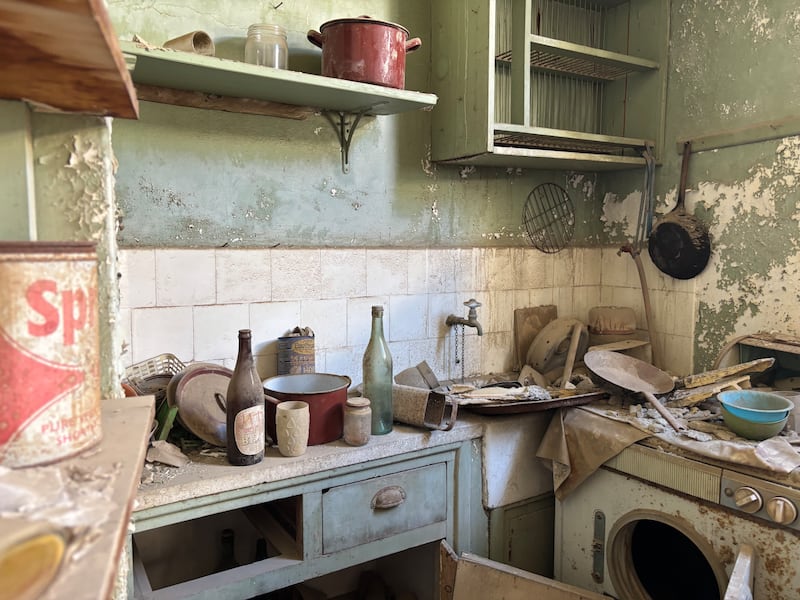
An apartment kitchen in Nicosia, Cyprus, which was abandoned during the 1974 conflict and is now frozen in time in a demilitarised buffer zone controlled by UN peacekeepers. Photograph: Jack Power
That has created the conditions for a possible settlement and shifted responsibility for solving the “Cyprus problem” on to the politicians.
The election of Tufan Erhürman as the new Turkish Cypriot leader last October has raised hopes. Erhürman was elected on a mandate of resuming talks after years of silence.
Everybody is watching the response of Nikos Christodoulides, president of the Republic of Cyprus, as well as Turkish president Recep Tayyip Erdogan.
It’s worth keeping the experience of Cyprus in mind when you hear someone say Ukraine will need to hand over its territory it holds in the east to Russia in any peace deal. There’s no guarantee that would be temporary.
It is understood in private discussions with European leaders, Ukrainian president Volodymyr Zelenskiy has stressed accepting such terms would not just be giving up land, but Ukrainian people, who would be left indefinitely under Russian occupation.
Ultimately, pressure from US president Donald Trump may force Kyiv into territorial concessions as the price of a truce.
Fast-tracking Ukraine’s entry into the European Union to give Zelenskiy something to sell to his people after four years of fighting will be of little comfort to Ukrainians in the Donbas region occupied by Russia. Then there’s the danger Vladimir Putin simply regroups and launches another attack to take the rest of Ukraine.
Back in Cyprus, what do the taxi drivers of Nicosia, the divided capital city, think about the 60-year stalemate?
Lampros, a father of six children, explains he was one year old during the Turkish invasion. His father was killed in the fighting. We talked during the hour-long drive from Nicosia to the port city of Limassol in the south.
“The people are never the problem,” he says, adding that both communities lived alongside each other for years before the conflict.
Today, many of them want a resolution to make life easier, but that sentiment was not always shared by political leaders. “Politics is the problem,” he says.