 (Getty Image)
The Seoul Counseling Center for Migrant Women will be moved to its new location in Jongno-gu, central Seoul, on Jan. 26, in a bid to boost accessibility and links with emergency protection services.
It will be moved from its current location in Jung-gu to the Seoul Global Center, which is near the major tourist sites around Gwanghwamun Station on Subway Line No. 5 and Jonggak Station on Subway Line No. 1, the Seoul Metropolitan Government announced Thursday.
Park Eun-sook, director of Seoul’s multicultural affairs division, said the relocation will make the center “even more accessible and convenient,” allowing women facing complex or urgent problems to receive help without delay.
Seoul’s dedicated counseling center for immigrant women is one of the few places offering immediate and comprehensive help for victims of various crimes, including international students and tourists. Established in 2013 as the first municipal center to support migrant women, it combines a counseling office and an emergency shelter to provide one-stop services.
Data has indicated that a growing number of migrant women in South Korea are becoming victims of crime. An October report from the Ministry of Gender Equality and Family showed that 35,339 immigrant women received counseling across the country in 2024, more than triple the 2020 figure (9,613).
Some 35.8 percent of the counseling sessions were related to domestic violence, and many were also subject to sexual harassment and workplace exploitation.
Complaints issued by victims included difficulties navigating police systems or legal processes due to language barriers or fears related to their visa status. Human-rights advocates say these gaps leave women vulnerable to repeated violence, with many having nowhere to turn in moments of urgent need.
Services provided by Seoul’s counselling center range from legal assistance — such as specialized counseling on taxation, real estate and visa matters — to education support and case reporting, emergency accommodation, psychological counseling, and multilingual interpretation. Its services are open to marriage migrants, international students, migrant workers, and even short-term visitors.
Last year alone, the center handled 4,866 cases related to domestic violence and divorce, 1,640 cases of sexual violence, 1,105 cases of general assault, 978 divorce disputes, 633 cases of prostitution-related exploitation, 299 labor issues, 220 residency problems and eight cases involving marital conflict.
In response, the center provided 4,801 instances of legal assistance, 807 psychological counseling sessions, 971 emergency protections and 223 medical supports. Women with nowhere to go or facing imminent danger were sheltered for up to three months at an affiliated shelter.
The center currently offers counseling in six languages — Vietnamese, Filipino, Chinese, Mongolian, Korean and English — and operates a 171-member multilingual interpretation team to support women who speak other, less common languages.
Over the years, it has become a vital point of contact for victims of domestic and sexual violence who would otherwise remain unprotected. Since its launch, the center has provided an average of more than 12,000 consultations annually, with domestic violence and related legal issues accounting for the largest share. More recently, counselors say they have seen a surge in cases involving tourists facing emergencies during their stay in Korea.
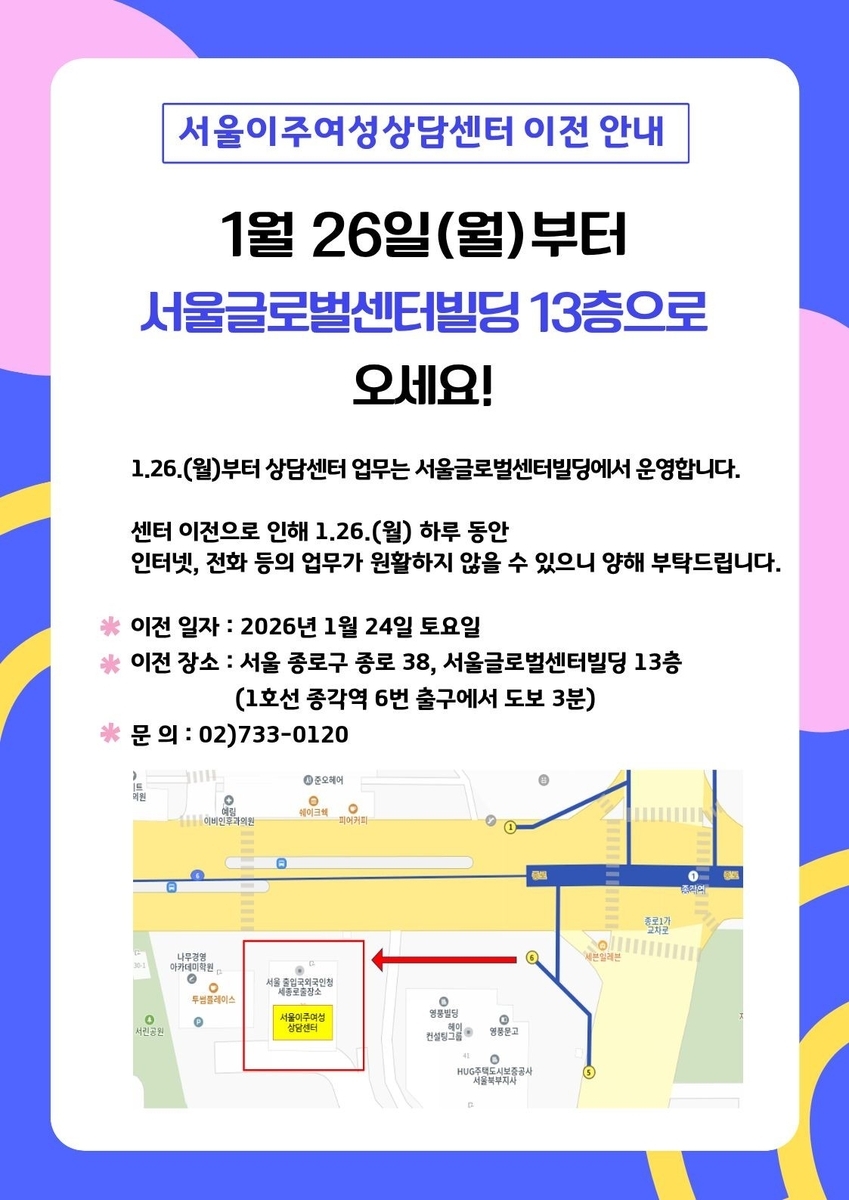 A guide map on an informational pamphlet shows how to get to the new Seoul Counseling Center for Migrant Women location in Seoul Global Center, marked in red. (Seoul Metropolitan Government)
jychoi@heraldcorp.com