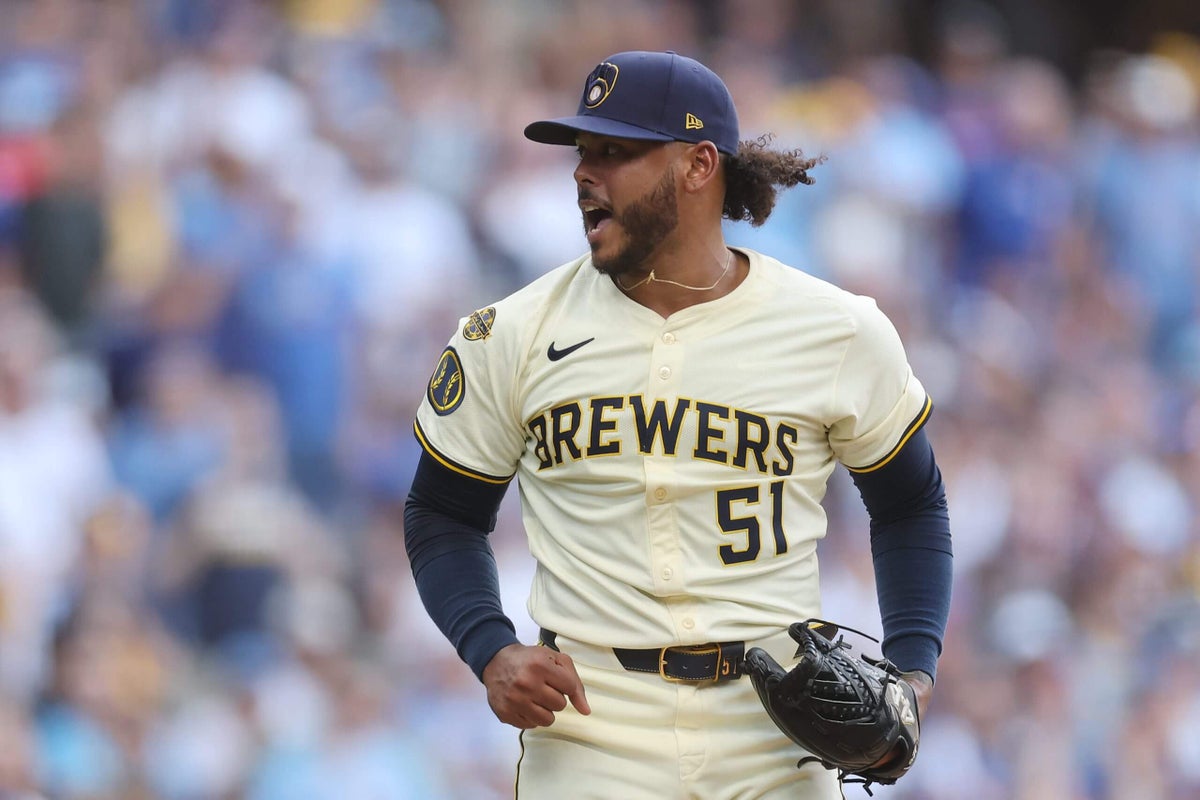
In an offseason defined by significant change, the New York Mets are completing their roster overhaul with a flourish by acquiring top starter Freddy Peralta Wednesday night in a trade with the Milwaukee Brewers, the club announced.
In exchange for the 29-year-old, who is a free agent after the season, and reliever Tobias Myers, the Brewers are receiving pitcher Brandon Sproat and infielder Jett Williams, both top prospects.
We have acquired RHP Freddy Peralta and RHP Tobias Myers from Milwaukee in exchange for RHP Brandon Sproat and minor league INF Jett Williams.
Welcome to New York, Freddy and Tobias! pic.twitter.com/2svOj1XtbY
— New York Mets (@Mets) January 22, 2026
Throughout the offseason, the Mets targeted a starter worthy of plugging into the top half of their rotation. Peralta deserves to reside at the top. The rest of the Mets’ rotation is set to feature Nolan McLean, Clay Holmes, Sean Manaea, David Peterson and Kodai Senga, with Jonah Tong and Christian Scott lingering as depth.
The Mets were willing to meet Milwaukee’s asking price
Executives from different teams did not view the free-agent starting pitcher class as deep in quality, and Peralta represented the best trade candidate available (the Detroit Tigers are unlikely to deal ace Tarik Skubal). The price to acquire him was always going to be high.
Even for just a rental, the Mets should be able to absorb the loss from their farm system, which ranks among the best. For teams interested in Peralta, the Brewers’ asking price was always multiple top-100 prospects and preferably someone who could help backfill major-league innings. The Mets were better positioned to acquire Peralta than other clubs. Their pitching development program boasts several intriguing pitchers at the upper levels of the minor leagues.
The trade reunites Peralta with president of baseball operations David Stearns and assistant general manager Eduardo Brizuela, formerly two leaders in the Brewers’ front office. In 2015, during Stearns’ first year as the Brewers’ general manager, he flipped veteran Adam Lind for Peralta, who was then a little-known prospect with the Seattle Mariners.
Over time, Peralta flourished with the Brewers, evolving from a one-pitch pitcher known as “Fastball Freddy” to someone who leans on a full arsenal for quality outings.
Mets’ whirlwind offseason continues
The addition of Peralta caps off a wild week of transactions for New York. Earlier on Wednesday, the Mets held a news conference for the signing of infielder Bo Bichette. Hours before that, on Tuesday night, they completed a deal for center fielder Luis Robert Jr.
Earlier this offseason — and after moving on from franchise mainstays Pete Alonso, Brandon Nimmo, Edwin Diaz and Jeff McNeil — the Mets added relievers Devin Williams and Luke Weaver, plus infielder Jorge Polanco and Marcus Semien. The offseason, however, would’ve felt incomplete if the Mets failed to land someone such as Peralta, given how much their rotation struggled last season. With Peralta atop the rotation, there is less of a concern for quality innings. They got the kind of pitcher they needed.
Peralta in final year of team-friendly extension
Peralta should have been a free agent by now, but in March 2020 — when it was still unclear whether he would be a starter or a reliever — he agreed to a five-year, $15.5 million extension. The deal came with a pair of $8 million team options, which the Brewers have gladly exercised as Peralta has become a top-of-the-rotation bargain.
When Peralta signed the extension, The Athletic wrote that his agency, Rep1 Baseball, “wasn’t too pleased with him sacrificing arbitration years for security.”
Peralta is due to make $8 million again this year before becoming a free agent at the end of the season, when he’ll be 30 years old and in line for a much larger payday. In the meantime, he’s a dependable two-time All-Star being paid like the uncertain wild card he used to be.
Brewers have done this before
When veteran Brandon Woodruff accepted the Brewers’ qualifying offer in November, questions naturally turned to the trickle-down effect and whether Woodruff’s $22.025 million contract made it inevitable that the small-market Brewers would have to trade Peralta. Team officials insisted the two were unrelated.
“Independent decisions,” president of baseball operations Matt Arnold told The Athletic, “and excited about our rotation.”
However, finances have always mattered to the Brewers. According to Cot’s Contracts, the Brewers have not had a top-15 payroll in the past decade. In February 2024, they traded ace Corbin Burnes — who was on the verge of a $15.6 million salary — to the Baltimore Orioles for young starter DL Hall and infielder Joey Ortiz.
Burnes was a homegrown Cy Young Award winner who, like Peralta, was a year away from free agency. The Brewers traded his final year of control for two big league-ready players: Ortiz has been a glove-first, everyday infielder the past two seasons, while Hall has a 4.30 ERA in 33 appearances in between injuries.
Peralta defied the odds to become an All-Star
Never an elite prospect, and given a modest signing bonus as a teenager, Peralta rarely looked the part of a big-league ace. He has neither a big frame nor a massive fastball, but Peralta uses a four-pitch mix to avoid hard contact and generate swings and misses.
Since 2021, he ranks 15th in the majors with a 3.30 ERA (among those with at least 500 innings), and only Dylan Cease and Blake Snell have a higher K/9 rate. Peralta is coming off the best season of his career in which he had a 2.70 ERA across 33 starts, making his second All-Star team and finishing fifth in NL Cy Young Award voting. His velocity has improved throughout his big-league career, and he averaged a career-best 94.8 mph with his four-seamer in 2025.
Peralta has spent his entire big-league career with the Brewers and has been a rotation fixture since 2021, but he was originally signed by the Mariners in 2013. The Brewers acquired him almost exactly a decade ago, in the trade for Lind in December 2015.
State of the Brewers rotation
The Brewers had the best record in baseball last season, and they’ve advanced to the postseason in seven of the past eight years. They’ve been among the most consistent teams in baseball, but as with every small-market franchise, questions constantly swirl about how — and whether — the Brewers can maintain such success.
For the second time in three years, they’ve chosen to add by subtraction. Previously this winter, they traded outfielder Isaac Collins and reliever Nick Mears to the Kansas City Royals for bullpen lefty Angel Zerpa.
In trading Peralta, the Brewers are putting faith in a young rotation to sustain them. Woodruff now looks like the de facto ace, while first-round pick Jacob Misiorowski emerged last season as another potential difference maker. Minor trade additions Quinn Priester and Chad Patrick also pitched well last season as mid-rotation starters, and Robert Gasser — another minor trade pickup — has pitched well in limited opportunities. The Brewers also have Hall, Logan Henderson and Aaron Ashby as in-house rotation options.
This story will be updated.