faq
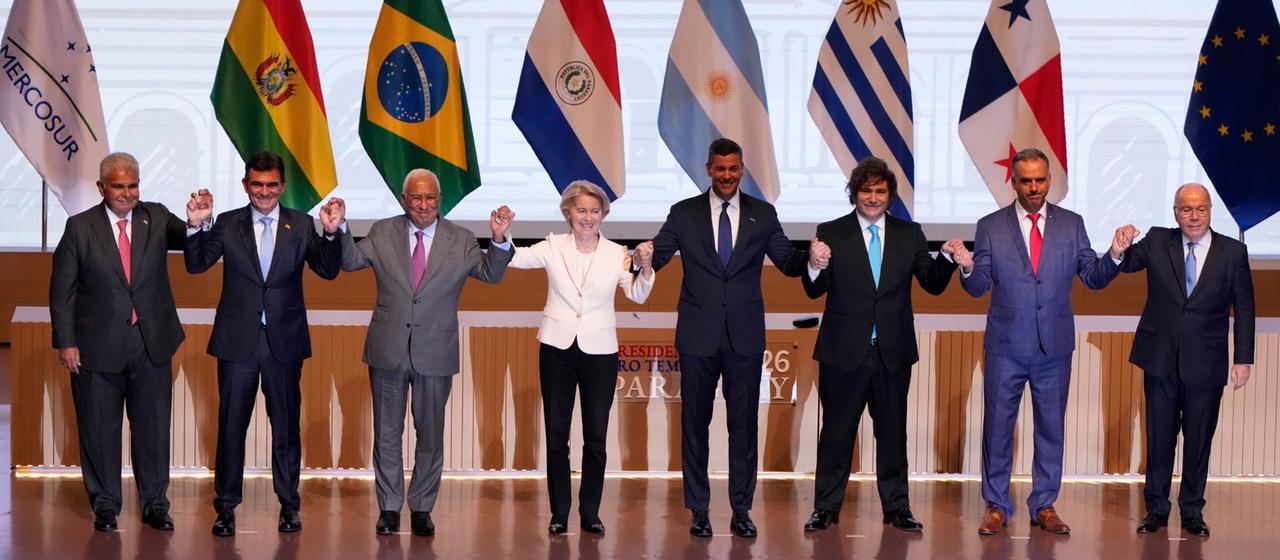
The EU hopes to have opened up a new market through the free trade agreement signed today with the South American Mercosur. It’s about growth – and not least about standing up to China.
What is that Mercosur agreement?
This is a free trade agreement between the European Union and the South American economic organization Mercosur. Six states are members of Mercosur, four of which are part of the agreement with the EU: Argentina, Brazil, Paraguay and Uruguay.
MERCOSUR
The Common South American Market (Mercado Común del Sur, MERCOSUR) is a regional association of the South American states of Argentina, Brazil, Paraguay, Uruguay, Venezuela and Bolivia.
Venezuela’s membership has been suspended since 2017. Bolivia is initially not part of the MERCOSUR agreement with the EU.
MERCOSUR was founded in 1991 and aims to promote regional integration through political, social and economic cooperation.
Source: Federal Ministry for Economic Cooperation and Development, dpa
The agreement has been in the works for over 25 years, but has repeatedly stalled. Until recently there was also a lot of criticism, for example from farmers and environmentalists. Last Friday, the EU Council approved the agreement. After the signing in Paraguay, the EU Parliament still has to approve.
The agreement will facilitate trade relations between the EU and the participating Mercosur states by reducing tariffs on a large proportion of exports. The auto industry in this country, whose exports have so far been subject to tariffs of 35 percent, is particularly likely to benefit from this. Mechanical engineering and the pharmaceutical industry are also considered winners of the free trade zone.
How many people are affected?
Around 700 million people. This makes the agreement the largest free trade area in the world – it will cover a quarter of global economic output. 270 million live in the Mercosur region, making it the sixth largest economic region in the world.
What consequences does this have for consumers?
Consumers could benefit from lower prices if the eliminated tariffs on imported products are passed on to them – for example meat, fruit, soy, coffee and sugar.
However, it is not yet possible to estimate how large this effect could be. This is also because, in order to protect European agriculture, the markets for certain agricultural products are not fully opened: the customs relief only applies to a certain delivery quantity.
Why are there so big? restrictions in food?
European farmers are worried that the agreement will bring cheaper food onto the market with prices that they cannot compete with. That’s why there were repeated protests until recently. The EU then found a compromise in December.
The agreement is therefore particularly strict when it comes to food. Limited import quotas apply to beef, for example; an additional 99,000 tonnes per year can be imported duty-free in the future, and 30,000 tonnes to cheese. These quotas also apply to other products, such as poultry, pork, sugar and ethanol.
Furthermore, imports must meet European food standards. The agreement also includes protection for over 340 geographical indications of origin such as Parmesan, champagne and Munich beer.
In return, the Mercosur bloc is removing tariffs on agricultural products from the EU such as wine, which was previously burdened with 27 percent, or spirits. Here the figure was 35 percent.
What are they like? Trade relations between the Mercosur countries and EU currently?
For the Mercosur region, the EU is the second largest trading partner in goods trade, directly after China. In return, Mercosur is the EU’s tenth largest trading partner. Over 80 percent of trade took place between the EU and Brazil; according to the European Commission, around 750,000 jobs depend on trade with Mercosur.
The trade balance is quite balanced: in 2024, the EU’s exports amounted to around 56 billion euros, while it imported goods worth around 57 billion euros. The EU’s most important export goods are machinery and equipment, vehicles, chemical and pharmaceutical products. Above all, agricultural products and raw materials are imported.
Germany, on the other hand, has a larger export surplus compared to Mercosur, with the value of exported goods exceeding that of imports by eleven billion euros in 2023. Trade with Mercosur accounts for around one percent of German exports, says Commerzbank’s chief economist, Jörg Krämer ARD financial editorial team.
How will this affect trade?
The EU Commission estimates that the agreement could increase EU exports to South America by up to 39 percent – that would correspond to an increase of 49 billion euros in European economic output. This could support more than 440,000 jobs in Europe, the Commission continued.
In addition, according to her, the savings in customs duties alone should save European retailers a total of four billion euros annually. There would also be advantages for service providers, as they would now be able to apply for contracts in the Mercosur area on an equal basis.
The foodstuffs on which the agreement imposes restrictions will probably be little affected. This was the conclusion reached by an analysis by the federally owned Thünen Agricultural Research Institute. A decline in European production is expected, especially for beef and poultry, but at 1.5 percent this is not particularly high. At the same time, the institute sees a new market for dairy products and processed foods in the Mercosur region.
Why has the EU pushed ahead with the agreement now?
In times when world trade is in such turmoil and is sometimes used as a means of political pressure – such as by US President Donald Trump with his tariffs or by China with dumping prices in exports – it is important for the EU to broaden its economic position and develop new trading partners.
It has now achieved this with the Mercosur agreement. The region is small and cannot replace these established markets, says Commerzbank chief economist Krämer in an interview with ARD financial editorial team. “But you also have to see that Mercosur is growing well.”
In addition, there is the signaling effect of such an agreement, says Krämer. It was extremely important for the EU to be seen as a reliable negotiating partner. A failure of the agreement would have done enormous damage to this reputation – and made future agreements, for example with India, more difficult.
Ultimately, the EU also hopes that the agreement will be able to keep the power of other players such as China in check – and thus also set an example for free world trade. For some countries in the region, especially the largest economic power Brazil, China is already the most important trading partner.