The FTSE 100 (^FTSE) and European stocks advanced on Thursday as traders breathed a sigh of relief after Donald Trump U-turned on his latest tariff threats.

The US president wrote on his Truth Social platform overnight that he would not impose the threatened levies of 10% extra, starting 1 February on eight European countries, including Britain. He cited agreement on “the framework of a future deal with respect to Greenland”.

On Wednesday, he had already calmed markets somewhat when he confirmed he would not launch an attack to secure the territory by force.

Meanwhile, NATO secretary Mark Rutte said he had a “very good discussion” with Donald Trump about how to keep the Arctic region safe from Russia and China.

Rutte said the question is how Arctic countries, such as Canada, Iceland, Denmark, Sweden, Finland and Norway, can collectively work with the US so that the Arctic remains safe, to keep the Russians and Chinese out.

Michael Brown, analyst at Pepperstone, said: “While further talks will take place on the specifics of that deal, those particulars matter little to financial markets.

“The crux of the matter is that, undeniably, geopolitical risk has been taken down several notches on the back of this news.”

Elsewhere, the UK borrowed less than expected in December, offering some respite for chancellor Rachel Reeves after a year marked by tax rises.

Public sector net borrowing totalled ÂŁ11.6bn, below the ÂŁ13bn forecast by economists polled by Reuters and 38% lower than in the same month a year earlier, according to figures published by the Office for National Statistics (ONS).

London’s benchmark index (^FTSE) was 0.7% higher in early trade

Germany’s DAX (^GDAXI) surged 1.2% and the CAC (^FCHI) in Paris headed 1.3% into the green.

The pan-European STOXX 600 (^STOXX) was up 1.1%.

Wall Street is set for a positive start as S&P 500 futures (ES=F), Dow futures (YM=F) and Nasdaq futures (NQ=F) were all in the green.

The pound was flat against the US dollar (GBPUSD=X) at 1.3424.

FTSE Index – Delayed Quote • USD

10,181.13 +43.04 (+0.42%)

As of 12:36:09 GMT. Market open.

Follow along for live updates throughout the day:

LIVE 13 updates

Board of Peace signing ceremony at Davos

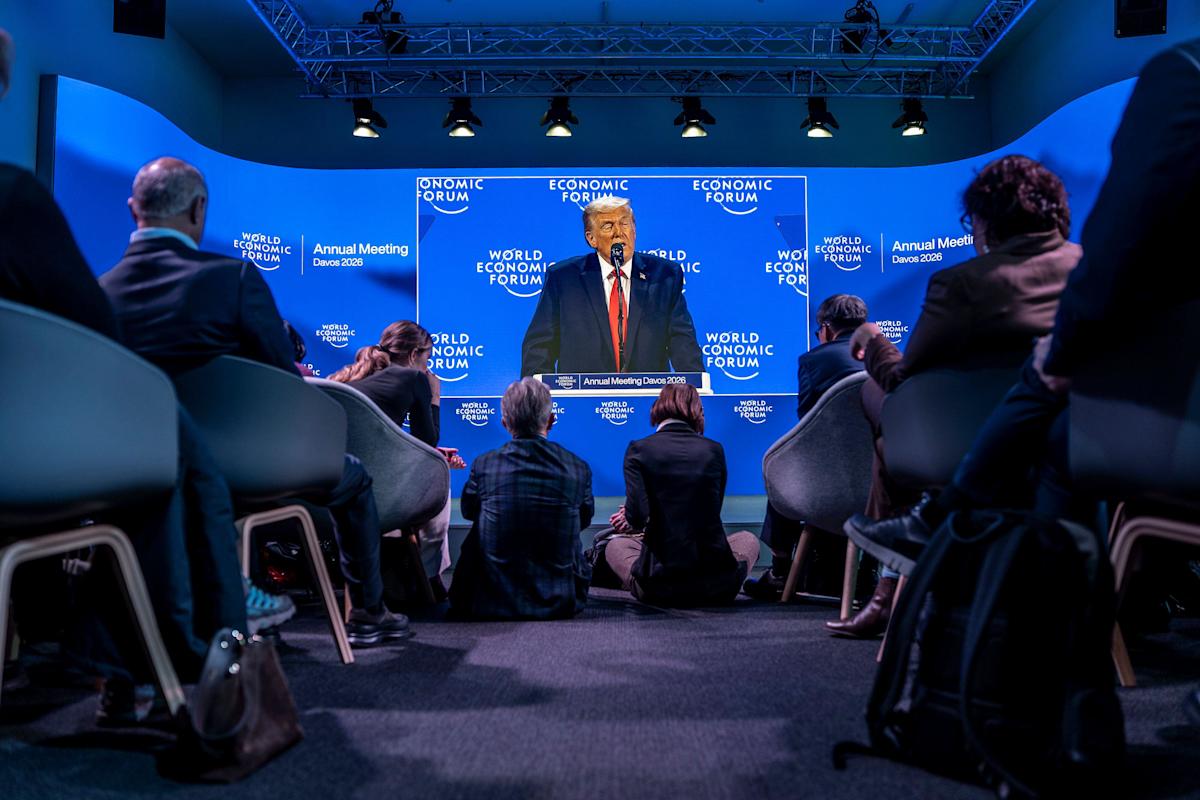
Donald Trump took to the stage again at Davos today, as the Board of Peace signing got underway, with the US president as the chairman.

Trump said the board of peace will work with “many others, including the United Nations”.

A WEF official declared:

Below is a list of countries who have accepted invitation to join the board:

Argentina, Armenia, Azerbaijan, Bahrain, Belarus, Egypt, Hungary, Indonesia, Jordan, Kazakhstan, Kosovo, Morocco, Pakistan, Qatar, Saudi Arabia, Turkey, United Arab Emirates, Uzbekistan and Vietnam.

Those who won’t join for now included the UK, France, Norway, Slovenia, and Sweden.

Others have also been invited but have not yet committed either way, including Cambodia, China, Croatia, Germany, India, Italy, the EU’s executive arm, Paraguay, Russia, Singapore, Thailand and Ukraine.

Moderna continues to rise after skin cancer treatment study

Shares in US pharmaceutical and biotechnology firm Moderna (MRNA) jumped 15.8% in Wednesday’s session and were up another 4.6% in pre-market trading on Thursday.

The rise in shares came after Moderna and fellow pharma company Merck (MRK) announced positive results from its skin cancer treatment study. Merck shares rose 1.5% on Wednesday following the released of the findings.

The companies said on Wednesday that five-year data showed that a combination of Moderna’s intismeran autogene vaccine and Merck’s Keytruda drug, used on patients with high-risk melanoma, reduced the risk of recurrence or death by 49%.

“For many patients with stage III/IV melanoma, there is a significant risk of recurrence following surgery,” said Dr. Marjorie Green, senior vice president and head of oncology, global clinical development at Merck Research Laboratories.

“As such, demonstrating the longer-term potential of intismeran autogene and KEYTRUDA to reduce the risk of recurrence for certain patients with melanoma is a meaningful milestone.”

B&M alerts over profits again

Discount chain B&M has warned over profits once again after seeing sales come under pressure and slashing prices as it continues with overhaul efforts.

The group said UK like-for-like sales fell 0.6% over the all-important quarter to December 27, although it saw an “encouraging” 3% rise in December and said growth had continued into January.

The group cut its full-year underlying earnings outlook for the third time since last October, to between ÂŁ440mto ÂŁ475m, down from the previous guidance of ÂŁ470m to ÂŁ520m.

This would mark a hefty drop on the ÂŁ620m underlying earnings reported for the year to March 29 2025.

Shares in B&M fell as much as 5% at one stage in morning trading on Thursday, before settling more than 1% down.

B&M said: “The downward movement in range is driven by ongoing investments in pricing and clearance, improvements in stock quality and the financial underperformance of Heron Foods, where we continue to review and reposition our customer offer.”

Sales in Heron Foods fell 0.1% over the latest quarter.

B&M said it ramped up efforts to reduce unwanted stock through hefty discounts and was “confident the actions we are taking can restore sustainable like-for-like growth at B&M UK over the next 12 to 18 months”.

Half of UK homes rose in value last year by an average of ÂŁ9,900

Half of all the UK’s 30 million homes increased in value last year, with an average gain of ÂŁ9,900, according to data from Zoopla.

The property website said its analysis, published Thursday, showed that 15.2 million homes registered an increase in value of 1% or more. It found that 3.1 million homeowners saw the value of their property increase by ÂŁ20,000 or more.

In contrast, the analysis showed that 9.1 million homes lost at least 1% of their value over the course of last year, by an average of ÂŁ10,800. The remaining 5.6 million homes maintained their value to within plus or minus 1%.

Across all of the UK’s 30 million homes, the average overall price change was found to be a ÂŁ2,300 increase.

Zoopla said the data showed a “clear-cut regional hierarchy”, as more than 70% of homeowners in northern regions of England, Scotland and Northern Ireland recorded value gains.

Northern Ireland had the highest share of homes increasing in value in 2025, with 94% of properties seeing price gains by an average of ÂŁ14,200.

Scotland was the region with the second-biggest proportion of homes rising in value, with 73% of properties recording increases by an average of ÂŁ10,400.

A similar proportion (72%) of homes in the North West gained in value last year, by an average ÂŁ9,700.

London came lower down in the table, with Zoopla’s analysis showing that 35% of homes increased in value last year, though it saw the biggest average gain of ÂŁ17,400.

Read more here

FTSE risers and fallers

Here are the top FTSE risers and fallers this morning:

We’re much better place after Greenland deal, says Cooper

Foreign Secretary Yvette Cooper has said she hoped “we are now in a much better place” to focus on collective Arctic security after Trump said he had formed “the framework of a future deal” regarding Greenland with Nato Secretary-General Mark Rutte.

She told Sky News on Thursday:

Gold price to hit $5,400 this year, says Goldman Sachs

Gold prices stabilised on Thursday after falling by more than 1% earlier in the session after US president Donald Trump stepped back from threats of EU tariffs and Goldman Sachs raised its end of 2026 price forecast to $5,400 per ounce.

Gold futures (GC=F) were little changed at $4,835.10 a troy ounce, while spot prices slipped 0.7% to $4,829.94 at the time of writing. Prices had touched a record high of $4,887.82 in the previous session.

“The market was reacting after Trump’s remarks, but the concerns are still lingering, and that’s protecting the downside for both gold and silver (SI=F), along with concerns surrounding the independence of the Fed,” said Soni Kumari, commodity strategist at ANZ.

Meanwhile, Goldman Sachs raised its end of 2026 gold price forecast to $5,400 per ounce, from $4,900 previously, citing continued diversification into gold by private investors and emerging market central banks.

The bank said in a note:

Lale Akoner, global market analyst at eToro, said the latest surge in prices reflected a broader erosion of confidence in traditional financial anchors.

She added that central banks were continuing to add to gold reserves, including increased buying from Poland and Bolivia, while investors were increasingly viewing the metal as portfolio insurance rather than a short term hedge. In a more volatile and fragmented global economy, she said, gold was reasserting itself as a strategic long term asset.

Trump U-turns on Greenland tariff threat

Traders have breathed a sigh of relief this morning after Donald Trump U-turned on his latest tariff threats last night.

The US president wrote on his Truth Social platform that he will not be imposing the threatened levies of 10% extra starting 1 February on eight European countries, including Britain. He cited agreement on “the framework of a future deal with respect to Greenland”.

On Wednesday, he had already calmed markets somewhat when he confirmed he would not launch an attack to secure the territory by force.

Meanwhile, NATO secretary Mark Rutte said he had a “very good discussion” with Donald Trump about how to keep the Arctic region safe from Russia and China.

Rutte said the question is how Arctic countries, such as Canada, Iceland, Denmark, Sweden, Finland and Norway, can collectively work with the US so that the Arctic remains safe, to keep the Russians and Chinese out.

Michael Brown, analyst at Pepperstone, said: “While further talks will take place on the specifics of that deal, those particulars matter little to financial markets.

“The crux of the matter is that, undeniably, geopolitical risk has been taken down several notches on the back of this news.”

Today’s Davos agenda

Today is Day 2 of the World Economic Forum in Davos, Switzerland, and here’s the agenda:

6.30am: Ukrainian breakfast discussion, with Nato secretary-general Mark Rutte, Edgars Rinkevics, President of Latvia; Alexander Stubb, president of Finland; Dick Schoof, PM of the Netherlands, Andrej Plenković, PM of Croatia, and Larry Fink of Blackrock

7.30am: Conversation with Gavin Newsom, Governor of California

8am: Conversation with Isaac Herzog, president of Israel

8.30am: Special Address by Friedrich Merz, chancellor of Germany

9.30am: Conversation with Kyriakos Mitsotakis, prime minister of Greece

12.30pm: Session on Venezuela: What Next?

1pm: Special Address by Prabowo Subianto, president of Indonesia

UK government borrowing drops to ÂŁ11.6bn in December

The UK borrowed less than expected in December, offering some respite for chancellor Rachel Reeves after a year marked by tax rises.

Public sector net borrowing totalled ÂŁ11.6bn, below the ÂŁ13bn forecast by economists polled by Reuters and 38% lower than in the same month a year earlier, according to figures published by the Office for National Statistics (ONS).

The data come after Reeves raised taxes again in her autumn budget, partly to rebuild headroom against her fiscal rules. For the first nine months of the fiscal year that began in April, borrowing reached ÂŁ140.4bn, some ÂŁ300m lower than in the same period a year earlier.

“Borrowing in December was substantially down on the same month in 2024, as a result of receipts being up strongly on last year whereas spending is only modestly higher,” said Tom Davies, senior statistician at the ONS.

“However, across the first nine months of the financial year as a whole, borrowing was fractionally lower than in the same period in 2024,” he added.

A rise in tax revenues, driven largely by higher income tax and national insurance receipts, helped to narrow the deficit last month. The ONS said government tax revenues increased by ÂŁ7.7bn from a year earlier to ÂŁ94bn in December, while public spending rose by ÂŁ3.2bn to ÂŁ92.9bn over the same period.

Read the full article here

Australian unemployment hits seven-month low

The unemployment rate in Australia decreased to a seven-month low of 4.1% from 4.3% in November, better than market expectations of 4.4%.

Net employment surged by 65,200 during the month compared to November, which saw a revised drop of 28,700. This figure significantly exceeded market forecasts of a 27,000 increase, while full-time employment rebounded by 54,800, in contrast to a decline of 56,500 in the preceding month.

Against this background, the Australian dollar rose 0.6% overnight, trading at 0.6804 against the US dollar, marking its highest level in 15 months. Meanwhile three-year government bond yields (+7.6bps) reached a more than two-year high of 4.25%.

Markets are anticipating a 61% probability of a rate hike from the RBA on 3 February, an increase from 26% prior to the data release.

Asia and US overnight

Stocks in Asia were higher overnight, with the Nikkei (^N225) rising 1.7% on the day in Japan, as gains were driven by bank stocks, while the Hang Seng (^HSI) was 0.2% up in Hong Kong. The Shanghai Composite (000001.SS) climbed 0.1% by the end of the session.

In South Korea, the Kospi (^KS11) added 0.9% on the day, supported by chipmakers and autos. It crossed the 5,000 mark for the first time intraday, after hitting records earlier this month, but finished just below this level.

It came as exports in Japan increased for the fourth month in a row, rising 5.1% year-on-year in December. This marked a decrease from the 6.1% increase in November, and fell short of the median prediction of a 6.1% gain.

Meanwhile, imports grew 5.3%, surpassing the anticipated rise of 3.6%. This indicates stronger domestic demand and elevated input costs. Consequently, Japan reported a trade surplus of 105.7bn yen, which is considerably less than the expected surplus of approximately 360.0bn yen.

Across the pond on Wall Street, the S&P 500 (^GSPC) rose 1.2%, and the tech-heavy Nasdaq (^IXIC) was also 1.2% higher after the Donald Trump ruled out using military force to take control of Greenland. The Dow Jones (^DJI) also gained 1.2% during the session.

Coming up

Good morning, and welcome back to our markets live blog. As usual we will be taking a deep dive into what’s moving markets and happening across the global economy.

Looking at the day ahead, US data releases include the weekly initial jobless claims, the updated estimate of Q3 GDP and PCE inflation for November.

In the Euro Area, we’ll also get the European Commission’s preliminary consumer confidence indicator for January.

From central banks, we’ll get the ECB’s account of their December meeting. Finally, today’s US earnings include Intel, General Electric, and Procter & Gamble.

Here’s a snapshot of what’s on the agenda:

7am: Trading updates: Associated British Foods, B&M, Wickes, AJ Bell, Mortgage Advice Bureau, Harbour Energy, Wizz Air and The Works

7am: Public Sector Net Borrowing

1.30pm: US continuing claim, initial jobless claims

3.30pm: US Crude Oil inventories

Download the Yahoo Finance app, available for Apple and Android.