In May 2025, Tech Funding News called it: Cast AI, the startup slashing cloud bills by up to 80%, would become Lithuania’s next unicorn. Last week, the company crossed the $1B mark.
We spoke with Laurent Gil, co-founder and president, about what makes Vilnius tick, why the engineering culture here punches above its weight, and how Cast AI plans to become the default layer for enterprise GPU access worldwide.
Here’s what he told us!
The unicorn feeling might be just a validation
For Laurent, hitting that unicorn status was more about validating the technology than winning the race itself. He tells us, “The unicorn milestone validates what we’ve built, but the real work is always ahead of us.”
Today, most enterprises are still tied to a single cloud provider and a fixed region for their AI workloads. That rigidity clashes with surging demand for GPU capacity and growing concerns around resilience, performance and cost.
“Right now, companies are locked into single cloud providers and defined regions for their AI workloads. That needs to change,” Gil explains.
OMNI Compute is Cast AI’s answer: a layer that sits above the hyperscalers and other providers, allowing enterprises to tap into GPU capacity anywhere, across any cloud, without refactoring code or adding operational overhead.
Over the next 12–18 months, the company’s main goal is to make its OMNI Compute product the standard interface for how enterprises access and operate GPU infrastructure worldwide.
“My personal focus, together with my co-founders, is on the strategic partnerships that make this possible. The relationship with Oracle and the investment from Shinsegae Group are just the beginning. We’re building a network that lets enterprises tap into GPU capacity anywhere, across any cloud… That’s the category we’re defining,” Gil elaborates.
When Samsung and BMW trusted production workloads
The true product‑market fit moment came only when enterprises stopped using Cast AI purely as a cost-saving tool and began trusting it with their most critical workloads.
“Everyone assumes we’re a cost optimisation company because we cut cloud bills by up to 80%. But the real product-market fit happened when enterprises started trusting us to run their production workloads because we made them more reliable,” Gil says.
That shift underpins how Cast AI now positions itself: an SLO‑first platform. Rather than optimising for spend as the primary metric, the company targets service-level objectives and treats cost savings as a by-product of efficient infrastructure.
“When companies like Samsung or BMW deployed Cast AI on their production Kubernetes clusters, they weren’t just looking to save money. They needed their applications to perform better and stay up and running. That’s when I knew we had true product-market fit,” Gil explains.
Lithuania’s secret sauce is culture
On paper, Cast AI’s Lithuanian roots might look like a classic cost move: a capital‑efficient engineering base in a smaller European market. Gil pushes back strongly on that narrative. And we totally agree.
“Lithuania’s tech ecosystem has given Cast AI something far more valuable than cost efficiency. It has shaped our culture of ownership, engineering maturity, and international mindset from day one,” he argues.
According to Gil, the company’s early and ongoing choices reflect a distinctly Lithuanian engineering culture built on pragmatism, accountability and real problem‑solving, rather than vanity metrics or short‑term wins.
The Vilnius team was the core of the company’s DNA. “Our early and ongoing choices reflect a local engineering culture from Lithuania built on pragmatism, accountability, and real problem-solving. That culture comes from a strong talent pipeline shaped by global-scale challenges and an appetite for innovation that’s visible across the Lithuanian tech ecosystem,” he says.
What about diversity?
Cast AI has grown into a distributed organisation of more than 300 employees across 34 countries. Yet Vilnius remains one of the company’s most important centres. “Today, Cast AI operates across 34 countries spanning Europe, North America, Latin America, Africa, and APAC, bringing a wide range of perspectives into how we build and lead,” Gil says.
Women represent roughly one‑third of the global workforce, with representation across technical, operational and leadership roles. For Gil, diversity is less about formal targets and more about ensuring that different perspectives influence real decisions.
He notes, “For us, diversity is about building an environment where ideas are evaluated on merit, not hierarchy, and where different perspectives genuinely shape decisions, products, and outcomes.”
Building to last, not to exit
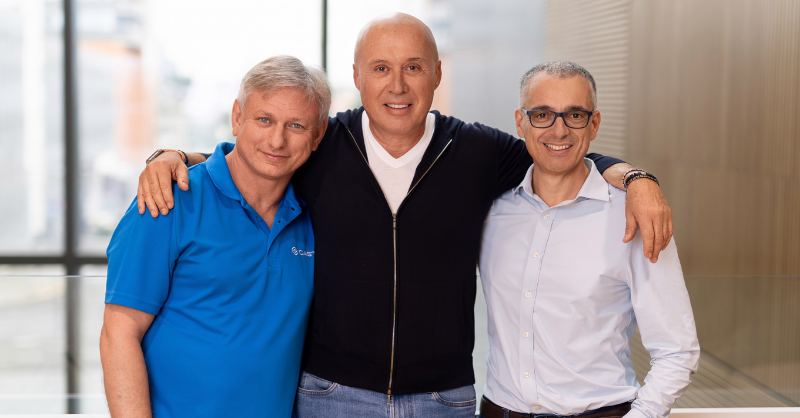
Cast AI is the third company Gil has built with co‑founders Frayman and Kuperman, after Viewdle and Zenedge. Those earlier journeys ended in successful exits (Viewdle to Google and Zenedge to Oracle), but they also shaped how the trio now think about company‑building.
“With Viewdle and Zenedge, there was always this underlying pressure to validate the company, to get to a successful business, to prove it worked. You’re building for that moment. This time, we’re not building for an exit. We’re building a platform and a great business,” Gil reflects.
Again, he returns to the idea of being SLO‑first, not exit‑first. Optimising for reliability and performance allows the team to make decisions that are not dictated by short‑term revenue or the next board meeting.
“At Cast AI, we’re SLO-first. We optimise for reliability and performance, and cost efficiency is the by-product. When you’re building for the long term, you can make decisions based on what’s right for the platform and the customers, not what looks good in the next board deck,” he says.
As Lithuania adds another unicorn to its count, Cast AI shows what the next generation of Baltic startups might look like: global from day one, infrastructure‑deep, and unafraid to let a small ecosystem punch well above its weight in shaping how the world’s AI workloads actually run.