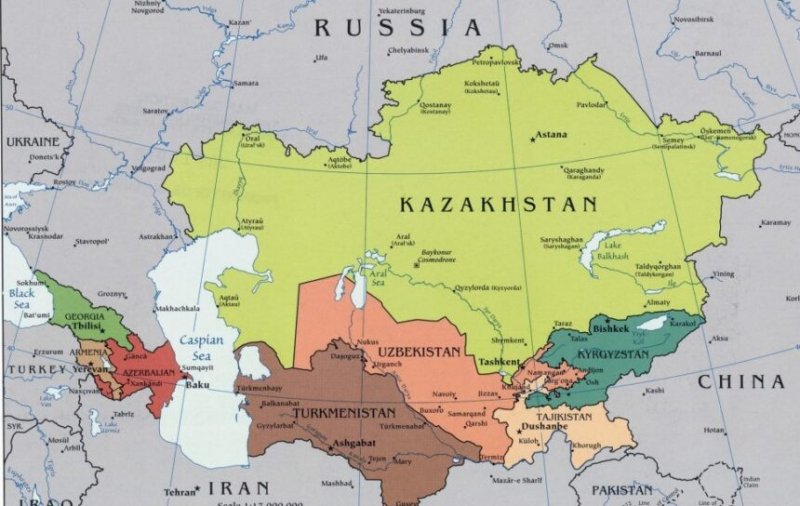
Central Asia has long occupied a pivotal position in world affairs, serving as a bridge between civilizations, trade routes, and empires, News.Az reports.
For centuries, its vast steppes, deserts, and mountain corridors connected east and west, north and south. In recent decades, however, the region often appeared peripheral in global discourse, overshadowed by developments in larger neighboring powers. Today, that perception is changing rapidly. Central Asia is once again emerging as a strategic crossroads, driven by shifts in global power balances, economic transformation, and renewed interest from regional and extra regional actors.
This renewed attention is not accidental. It reflects deeper structural changes in the international system, including the diversification of supply chains, the reconfiguration of energy routes, and evolving security concerns. As a result, central asian states are no longer passive arenas of competition but increasingly active players shaping their own strategic trajectories.
Geography as destiny revisited
Geography has always defined Central Asia’s importance. Landlocked yet centrally located, the region links Europe, the Middle East, South Asia, and East Asia. In the contemporary context, this geography has gained new relevance. Disruptions in traditional maritime routes and growing geopolitical risks have prompted governments and businesses to seek alternative land-based corridors. Central Asia offers precisely such pathways.
Transport and logistics initiatives have elevated the region’s profile. Railways, highways, and dry ports now form the backbone of emerging transcontinental corridors. These routes promise shorter delivery times, diversified trade options, and reduced dependency on single chokepoints. As a result, Central Asia is increasingly viewed as an indispensable node in global connectivity rather than a remote hinterland.
Kazakhstan and the scale factor
Among central asian countries, Kazakhstan stands out due to its sheer size, resource base, and strategic depth. Its territory connects Eastern Europe to western china, making it a natural transit country. Beyond geography, Kazakhstan has pursued a multi-vector foreign policy, balancing relations with major powers while safeguarding its sovereignty.
Economically, Kazakhstan’s energy resources continue to anchor its global relevance. Oil, gas, and uranium exports position the country as a key supplier in global markets. At the same time, there is a growing emphasis on diversification, logistics, and value-added industries. This combination of scale, resources, and strategic diplomacy reinforces Kazakhstan’s role as a central pillar of regional stability.
Uzbekistan’s transformation and leadership ambitions
Uzbekistan represents another critical driver of Central Asia’s rising importance. Over the past several years, the country has undergone significant political and economic reforms. These changes have opened its economy, improved regional relations, and attracted international investment.
Uzbekistan’s demographic weight and central location give it a unique influence. By promoting regional dialogue and economic cooperation, Tashkent has positioned itself as a convening power. Its emphasis on connectivity, trade facilitation, and industrial development aligns with broader regional interests. This proactive approach signals a shift from inward-looking policies to a vision of shared regional growth.
Turkmenistan and strategic neutrality
Turkmenistan follows a distinct path, guided by its policy of permanent neutrality. While maintaining limited political engagement, the country plays a crucial role in regional energy dynamics. Its vast gas reserves and export routes are strategically significant, particularly in discussions about energy diversification.
Turkmenistan’s infrastructure projects and transit potential contribute to Central Asia’s broader connectivity ambitions. Although its engagement model differs from its neighbors, its strategic assets ensure that it remains an important factor in regional calculations.
Security dynamics and regional responsibility
Security considerations are central to Central Asia’s renewed prominence. The region sits adjacent to areas affected by instability, extremism, and unresolved conflicts. Developments in neighboring regions have reinforced the need for effective border management, counterterrorism cooperation, and information sharing.
In response, central asian states are increasingly coordinating their security policies. Joint exercises, intelligence cooperation, and dialogue mechanisms reflect a growing sense of shared responsibility. Importantly, this cooperation is not limited to military dimensions. It also includes efforts to address socioeconomic drivers of insecurity, such as unemployment, radicalization risks, and migration pressures.
Balancing external powers
Central asia’s strategic value inevitably attracts the attention of major powers. Russia, China, the european union, the united states, and regional actors all view the region through the lens of their own interests. Energy security, market access, infrastructure development, and political influence are key drivers of engagement.
What distinguishes the current phase is the agency of central asian states. Rather than aligning exclusively with any single power, they are pursuing diversified partnerships. This balancing strategy allows them to extract economic benefits while preserving strategic autonomy. It also reduces vulnerability to external shocks and political pressure.
Economic integration and regional cooperation
One of the most significant developments in recent years has been the revival of regional cooperation. Central asian leaders increasingly recognize that shared challenges require collective solutions. Water management, environmental protection, transport connectivity, and trade facilitation are areas where cooperation yields tangible benefits.
Regional forums and summits have multiplied, fostering dialogue and confidence building. While institutional integration remains limited, the trend toward pragmatic cooperation is clear. This gradual strengthening of regional ties enhances central asia’s collective bargaining power and international standing.
Energy transition and future relevance
The global energy transition presents both challenges and opportunities for central asia. Traditional hydrocarbon exporters must adapt to changing demand patterns, while resource-rich countries can leverage critical minerals essential for renewable technologies. Central asia’s reserves of uranium and rare earth elements are gaining strategic significance.
At the same time, renewable energy potential is increasingly recognized. Solar and wind resources across the region offer opportunities for sustainable development and export oriented energy projects. By positioning themselves within the global energy transition, central asian states can secure long term relevance beyond fossil fuels.
Societal change and human capital
Demographic trends and societal change also shape the region’s future. A young and growing population presents both opportunities and pressures. Investment in education, skills, and innovation is essential to harness this potential. Several central asian governments have prioritized human capital development as a strategic objective.
Urbanization, digitalization, and cultural exchange are transforming societies across the region. These changes contribute to greater openness and international engagement, reinforcing central asia’s integration into global networks.
From periphery to pivot
Central asia’s rise as a strategic crossroads reflects a convergence of geography, policy choices, and global trends. The region is no longer defined solely by its past or by external narratives. Instead, it is actively shaping its role in a complex and interconnected world.
As global power dynamics continue to evolve, central asia’s importance is likely to grow further. Its ability to balance external interests, strengthen regional cooperation, and pursue sustainable development will determine how effectively it translates strategic attention into lasting prosperity and stability.
In this context, central asia is not merely returning to the map. It is redefining its place at the heart of global geopolitics, once again reminding the world that crossroads are not just points of passage, but centers of influence and opportunity.