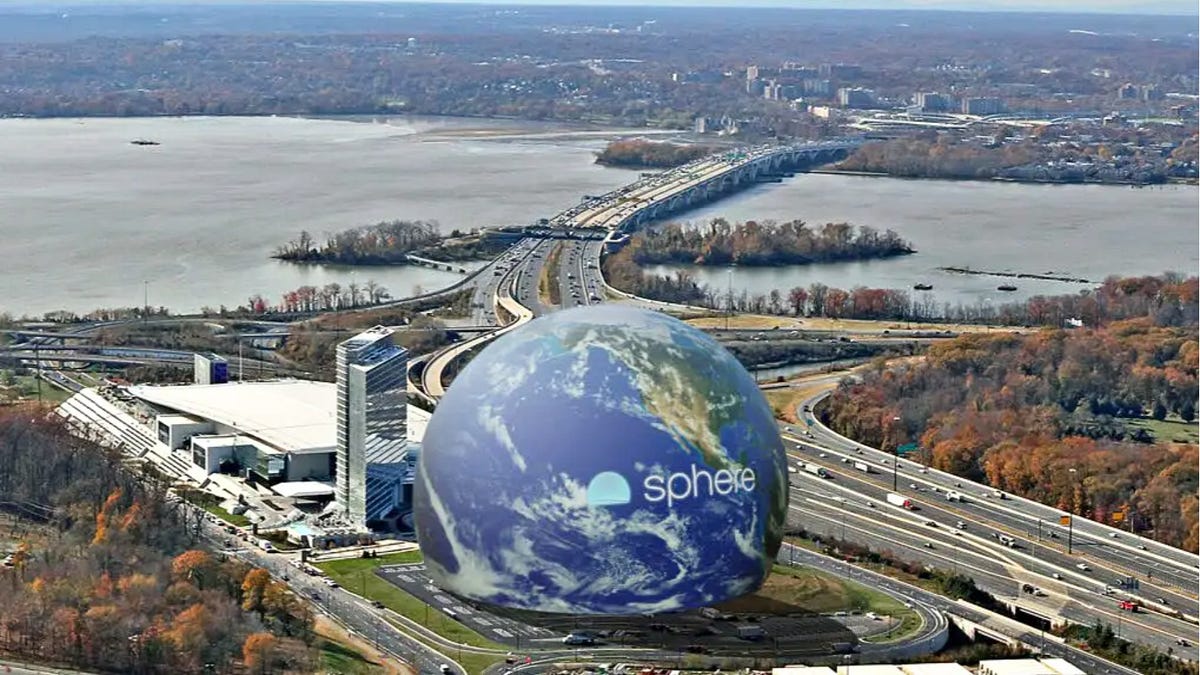
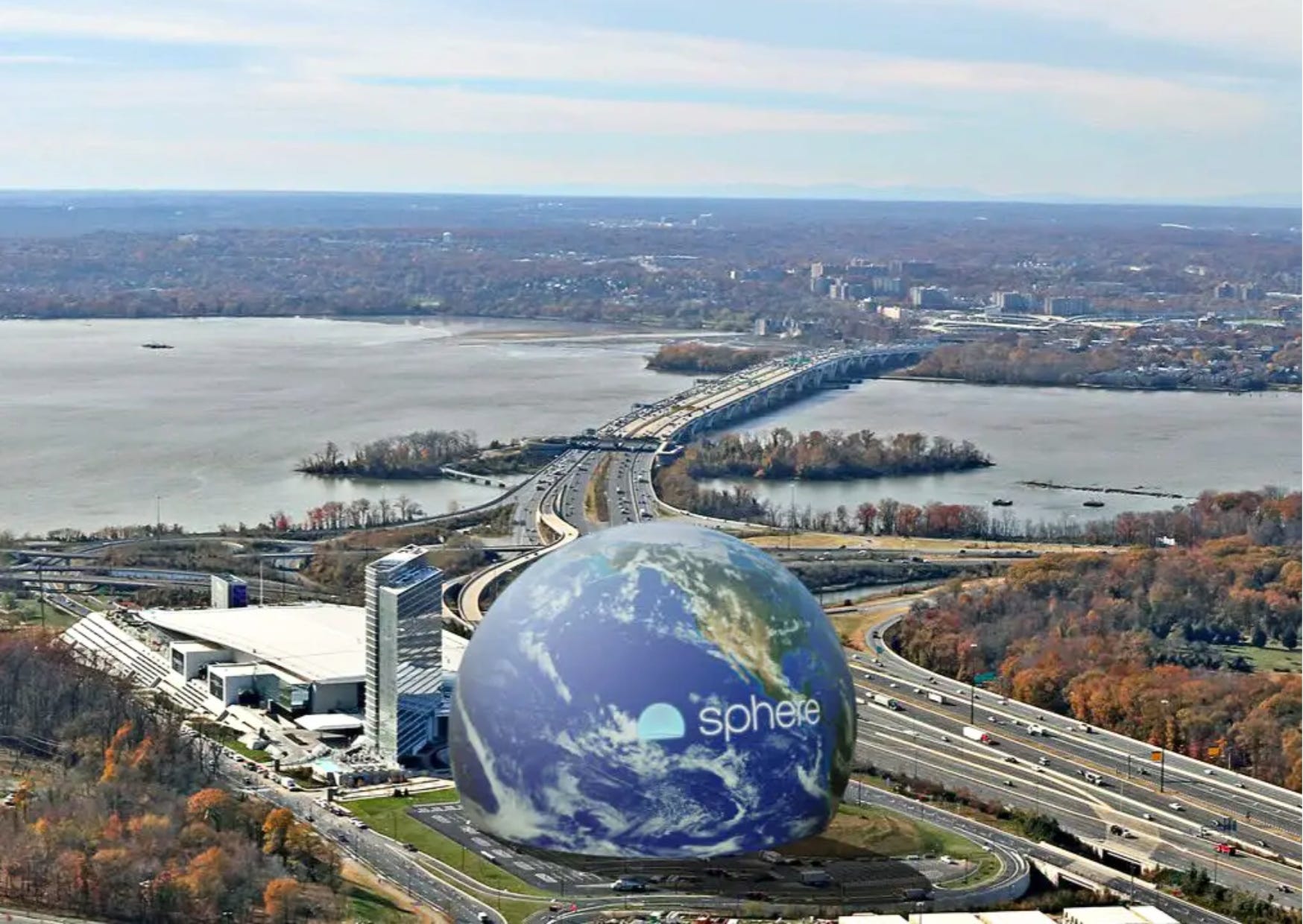
Sphere Entertainment, the holding company behind the $2.3 billion Las Vegas Sphere, announced plans this week to build its second U.S. venue in National Harbor. Located 15 minutes outside Washington, D.C., the smaller-capacity venue (6,000 seats vs. 17,600 seats) will cost about $1 billion to build and has a targeted opening date of 2030.
Local politicians say this project will support 4,750 jobs once the venue is fully operational, generating more than $1 billion in annual economic impact. I, for one, am skeptical of those numbers. But let’s not miss the forest for the trees. This announcement represents a strategic pivot for one of the world’s most ambitious live entertainment experiences (and a key reason why the stock is up 100% in 6 months).
The Sphere’s flagship venue in Las Vegas currently makes money in four ways:
The Sphere Experience: These are ticketed immersive productions. Think of it like the movie theater model. The Sphere spends $80 million to $100 million to develop movies like Postcard from Earth or The Wizard of Oz for its 160,000-square-foot, 16K x 16K-resolution screen. There are multiple showtimes per day, year-round, allowing them to monetize the building when there is no major event.
Concert Residencies: The Sphere signs multi-show concert engagements with major artists. U2 inaugurated the venue with 40 shows, grossing an estimated $244.5 million. Along with premium-priced ticket sales ($400+), these events drive incremental spend from food and beverage, merchandise, and luxury suites. The Sphere helps offset production costs and splits profits with the performing artist.
Exosphere Advertising: The Sphere’s 580,000-square-foot exterior serves as a high-impact advertising surface. According to an internal presentation leaked by Ad Age, the Sphere charges brands $450,000 for daily packages, $650,000 for weekly packages, or up to $2 million for special events, such as the Super Bowl. These prices include working with the Sphere’s 300+ person design team on the creative, and the company estimates that each advertising package receives an estimated 4.7 million daily impressions (300,000 in-person, 4.4 million online).
Corporate Events: When the Sphere’s interior isn’t being used for concerts or movies, it can be rented for corporate events. This includes Delta’s takeover at CES and Hewlett-Packard’s corporate keynote, as well as the 2024 NHL Draft.
If you have followed the Sphere’s financial performance over the last 12 to 24 months, you’ve probably seen headlines that say the venue is performing poorly. Last quarter, the Sphere reported $174.1 million in revenue, yet still recorded an operating loss of $84.4 million. This YouTube video, titled “How Las Vegas Sphere Became a $2.3 Billion Failure,” has 530,000 views all by itself, and there are dozens of others like it.
While these sensationalized headlines might help increase a YouTube video’s click-through rate, they also fail to explain what is really happening in Las Vegas.
The Las Vegas Sphere’s early results were guaranteed to look ugly because the venue is capex-heavy and likely fixed-cost-heavy. In addition to a $2.3 billion construction cost (2x the initial projection due to delays and COVID-related price increases), the venue has large fixed components (venue ops, staffing, insurance, maintenance, tech upkeep, depreciation, etc.) and also venue-specific variable components (marketing, ticketing fees, production costs amortization, artist profit-sharing agreements, etc.).
This structure naturally produces a “J-curve”: early periods have high overhead and ramp inefficiencies; later periods benefit from increased utilization, content reuse, and operating experience. So, while it’s true that the Sphere reported operating losses of more than $500 million in its first fiscal year, the numbers have been (and will continue to) improve over time. On an adjusted basis (excluding depreciation and amortization), the Sphere turned profitable earlier this year, reporting Q3 operating income of $17.1 million — a considerable jump from a $26.3 million loss in Q3 2024.
Extended mini-residencies with bands like U2, Phish, Dead & Company, and The Eagles certainly helped the Sphere’s financials, but the company’s Wizard of Oz production is the best example of how its business model can work in the long term.
After spending 2 years and $100 million adapting the 1939 classic for its screens, the Sphere has sold more than 2 million tickets for the film since its August debut. That amounts to more than $260 million in ticket sales alone, or roughly $2 million of ticket sales income per day since its debut, while also serving as a template that Hollywood studios can adapt for other classic IP experiences, such as Harry Potter or Star Wars.
Sphere Entertainment won’t release year-end results for the Wizard of Oz for another few months, but the margins on these films are typically pretty solid. According to the company’s 2024 financial report, the Sphere hosted 657 showings of its film Postcard from Earth last year. The average revenue generated per show was $408,000, against $125,000 in operating expenses, resulting in a per-show gross profit of $283,000.
But the Sphere wouldn’t be trading at a $3.3 billion market cap if it were just a single venue; the initial idea was to gain leverage by creating a global network of venues.
The challenge with this model is that the Las Vegas Sphere ended up costing far more than early expectations ($2.3 billion vs. an initial estimate of $1.2 billion). That makes replication hard if the company is financing builds on its own balance sheet. Plus, the demand for additional venues turned out to be lower than the company anticipated.
For example, London’s mayor blocked Sphere Entertainment from building a second Sphere in Stratford, citing the impact of light pollution on local communities. Sphere Entertainment had already purchased the land in East London for $76 million (and spent millions more on development), resulting in a $116.5 million impairment charge.
So to make the business model work, expanding from one venue to dozens, Sphere Entertainment had to find an alternative solution to de-risk its expansion process.
One way that the Sphere has done this is through a franchise model. In 2024, Abu Dhabi acquired the exclusive right to build/operate Sphere Abu Dhabi, as well as regional exclusivity for additional venues. As part of the 25-year deal, the Sphere received a franchise initiation fee and ongoing royalties, including a royalty tied to total revenues and a separate royalty tied to ticket sales for Sphere Experience films.
This showcased how the Sphere can move from a capex-heavy operation to an asset-light platform licensor. However, this model really only works in markets willing to pay a premium for access, which leads us to the company’s new “mini-Sphere” model.
Smaller venues, like the recently announced Sphere in National Harbor, help the Sphere reduce costs across the board, from capex to construction complexity. Lower costs don’t necessarily scale linearly (because a smaller Sphere still requires expensive core technology systems), but mini-Spheres help increase venue demand. While only a dozen cities could theoretically support a 20,000-seat, $2.3 billion Sphere, there are potentially more than 100 cities that can support a 6,000-seat, $1 billion Sphere. Not all of them will do it, of course, but the Sphere really only needs ten of them to bite.
It’s also important to note that this model works better for local governments. The National Harbor project, for instance, is reportedly receiving approximately $200 million in state, local, and private incentives. Not only is it easier to justify spending $200 million on a Sphere (compared to $1 billion or more), but lower amounts also offer optionality, such as reducing tax burdens or funding infrastructure projects.
Expansion aside, smaller venues also change the economics in a few big ways.
Content Networks: The Sphere’s original productions require significant upfront investment ($80M+), but building a network changes the math. The Wizard of Oz becomes an asset that can be shown in multiple cities, several times per day. The marginal cost to program it elsewhere is far lower than producing a new original, dramatically improving its ROI if the content travels well and demand persists.
Concert Adoption: One of the Sphere’s biggest problems today is that artists can’t just pop in for a show while on tour. Since programming costs can run upwards of $400,000 per song, artists have to complete mini-residencies to make it financially feasible. But by shifting to smaller venues, the Sphere can broaden its roster of artists by creating standardized “Sphere-ready” show packages in multiple cities.
Increased Utilization: One overlooked point is that smaller venues are simply easier to fill. By reducing the seat count from 20,000 to 6,000, it will be easier to sell out movies. Smaller venues can also help support more frequent residencies, with the Sphere then leaning heavier into corporate events, because, let’s be honest, the Sphere’s wow factor ultimately matters more than its total seat count.
The National Harbor deal still needs to close before construction can begin for a 2030 opening. That said, the Washington, D.C., area feels like a strong location to test this model. The venue is expected to be built adjacent to the MGM Casino, and the DC metropolitan area immediately provides the Sphere with access to an established tourism hub within the 8th-largest DMA in the country (6.4 million residents).
The investment case for Sphere Entertainment would look cleaner (and be easier to analyze) if James Dolan hadn’t attached his sinking regional sports network (MSG Networks) to the company. But given how the Las Vegas venue’s economics have steadily improved since its 2023 opening, investors have taken note that audiences are willing to pay substantial premiums for immersive experiences. Now, Sphere Entertainment needs to prove it can scale its innovative model into a global network.
If you enjoyed this breakdown, please share it with your friends.