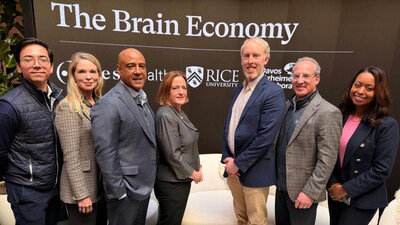
HOUSTON, Jan. 22, 2026 /PRNewswire/ — Rice University launched the Global Brain Economy Initiative (GBEI) Jan. 21 during the annual meeting of the World Economic Forum in Davos, Switzerland. This initiative positions brain capital, or brain health and brain skills, at the forefront of global economic development, particularly in the age of artificial intelligence.

Pictured L to R: Adrian Trömel, interim vice president for innovation; Caroline Levander, vice president for global strategy; Reginald DesRoches, president; Amy Dittmar, Howard R. Hughes Provost and executive vice president for academic affairs; Harris Eyre, the Harry Z. Yan and Weiman Gao Senior Fellow for Brain Health and Society; Stephen Bayer, vice president for development and alumni relations; Melinda Spaulding Chevalier, vice president for public affairs.
The GBEI, based at Rice and launched in collaboration with The University of Texas Medical Branch (UTMB) and the Davos Alzheimer’s Collaborative, aligns with a recent World Economic Forum and McKinsey Health Institute report titled “The Human Advantage: Stronger Brains in the Age of AI,” co-authored by Rice researcher Harris Eyre.
Led by Eyre, the GBEI aims to establish brain capital as an essential asset for the 21st century. As AI transforms workplaces and the global population ages, Rice’s strategy connects neuroscience with economic policy to promote long-term growth, workforce resilience and social well-being.
“One of Rice’s strengths is connecting research with real-world impact,” said Amy Dittmar, the Howard R. Hughes Provost and executive vice president for academic affairs. “With an aging population and the rapid transformation of work and society driven by AI, the urgency has never been greater to focus on brain health and build adaptable human skills — both to support people and communities and to ensure long-term economic stability.”
GBEI to move ideas into action
The GBEI aims to convert research into practical solutions for governments, employers and investors to enhance brain health and human skills. Its mission is to address disparities in support for brain capital across health care, education, workplaces and public policy.
The initiative functions as a global center of excellence and coordinating platform and advances brain capital through four core strategies, including:
Defining a shared framework that integrates brain health and skills as a unified driver of human and economic performance.
Measuring impact by establishing common research agendas, standards and metrics for brain capital.
Testing solutions through real-world pilots that improve cognitive health, workforce performance and local economic outcomes.
Supporting investment in brain health by developing financing frameworks to attract capital that is aligned with long-term value creation.
In its first year, the GBEI will establish a global brain research agenda, piloting brain economy strategies in select regions and introducing a framework to guide funders and financial leaders. It will also advocate for brain economy public policies at major global forums, including the G7 Summit in France, G20 Summit in the U.S., United Nations General Assembly, World Health Assembly and COP31 in Turkey.
Story Continues