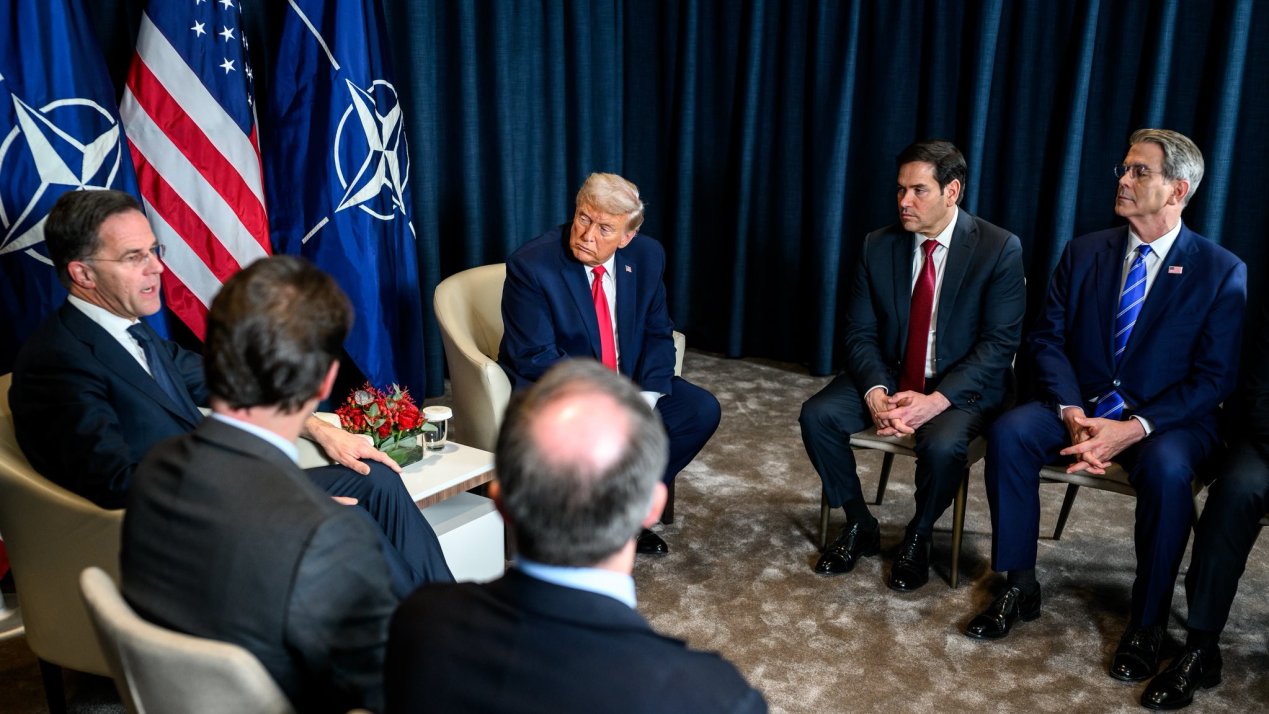
President Donald Trump said Washington and NATO are shaping a potential cooperation framework around Greenland, a move that led him to pause new tariffs on several European partners while negotiations continue. Even as Trump welcomed the progress, Denmark pushed back, stressing that NATO Secretary General Mark Rutte has no authority to negotiate the island’s future.
Trump described the initiative as a preliminary understanding rather than a completed agreement. He said the proposal is still technical and will be clarified later, but suggested it could include US participation in Greenland’s mineral development and involvement in the administration’s “Golden Dome” missile defense system.
According to Trump, the United States and its allies would share roles in defense infrastructure and resource development. He added that planned tariffs were shelved because talks have advanced enough to justify holding them back for now.
In a statement on Truth Social, Trump said the discussions are meant to deepen cooperation not only on Greenland but across the Arctic. He framed the effort as beneficial for both the United States and NATO members, adding that further talks are underway on defense installations on the island. Vice President JD Vance, Secretary of State Marco Rubio and special envoy Steve Witkoff will lead the negotiations and report directly to him.
Denmark quickly moved to contain expectations, reiterating that Rutte cannot speak for Denmark or Greenland. Prime Minister Mette Frederiksen acknowledged that dialogue has improved but warned the situation remains sensitive. She stressed that only Denmark and Greenland can decide matters affecting the island, particularly sovereignty. While cooperation on security, investment and economic issues is possible, she said control is not negotiable. Defense Minister Troels Lund Poulsen echoed that position but welcomed NATO’s interest in strengthening Arctic security, saying the alliance’s engagement has helped ease tensions.
Meanwhile, Rutte said NATO members must increase their presence in the Arctic under the emerging framework after Trump walked back threats to take Greenland by force. Allied military planners will begin coordinating requirements, with possible measures in place as early as 2026.
Across Europe, reactions mixed relief with caution. Italian Prime Minister Giorgia Meloni welcomed renewed engagement, while Dutch Prime Minister Dick Schoof said de-escalation was positive but insisted NATO partners continue coordinating Arctic defense.
German Chancellor Friedrich Merz urged Europeans not to abandon the transatlantic partnership, calling mutual trust NATO’s main strategic advantage. France’s Finance Minister Roland Lescure said recent developments point toward calming tensions rather than escalation.
Sweden’s Foreign Minister Maria Stenergard suggested European pushback helped prompt Washington’s softer tone, after several leaders criticized Trump’s stance, with French President Emmanuel Macron describing it as “new colonialism.”
Some officials believe European unity, US political pressure and market reactions contributed to Trump’s shift.
Trump’s Greenland Initiative
Trump’s interest in Greenland, first floated in 2019, has intensified in recent weeks, with the president saying the United States would secure control of the island “one way or another” before pulling back in favor of negotiations. On Jan. 14, a high-level meeting at the White House between the US, Denmark, and Greenland concluded without a clear resolution.
While discussions were described as “frank but constructive,” Danish Foreign Minister Lars Lokke Rasmussen firmly rejected US suggestions that Washington assume control of Greenland, calling them “totally unacceptable.” A working group was formed to explore compromise solutions, emphasizing cooperation while respecting Greenlandic sovereignty. Trump’s special envoy, Jeff Landry, announced plans to visit Greenland in March to continue negotiations, expressing optimism that a deal could eventually be reached.
Trump’s Greenland push has directly influenced European trade policy. Last week, Donald Trump warned that he may levy new tariffs on eight allied nations that resist his push to take control of Greenland. The countries targeted include the UK, Denmark, Norway, Sweden, France, Germany, the Netherlands, and Finland. He announced that a 10% tariff on all imports from these nations would take effect on Feb. 1, with the rate set to increase to 25% by June 1 if opposition continues. In addition, Trump announced he would impose a 200% tariff on French wine and champagne to pressure Macron into joining his Peace Council.
Under such pressures, Macron advocated for deploying the EU’s Anti-Coercion Instrument, enabling Brussels to impose counter-tariffs. On Jan. 21, European lawmakers agreed to freeze indefinitely the EU-U.S. trade agreement, which had been politically agreed last summer but still required formal approval by the European Parliament. Senior MEPs overseeing the file suspended the process, postponing a vote originally scheduled in the Parliament’s Committee on International Trade.
Lawmakers argue that US tariff threats undermine the agreement, which allows Washington to maintain 15% duties on European goods while the EU commits to eliminating tariffs on US industrial imports. Željana Zovko, the Parliament’s lead negotiator for the EPP, said the deal will remain on hold until the United States shows genuine willingness to engage without using economic pressure. EU leaders are preparing a coordinated response, potentially invoking the bloc’s “trade bazooka” to protect European interests. After President Trump’s most recent announcement of a framework of a future deal on Greenland, no concrete details have been released on the EU‑US trade deal’s status.
Trump’s participation at Davos has been marked by mixed signals. While he indicated that an agreement on Greenland could be reached and signaled he would not use military force, softening his previous rhetoric, his earlier statements painted a more assertive picture. Upon arrival, he repeatedly emphasized Greenland’s strategic importance, insisting there is “no turning back” on his plans. When pressed on how far he would go to secure the territory, he replied cryptically: “You will find out.”
Amid speculation about potential military options, Trump declined to rule out force, telling NBC News “no comment” when asked directly. At the same time, he questioned whether NATO would reciprocate if the United States needed assistance, stating, “I know we would come to NATO’s rescue, but I really question if they would come to ours.”