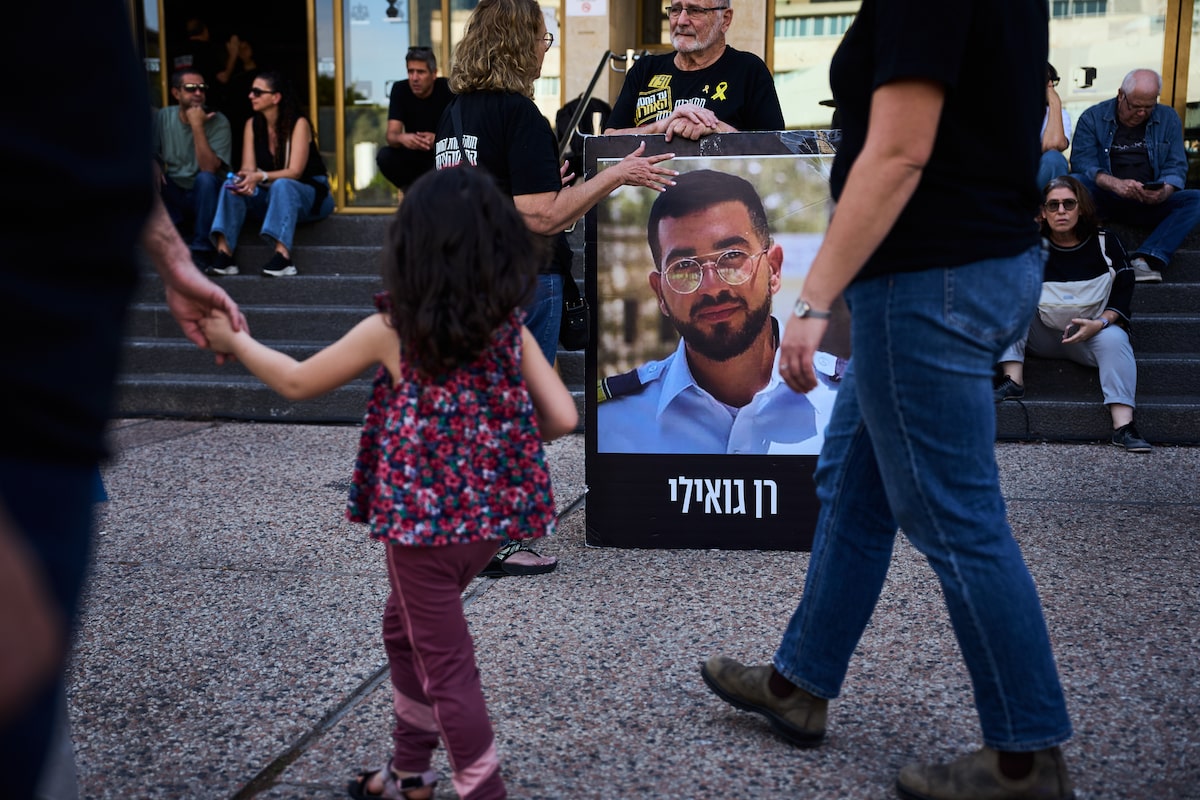
Weekly rallies in Tel Aviv demanding the release of Israeli hostages from Hamas custody now focus on Ran Gvili, the last of those captives.Oded Balilty/The Associated Press
Talik Gvili has been waiting 839 days for Palestinian militants to return her captive son, Ran Gvili, taken at age 24, believed to be deceased, and the last of the 251 hostages held in Gaza. Only when he is returned – alive or dead – will she believe that the Israel-Hamas war has ended.
“Time is not playing for us,” she told The Globe and Mail on Thursday, explaining that her son’s absence grows harder with each passing day, as her fear grows that he will be left there.
On Thursday in Davos, Switzerland, U.S. President Donald Trump held a signing ceremony to launch his newly formed Board of Peace, which will work on advancing the Gaza ceasefire. He made a reference to Mr. Gvili and said he needed to be returned. The U.S. had initially said that progress on the ceasefire, the first phase of which was agreed to on Oct. 10 last year, would not take place until all hostages were returned.
The moving target known as the yellow line represents danger for those in the Gaza Strip
“I’ve been very clear that Hamas must return that last remaining deceased hostage,” said Mr. Trump on Thursday, adding that the U.S. was “close on the track” of getting that done.
Israelis attached enormous symbolic significance to the return of the hostages and have held weekly rallies, believing, as Ms. Gvili does, that their return heralds an end to the war. For many Israelis, Mr. Gvili’s return and the Hamas’s disarmament would be the true markers of the war’s end, not statements from politicians.
Talik Gvili, the mother of Ran Gvili.Ronen Zvulun/Reuters
The U.S. has promised the disarmament of Hamas will occur but has yet to put in place a plan to do this, even as it transitions from phase one to phase two of the ceasefire.
Yuli Edelstein, a parliamentarian and a former chair of the Knesset foreign affairs and defence committee, told The Globe that “moving to phase two right now is wrong” because, as of yet, Mr. Gvili has not been returned, and Hamas has not been disarmed.
Mr. Gvili was taken on Oct. 7, 2023, when Hamas attacked southern Israel, capturing 251 hostages and sparking the war that has killed at least 70,000 Palestinians, according to figures from the Palestinian Health Ministry in Gaza.
That morning, Mr. Gvili was on medical leave from his police unit, awaiting surgery for a broken shoulder. He joined his unit anyway to fight Hamas on the roads in southern Israel and was shot in the leg and hand.
Taking cover alone by a road next to a kibbutz, he let others know of the Hamas fighters’ positions and, according to his mother, killed 14 of them before his capture. His body was last seen on a motorcycle in Gaza. Ms. Gvili has held out hope that he was wounded and has miraculously survived, a belief that has only made her long wait that much more unbearable.
As long as Hamas is armed, many Israelis believe a return to war is inevitable, especially since the period of the ceasefire has been marked by continued gun battles in Gaza between the Israeli army and Hamas.
Israeli forces kill 11, including three journalists, on one of Gaza’s deadliest days since ceasefire
In a country where reserve units are still receiving emergency calls to report for duty, it’s hard to say that the war is over. For now, it’s the level of fighting that has been reduced.
Mr. Trump’s son-in-law, Jared Kushner, spoke at Davos of the importance of Hamas demilitarization, as he showed the audience photos envisioning a rebuilt Gaza with modern skyscrapers. Investors, he said, will only fund construction if Hamas is disarmed.
“Without security, nobody’s going to make investments. No one is going to come and build there,” he said.
In a Jerusalem mall this week, Hosan Dabbagh, who described himself as an Israeli-Arab, said that only someone who is out of their mind would think of returning to war. “People there [in Gaza] are tired; they do not have water or food.”
Rubble in the northern Gaza Strip, as seen from Israel on Jan. 16, 2026.Amir Levy/Getty Images
Mr. Dabbagh said his focus was on what needs to happen between Arabs and Jews so that there would be peace. “People have to have empathy and think of the other; that is what will bring peace.”
Avidor Schwartzman-Flash, a father of two whose temporary home is in Kibbutz Ruhama, said that he still believes in a two-state solution, “because there isn’t any other choice.”
At one point, he said, he would even have argued that Israel should talk with Hamas to make peace. Since Oct. 7, however, he said he believes that peace is not possible as long as Hamas is armed because its goal is to destroy Israel.
On that day, the Schwartzman-Flash family had huddled for almost 23 hours in their safe room in Kfar Aza, listening to machine-gun fire and knowing that friends and family members had been killed as militants went house to house. Among the dead were his wife‘s parents, Igal and Cindy Flash.
Fearful of another Gaza war, the family is now hesitant to return to Kfar Aza.
“I know we’ll go back to war with Hamas sooner or later, because Hamas is still there. So, unfortunately, it’s inevitable,” he said.