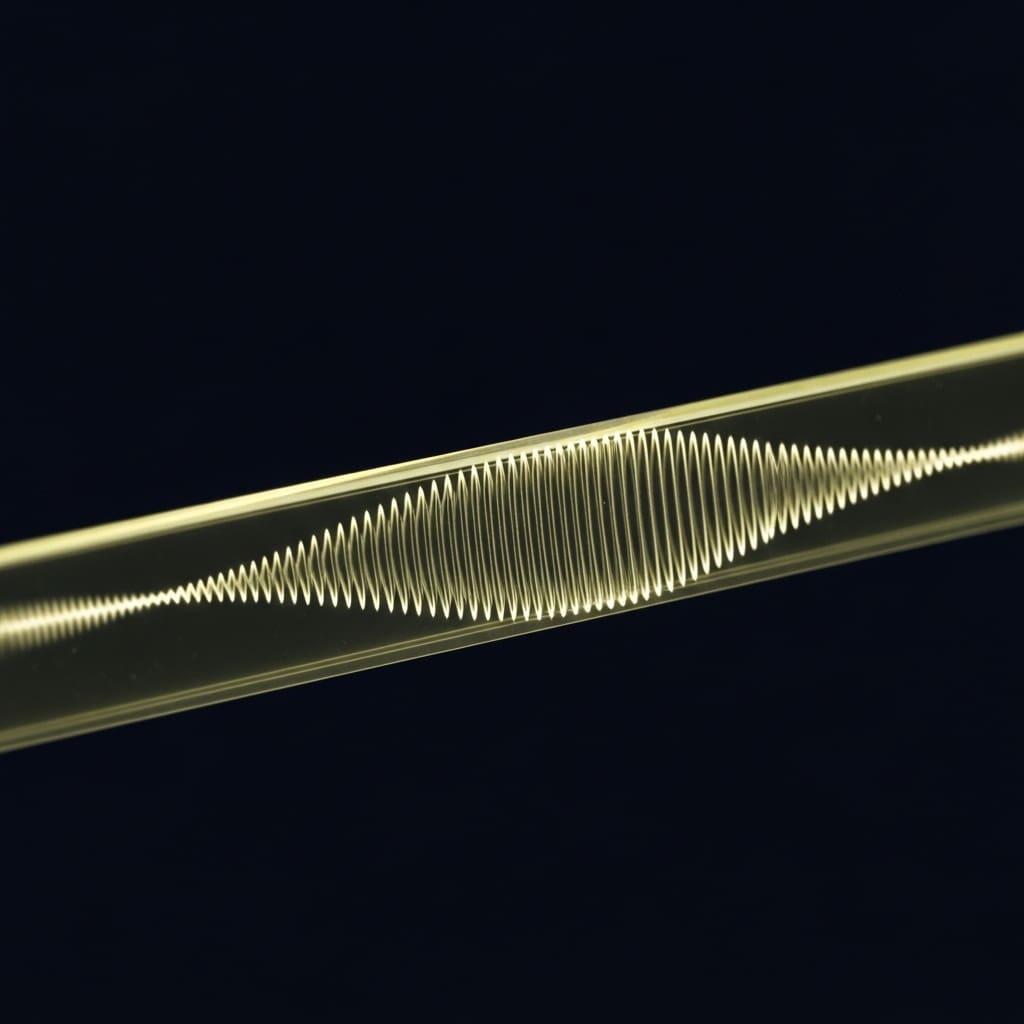
Researchers are increasingly exploring phononic nanodevices as a pathway to realising practical quantum technologies, leveraging the unique properties of phonons to interface with quantum systems. Michele Diego, Hong Qiao and Byunggi Kim, from the University of Tokyo and the University of Chicago, alongside Shiheng Li, Gustav Andersson et al, demonstrate a significant advance by fabricating gigahertz-frequency Lamb wave resonator cavities on suspended lithium niobate, a material known for its strong piezoelectric properties. Unlike traditional surface acoustic wave devices, this suspended structure minimises acoustic leakage, enabling remarkably high intrinsic quality factors of approximately 6000 at the single phonon level, as characterised at both room and millikelvin temperatures. This breakthrough paves the way for highly efficient coupling to superconducting qubits, such as transmons, and represents a crucial step towards developing robust and scalable quantum acoustic circuits.
5 metallization ratio, resulting in a unit period of 1μm, while the acoustic mirrors consist of 200 electrically floating aluminum fingers 250nm thick. By varying the spacing between the IDT and mirrors, the team investigated the impact on resonator performance, meticulously measuring the transmission spectra using a two-port vector network analyzer.
This high Q-factor is crucial for maintaining quantum coherence and enabling precise control of acoustic phonons. The team developed a lumped-element model based on the measured resonator parameters, incorporating the IDT capacitance, mechanical inductance, capacitance, and resistance to represent mechanical loss. By accurately modelling the resonator characteristics, the researchers provide guidance for optimising the coupling strength and achieving quantum-level measurements. This work opens avenues for developing novel quantum technologies, including quantum memories and transducers, by leveraging the unique properties of phonons in lithium niobate and overcoming the limitations of surface acoustic wave devices. The ability to confine acoustic energy within a thin suspended layer promises to enhance the performance and scalability of future quantum acoustic circuits.
Lithium Niobate Nanodevice Fabrication and Lamb Wave Confinement
Scientists engineered phononic nanodevices utilising lithium niobate to explore potential quantum technologies, focusing on gigahertz-frequency phonons. The study pioneered resonator cavities incorporating interdigitated transducers (IDTs) terminated by acoustic Bragg mirrors, enabling strong acoustic confinement and minimising energy loss into the substrate. Experiments employed a meticulous fabrication process, beginning with the patterning of 20 equally spaced electrode pairs, each with a 500nm pitch and 0.5 metallization ratio ,. Fitting the measured spectra with the Butterworth, van Dyke (BvD) model, they estimated a capacitance of C0 ≈ 0.07 pF, aligning with modelling calculations.
Data shows that the devices comprise aluminum interdigital transducers (IDTs) enclosed by acoustic mirrors, each IDT consisting of 20 equally spaced electrode pairs with a pitch of 500nm and a metallization ratio of 0.5, resulting in a unit period of 1μm. By varying the spacing between the IDT and mirrors, the team investigated the behaviour of the quality factor across different devices. Measurements of |S11| reflection and |S21| transmission, normalized and vertically offset for clarity, were conducted for various IDT-mirror spacings, revealing distinct resonant dips for each resonator cavity. Furthermore, analysis of the imaginary part of the inverse scattering parameter 1/S, combined with corresponding fits, allowed the scientists to extract intrinsic quality factors Qi for all measured cavities. The breakthrough delivers a pathway for coupling these resonators to superconducting transmon qubits for quantum-level measurements, potentially enabling the development of advanced quantum acoustic devices. Tests prove the viability of this approach, with the potential to significantly advance the field of phononic nanodevices and their application in quantum technologies.
Lamb Wave Resonators show high Q-factors and stability
Scientists have fabricated and characterised mechanically-suspended acoustic resonator cavities defined on a thin lithium niobate plate, demonstrating a promising avenue for quantum technologies. These devices support gigahertz-frequency Lamb waves, exhibiting reasonable agreement with finite element simulations of their acoustic behaviour. By employing a BvD model, they extracted equivalent circuit parameters, enabling evaluation of coupling these cavities to a transmon qubit, with achievable coupling strengths exceeding 1MHz. The authors suggest that even larger coupling strengths, potentially up to 10MHz, may be attainable with further optimisation.
The study acknowledges that the internal quality factor exhibits some dependence on drive strength, representing a limitation for precise control. Furthermore, the observed differences in leakage channels between room and millikelvin temperatures require further investigation to fully understand the underlying mechanisms. Future work could focus on optimising device geometry and materials to minimise these losses and maximise coupling strength, paving the way for more robust and efficient quantum acoustic devices. These findings represent a substantial step towards integrating phononic devices into quantum information processing systems, offering a potential pathway for manipulating and controlling quantum states using acoustic waves.
👉 More information
🗞 Gigahertz-frequency Lamb wave resonator cavities on suspended lithium niobate for quantum acoustics
🧠 ArXiv: https://arxiv.org/abs/2601.13509