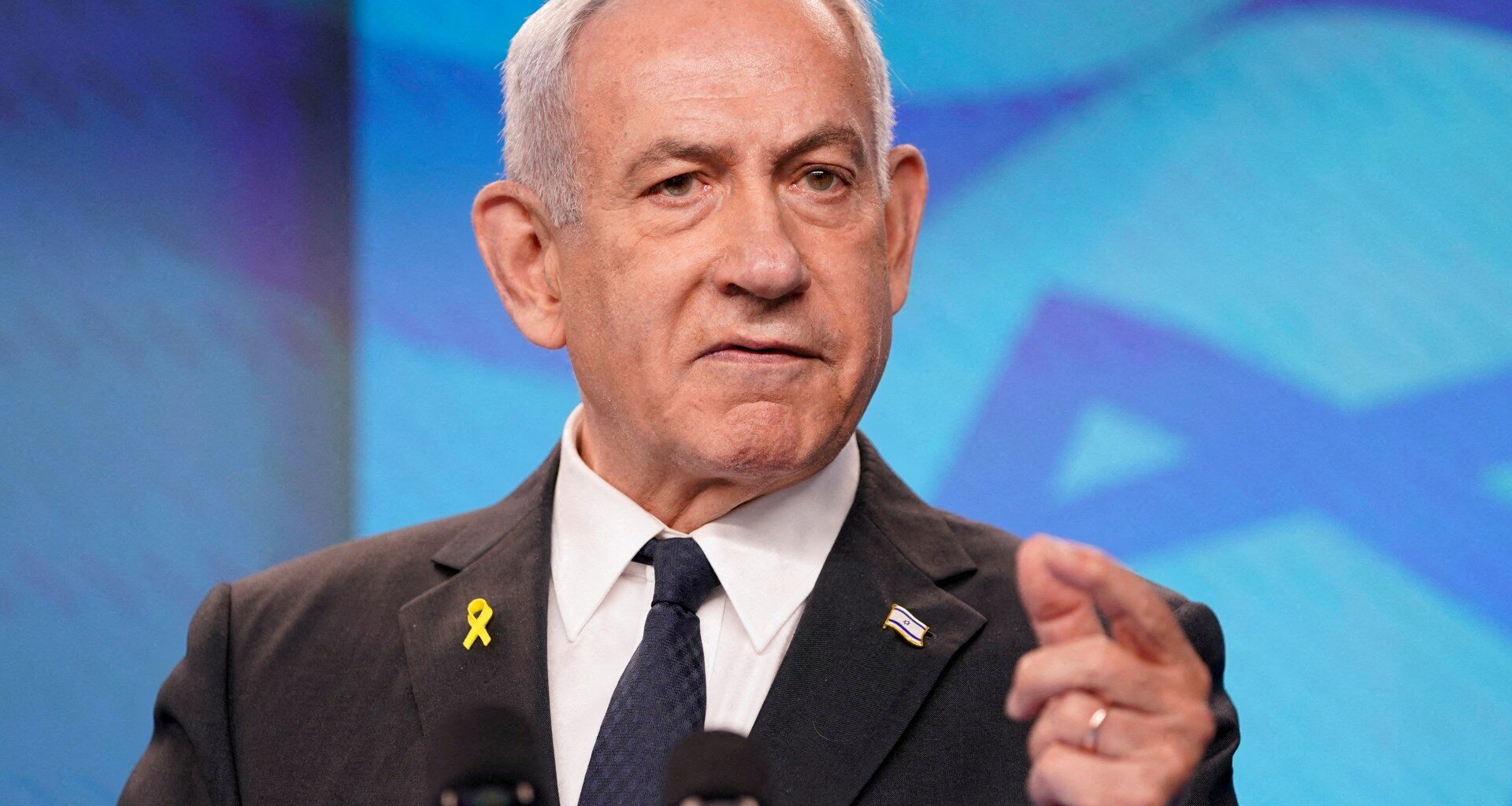
Israel has spent more than two years attacking Gaza in its genocidal war on the Palestinian enclave. It has destroyed the majority of its housing and infrastructure, and killed more than 70,000 Palestinians, leaving the rest of Gaza’s population facing a harsh winter with inadequate food, medicine, and shelter.
And yet Israeli Prime Minister Benjamin Netanyahu – for whom the International Criminal Court has issued an arrest warrant for war crimes committed in Gaza – this week joined US President Donald Trump’s “Board of Peace”, established to oversee the reconstruction and governance of Gaza.
Recommended Stories list of 4 itemsend of list
It opens up the question of what Netanyahu – and Israel – actually want from the Palestinian territory, and whether they want the territory to rebuild or just want a continuation of the status quo.
Ahead of Netanyahu lies a difficult journey, observers say. With Israeli elections looming later this year, he must appear to the world and the Israeli public as working with US ambitions for Gaza.
But he also needs to maintain his governing coalition, which relies in part on elements, such as his Finance Minister Bezalel Smotrich, who are not just opposed to the reconstruction of Gaza, but also opposed to the ceasefire in a territory that he and his allies – as religious Zionists – regard themselves as divinely entitled to settle upon.
So far, things do not seem to be going entirely Netanyahu’s way. He has failed to delay the transition to the second phase of Trump’s three-phase ceasefire plan, despite Hamas’s refusal to disarm. Similarly, despite his objections, Gaza’s Rafah crossing is due to open in both directions, allowing people in and out of the enclave, next week. Lastly, his protestations against Turkiye and Qatar joining the Board of Peace, and potentially deploying forces to Gaza as part of a proposed International Stabilisation Force, also appear to have been overruled by the US.
Settlement or security
At home, Netanyahu’s cabinet remains divided on Gaza. On Monday, Smotrich not only slammed US proposals as “bad for Israel”, but on Monday, called for the US base in southern Israel responsible for overseeing the ceasefire to be dismantled. Meanwhile, others in the Israeli parliament have primarily focused on the upcoming elections, aiming only to galvanise their political base, regardless of ideology.
Netanyahu continues to insist that Hamas will be disarmed, and the Israeli military is working on razing territory all along the border with Gaza, creating a buffer zone deep into the coastal enclave.
Even if Hamas does not completely lose all its weapons, it has been weakened, and pushing Palestinians further away from the Israeli border allows the Israeli government to project the image of security for its population.
The Israeli public, exhausted after more than two years of war, largely relegates the consequences of Israel’s actions to the back pages of national media.
“The public is deeply divided on Gaza and the Board of Peace,” said American-Israeli political consultant and pollster Dahlia Scheindlin. “Though there’s a minority bloc favouring resettling Gaza, most of Israeli society is splintered. People typically view Gaza with a mixture of fear and a need for security, driven entirely by the events of October 2023. They want Israel to remain in Gaza in some form and don’t trust outsiders to handle it. At the same time, there’s hope that US involvement could achieve what two years of war couldn’t.”
“However, nearly everyone starts from the same point: Anything is better than going back to war,” Scheindlin said.
“They don’t have a strategy, and everything is chaos,” peace campaigner Gershon Baskin said, referring to Israel’s leaders. “They’re in election mode and only speaking to their base. I went to the Knesset yesterday. It’s like watching lunatics in a house of madness. It’s a disaster.”
For much of the public, Palestinians remain invisible. “They don’t exist. Israel has probably killed more than 100,000, but the majority of Israelis don’t know or care what’s going on the other side of the border. We even dispute there’s a border; it’s just ours,” Baskin said. “We don’t even see it on TV. All they show are old clips on loop. You can find images of Gaza on social media, but you have to go looking for it.
“Most Israelis don’t.”
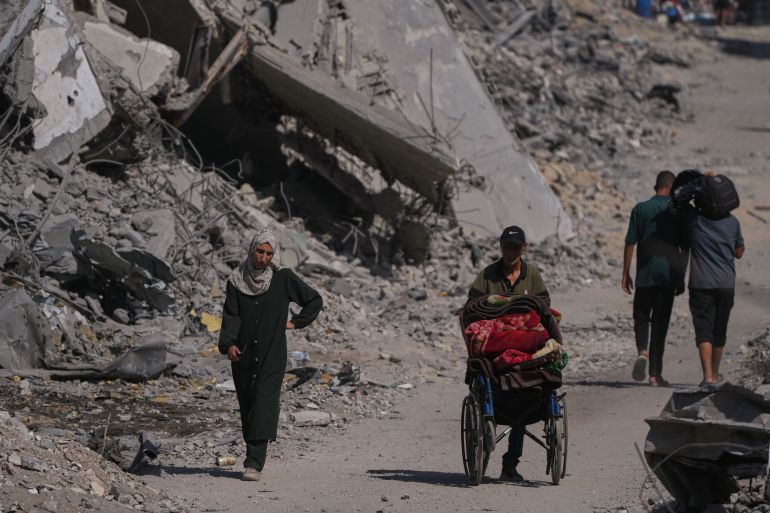 Palestinians walk through the destruction caused by the Israeli air and ground offensive in the al-Shati camp, in Gaza City [Abdel Kareem Hana/AP]Divided politics
Many Israeli leaders agree on one thing – that there will not be a Palestinian state.
How to reach that goal, or the details that accompany it and how Gaza fits into it all, are open to interpretation.
Irrespective of the outcome of the US-backed Gaza ceasefire process, Israel will remain alongside a territory, Gaza, against whose population it is accused of genocide. Currently, according to analysts within Israel, there appears to be no plan for the coexistence that geography dictates, only the unspoken suspicion that outside powers, in this case the US, are not really capable of determining how best to achieve it.
Even Israel’s commitment to US plans is open to question, with Netanyahu – when safely outside of Trump and his team’s earshot – framing the ceasefire’s second phase as a “declarative move”, rather than the definite sign of progress described by US envoy Steve Witkoff.
“The genocide hasn’t stopped. It’s continuing; it’s just moved from active to passive,” said Israeli lawmaker Ofer Cassif. “Israel is not bombing Gaza as before, but now it is leaving the people there to freeze and starve. This isn’t happening on its own. This is government policy.”
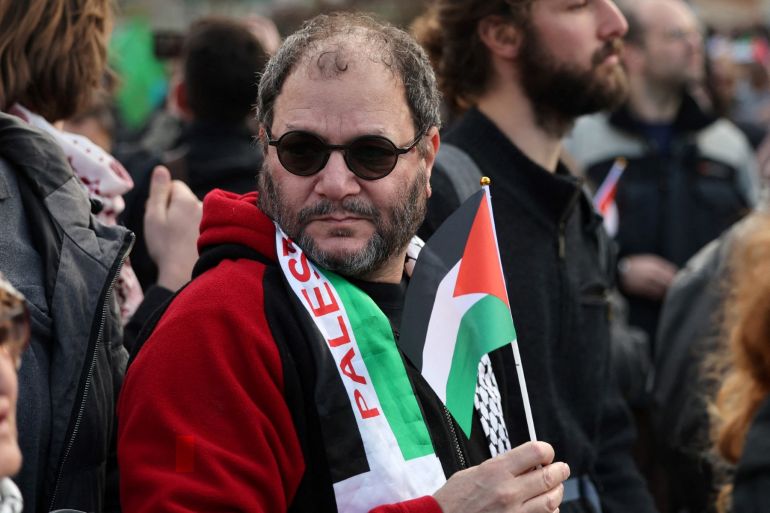 ‘The genocide hasn’t stopped. It’s continuing; it’s just moved from active to passive,’ Israeli lawmaker Ofer Cassif told Al Jazeera [Ahmad Gharabli/AFP]
Numerous analysts, including political economist Shir Hever, questioned Israeli leaders’ capacity for long-term planning.
Decisions, such as the attacks on Iran and Qatar, Hever said, were driven as much by domestic politics as overarching strategy. The Iran attack in June, for instance, coincided with a pending vote of no confidence in the government, while the Qatar strike in September may have been an attempt to refocus public attention away from Netanyahu’s ongoing corruption trial, he told Al Jazeera.
“There is no plan. Long-term planning is not how Israeli governments work,” Hever told Al Jazeera. “Smotrich and others have a long-term plan – they want to settle Gaza and expel Palestinians – but in real politics, there is no plan. Everything is short-term.”
Uncertain future
“I’m more optimistic than I have been for a long time,” Baskin, whose mediation between Israel and the PLO in the ’90s proved pivotal during the Oslo Accords, “There’s a new factor in play that hasn’t been there before: a US president that the Israeli government can’t say no to,” he continued, referring to the US decision to override Israeli objections against moving into phase two before Hamas’s disarmament, the inclusion of Qatar and Turkiye in the Board of Peace and the decision to open the Rafah crossing.
Cassif was less hopeful. “I don’t have any faith in this Board of Peace,” he said, “I think it’s now government policy to keep frustrating and delaying plans to form a stabilisation force; to just let people die while that happens.
“People accuse me of saying these things for politically cynical reasons, but of course, that’s not true,” he said, “I wish I didn’t have to say them at all.”
“It’s painful,” he continued, “And it’s painful to me not just as a humanist and a socialist, but as a Jew.”