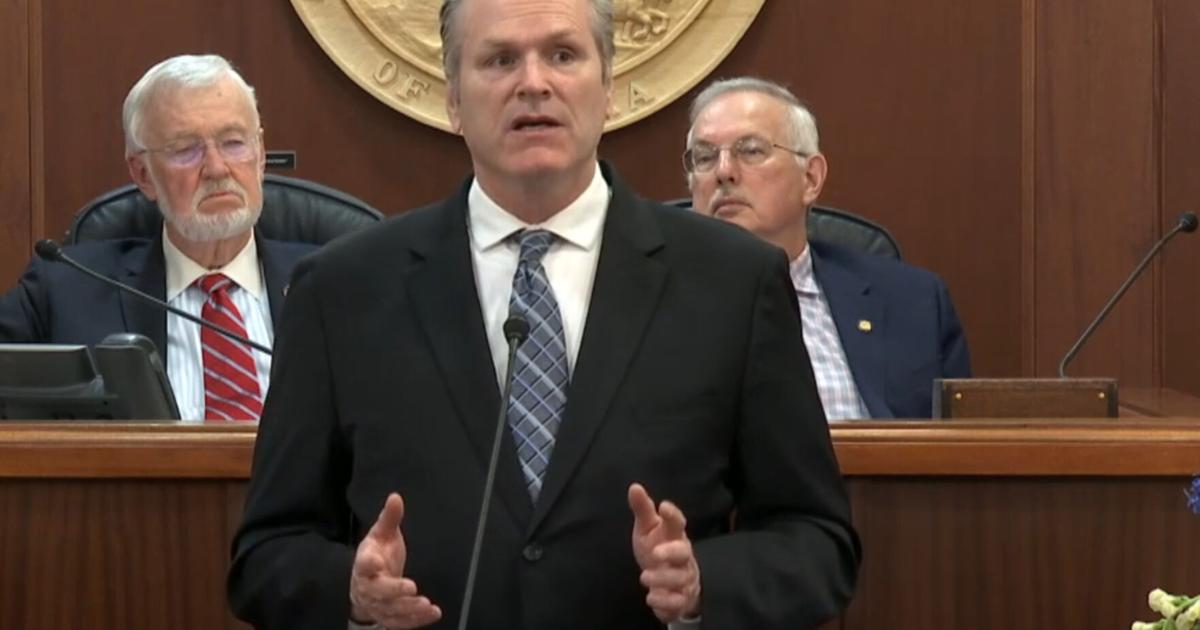
Gov. Mike Dunleavy presented a mostly optimistic look for Alaska’s future during his eighth and final State of the State address to the Alaska Legislature on Thursday.
“Alaska’s best days are ahead of us, not behind us,” Dunleavy said.
The address marks Dunleavy’s last year in office as he heads for the exit after being termed out and the latest stage of working in public government that ranged from being a superintendent, to lawmaker, to being elected governor.
“It’s been the best decision of my life,” he said. “Service is an honor, a privilege and a responsibility to live up to every day.”
He noted, despite criticism from various groups, that he had the support of Alaskans.
“Thank you for putting your faith in me for the last seven years,” Dunleavy said of Alaska’s residents. “It’s the people who are at the forefront of every decision.”
He recognized his wife and three daughters for supporting and “putting up with me in this role,” as well as members of his cabinet.
He pushed back against critics, arguing that his platform reflects voters’ decision to elect him, and pushed back against “interest groups” he said attempted to push their own agendas at the cost of Alaskans’ pocketbooks.
Dunleavy highlighted what he considered success stories during his seven years in office, including a 41% decrease in statewide crime, job gains and responses to 85 natural disasters ranging from fires and major storms to the Covid-19 pandemic.
He touted expansion of service at the Alaska Psychiatric Institute, a reduction in debt and improving gains of about $20 billion, embracing policies that benefit a wide range of energy sources.
“Some really great things have happened under my administration,” Dunleavy said. “Our economy has been getting stronger and stronger.”
He challenged the Alaska Legislature to work with him on developing a long-term fiscal framework in his last year. He said he intends to introduce elements for a fiscal plan.
“Each element will have its detractors,” Dunleavy said. “There will be those who’ll say it doesn’t work. But the fact of the matter is, the numbers and the elements of the plan could work.”
“This plan will allow Alaska to join the ranks of other successful states,” he said. “I want to minimize arguments over how much we spend each year.”
Dunleavy said Wednesday he intends to include “seasonal” sales tax during a cabinet roundtable. It represents a shift in his stance on taxes after seven years in office.
The proposed tax is intended to “maintain stability over five years,” something Dunleavy said will be financially tough if oil prices remain low and the federal government continues its reduced funding.
However, he avoided a direct reference to taxes during his Thursday address.
Dunleavy has toyed with or hinted at some type of tax over the past few years due as part of a long-term fiscal plan, but neither ever manifested. On more than one occasion, he vetoed legislation that would have implemented or adjusted state taxes.
“It’s the next five years that need our attention, that we need to stabilize,” he said.
He argued Alaska should not embrace a simple “spend-and-tax” policy, but instead push for broader policy.
“We shouldn’t be here to play politics or play games during an election year,” he said.
He added that he plans to introduce bills on workforce development, housing, and childcare.
“The goal is to build an Alaska-grown, Alaska-ready workforce,” he said.
He advocated for policies that embrace artificial intelligence, data services and technology.
“Let’s not be afraid of the future, of things like AI or robotics” Dunleavy said. “We can be a leader and active participant in developing our future.”
‘Positive relationships’
He blasted Biden-era policies, which he said disrupted Alaska’s mandate to be self-sufficient.
“No state suffered more than Alaska under that administration, but thankfully those days are behind us,” Dunleavy said.
He touted President Donald Trump’s efforts to help unlock Alaska resources during his first months in office, including the natural gas pipeline, repealing Biden-era protections on the North Slope.
“The list is exhaustive,” Dunleavy said. “Alaska is benefiting greatly from President Trump. We finally have a president who believes in Alaska. There’s no doubt that a positive relationship with the president is everything.”
He noted Alaska will benefit from $1.36 billion in federal rural health funds over the next five years. However, he skimped on details that the Alaska Legislature will need to take up policy to benefit from those dollars.
He said he intends to continue at full speed during his last year.
“There’s going to be no slowing down,” Dunleavy said. “There are too many opportunities for Alaska to execute.”
“We need to continue our work to strengthen public safety and put victims first,” Dunleavy said.
He stressed an emphasis on rural Alaska and continued stringent measures on fentanyl, which has become the major driver behind overdose deaths in Alaska. He added he’s pushed through reforms that include clearing a DNA backlog on sexual abuse cases.
“We have come a long way, but we still have a long way to go,” he said.
The governor doubled down on long-term prosperity due to resource development, the prospects of a natural gas pipeline, and increased North Slope oil production from projects like Pikka and Willow.
“The state’s future is bright,” he said, while reiterating additional work needs to be done.
Glenfarne Group, the Alaska LNG project’s majority owner, announced Thursday that several milestones pushed the project’s first phase — a 739-mile, 42-inch-diameter in-state pipeline — from development into early execution.
“We are on the cusp of realizing a decades-old dream,” he said of the Alaska LNG pipeline.
Dunleavy credited Glenfarne for pushing the pipeline forward over the last year, including securing a series of non-binding agreements and gas sale contracts in Asia.
“It’s a hungry company, one that does its homework,” he said.
Those milestones include tentative agreements for 700,000 metric tons of steel pipe, several conditional construction contracts and service awards with firms that include Fairbanks-based Doyon Energy Services and North Slope-based Cruz Construction, gas supply contracts with ExxonMobil and Hilcorp and a gas sales agreement with Enstar, Southcentral Alaska’s natural gas utility.
However, most of the project’s components are considered “conditional” or non-binding pending a final investment decision. Glenfarne officials cited confidentiality on funding mechanisms and the final pipeline price, but would be “reasonable and attractive.”
Tags:
- alaska_news
- Politics