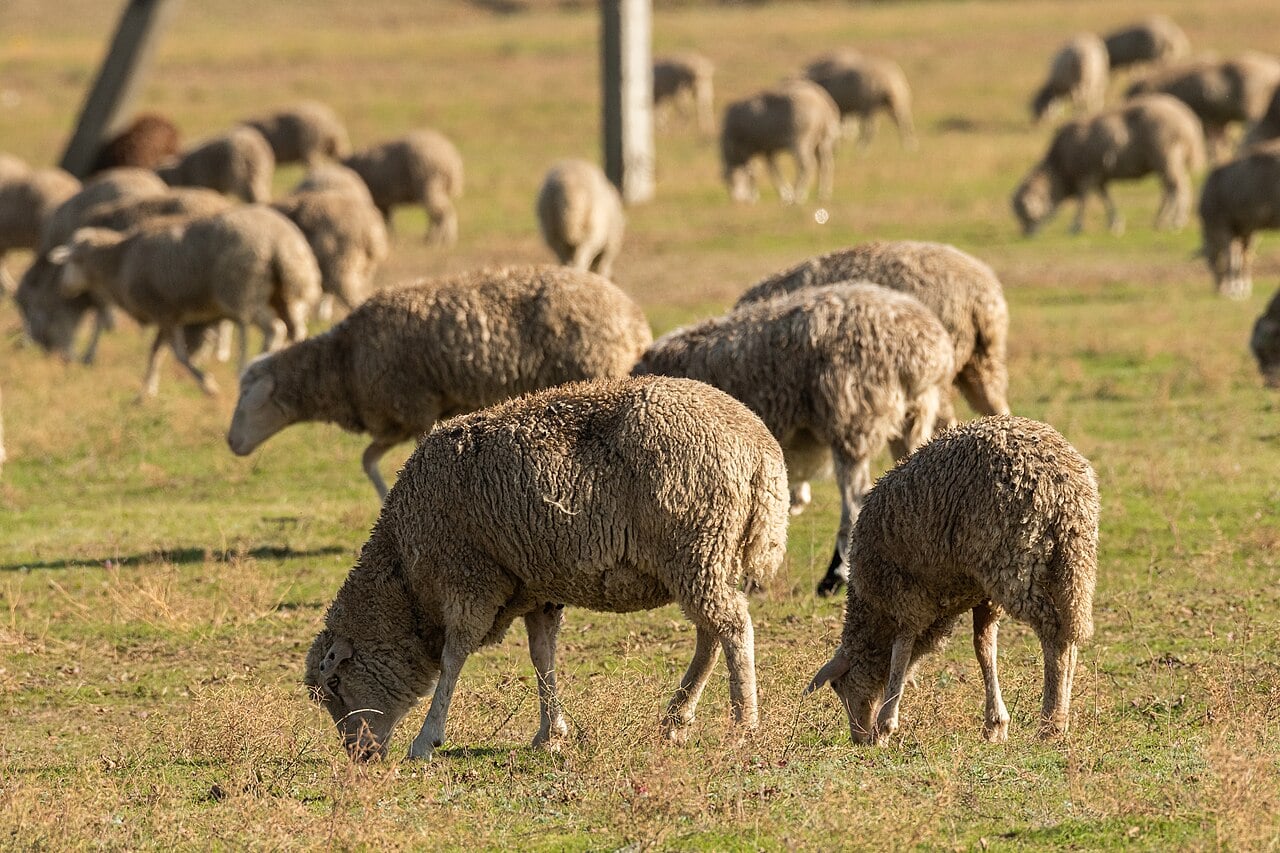
EU authorities support Greece’s biosecurity-first strategy as officials rule out vaccination for sheep pox. Credit: Wikimedia Commons / Горбунова mc / CC BY SA 4-0
Greece’s authorities have made clear that there is no approved vaccine for goat and sheep pox. For that reason, officials say strict biosecurity protocols remain the only reliable way to contain the disease.
At the same time, the government stressed that prevention, early detection, and strong control measures, not vaccination, continue to guide Greece’s overall response strategy.
Greece steps up emergency coordination amid sheep pox crisis
To strengthen the national response, a high-level meeting took place at the Greek Prime Minister’s office on January 22, 2026. The goal was to review the latest developments and coordinate the nationwide rollout of stricter biosecurity measures.
The meeting brought together cabinet ministers, the Secretary General for Agricultural Development, senior veterinary officials, and leading virology experts. As a result, the government aimed to ensure faster coordination and clearer implementation across the country.
EU supports Greece’s sheep pox control strategy
Government spokesperson Pavlos Marinakis said European authorities fully support Greece’s approach. In fact, he noted that no European country has adopted vaccination as a primary strategy, with Bulgaria cited as the only exception.
He also confirmed that vaccines are not currently approved for use. Therefore, Greece maintains that vaccination cannot serve as a practical option under existing European rules.
Scientific committee publishes Q&A to address concerns
To reduce confusion and respond to growing questions from farmers, the National Scientific Committee for the Management and Control of Goat and Sheep Pox released a detailed Q&A.
Through this document, the committee explained why Greece continues to focus on containment and prevention measures:
Vaccination would not stop transmission: The Committee warned that vaccination is not a shortcut. It does not stop the virus from spreading. Moreover, it may hide infections, which can delay detection and weaken control efforts.
No legal vaccine pathway in Europe: The Committee also said no vaccines have been approved by either Greek authorities or the European Medicines Agency (EMA). In addition, it stressed that using unapproved vaccines is illegal. More importantly, officials warned that illegal use could harm Greece’s position in international markets. As a result, exports linked to livestock and animal health rules could face serious risks.
Biosecurity remains the core defense: Officials have said Greece can control the outbreak only through strict adherence to biosecurity rules. These include disinfection procedures, movement restrictions, and continuous monitoring. The Committee also pointed to the most common reasons behind new outbreaks. For example, noncompliance with measures, delayed reporting of suspected cases, and illegal animal movements continue to drive transmission.
Compensation and financial support for farmers
Authorities confirmed that farmers whose animals are culled under disease-control measures receive compensation averaging €250 ($293) per animal. Greece says this level is higher than the EU average. In addition, farmers receive further support for animal feed and other operating costs.
In 2025, Greece distributed a total of €167.4 million ($196.5 million) in financial support linked to livestock epidemic management, broken down as follows:
€62.0 million ($72.7 million) for culled animals
€69.7 million ($81.8 million) for animal fees
€28.5 million ($33.4 million) for lost income
€7.2 million ($8.4 million) for operational costs of regional authorities
Greece pushes back on sheep pox misinformation
Government and scientific officials have warned that claims portraying vaccination as a stand-alone solution are misleading. Instead, they stress that Greece must rely on proven measures to stop the outbreak.
The Committee also rejected the idea of a “vaccine versus biosecurity” debate. According to officials, eradication depends on steady, science-based enforcement. Finally, authorities pointed to the wider economic impact, saying that Greece must protect agricultural exports, including its €1 billion ($1.173 billion) feta industry.