“No friends but the mountains,” a well-worn Kurdish adage goes. With no dependable allies in their neighbours or abroad, Kurds have throughout their history had to seek sanctuary from crackdown or the opportunity to regroup in the fight for greater autonomy by moving into the mountains.
But these mountains can also be inhospitably cold and cruel, an interminably tall and rugged barrier that bars them from more permanent safety.
After Saddam Hussein’s defeat in the Gulf War in 1991, emboldened Kurds and Shias launched uprisings that the Iraqi dictator duly moved to crush. As many as two million Kurds fled their homes, risking death by cold, starvation, or aerial bombardment.
On at the Arcola Theatre in London, Safe Haven tells the story of the obstinate determination of a Kurdish refugee and the resolute diplomats who fought for the John Major-led British government to launch a mission that would prevent a new genocide.
Safe Haven was written by Chris Bowers, a former British diplomat in Iraqi Kurdistan and a first-time playwright.
His access as a diplomat made him uniquely placed to tell of the dramatic political behind-the-scenes that led to Operation Safe Haven.
Chris learned of the operation’s origins during a conversation with Major, who visited Erbil during his diplomatic posting there.
“Major said he was told on a Sunday by three diplomats that he had to do it. These diplomats had bypassed the Foreign Office and got to him as he was flying to Luxembourg for a meeting with the European community,” Chris told The New Arab.
Chris met two of the three diplomats involved, as well as Dlawer Aladeen, the Kurdish refugee and postgraduate student whose persistence catalysed diplomatic action, and found supporting documents at The National Archives in Kew.
“I thought, this story has to be told,” Chris said. “It’s also about enabling Kurdish stories to be told – I say enable because I’m probably not the person to tell it from one perspective, but I am the person to tell it from another perspective.”
From Whitehall to the mountains
The play moves between deliberations at the Foreign Office, the home diplomat Clive shares with his wife Lisa, and the mountains of Iraqi Kurdistan, the stage divided roughly into thirds for the different locations.
Projections onto a frame carry us through mountainous landscapes or bear harrowing headlines. The stage sectioning and the projections carry us through the different settings with remarkable effect in what is a small studio space.
In London, diplomat Catherine is hardworking and quick-thinking; Clive, her more old-hand boss, tells her she is more than proving herself and should look to move up the career ladder.
“You had a good war,” he tells her of her Gulf War performance; “make the most of it.” But Catherine is also sentimental, idealistic, and willing to put prospects of promotion on the line to do what she believes is right, so when Dlawer pleads with her to force Britain to stop Hussein from committing a new genocide on Kurds, she is more than inclined to listen.
Set in the months following the First Gulf War, Safe Haven follows the desperate peril of millions of Kurdish civilians to the cold and remote mountains of northern Iraq, as they try to escape a violent crackdown [Ikin Yum]
‘Safe Haven’ explores the conception of Operation Safe Haven – the unprecedented mission that prevented a genocide [Ikin Yum]
The playwright for Safe Haven, currently showing at London’s Arcola Theatre, is Chris Bowers, a former diplomat who draws on his experiences to write about the Kurdish genocide [Ikin Yum]
There are also family reasons for Dlawer’s persistence; his pregnant sister, Nejat, is among those who have run for the mountains.
He is audacious and determined, and, as well as worming his way into the Foreign Office to meet Catherine, he is able, against all odds, to secure a meeting with former Prime Minister Margaret Thatcher and the then Archbishop of Canterbury to plead the Kurdish case.
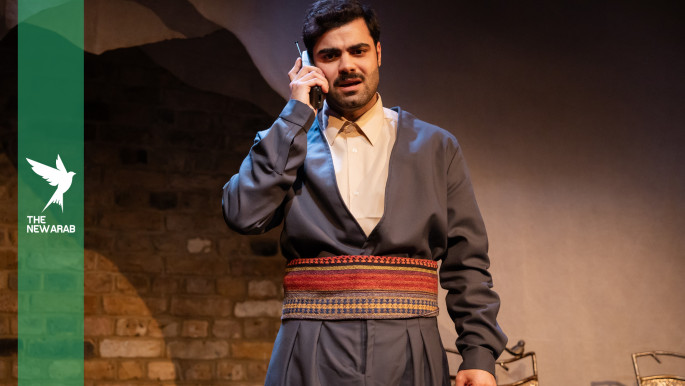
Dlawer is played by Kurdish actor and LAMDA graduate Mazlum Gul.
“What drew me in was that he isn’t written as a symbol or a statistic, but as a man trying to survive circumstances that are far bigger than him,” Mazlum tells The New Arab.
“Dlawer exists in moral grey areas, and that complexity felt important to honour, particularly given how Kurdish people are so often flattened into simplified narratives of victimhood.”
Dlawer is played by Kurdish actor and LAMDA graduate Mazlum Gul
Fuelled by Dlawer’s pleas, Catherine successfully wears Clive down with the help of his wife, Anne. The two diplomats hatch a risky plan to circumvent the usual diplomatic procedure and speak to Major directly.
An area for Kurdish refugees to come back to with near-guaranteed safety needs to be outlined and named. Verbal and legal gymnastics ensue; there can be no wording that hints of a potential precursor to a future independent Kurdistan. The term “safe haven”, however, is “indefinable, but life-saving”, Catherine explains.
While the diplomats push for Operation Safe Haven to materialise, we follow Nejat and her new friend Zeyra on their perilous journey through the mountains towards the Iraq-Iran border. They are cold, hungry and exhausted; every day that there is no action is a day closer to death.
Expressing the desires of so many Kurdish parents before and after her, Nejat says she wants to raise a child “who doesn’t have to hide in the mountains”, someone “who won’t die a martyr.”
The operation eventually gets the international approval it needs, saving an untold number of lives; it also paves the way for the eventual establishment of the semi-autonomous Iraqi Kurdistan that exists today.
Despite their Safe Haven success, the diplomats’ celebrations are muted. There is an acute awareness that had Major’s meeting in Luxembourg been on any other day, Safe Haven could not have come about.
Catherine is almost prophetic when she asks, “What next? There will be another genocide, what will we do then?” This tension between playing by the book and doing what feels right ultimately leads her to quit diplomacy altogether.
It also bears mentioning here that while Thatcher may have supported Safe Haven, the UK sent and allowed the sale of arms and military equipment to Iraq during her tenure as prime minister, while Hussein committed the Anfal genocide of the 1980s, including the Halabja massacre.
More than thirty years on from Safe Haven, the world’s attention on and empathy for Kurds remains fleeting and conditional.
“It’s been sobering to see how quickly such events fade from public memory, despite their long-term consequences,” Gul said.
“If this play encourages people to sit with complexity, to resist easy binaries of good and evil, and to recognise the human cost of political decisions, then I think it has done something meaningful.”
Safe Haven is on at the Arcola Theatre, London, until 7 February
Shahla Omar is a freelance journalist based in London
Follow her on X: @shahlasomar