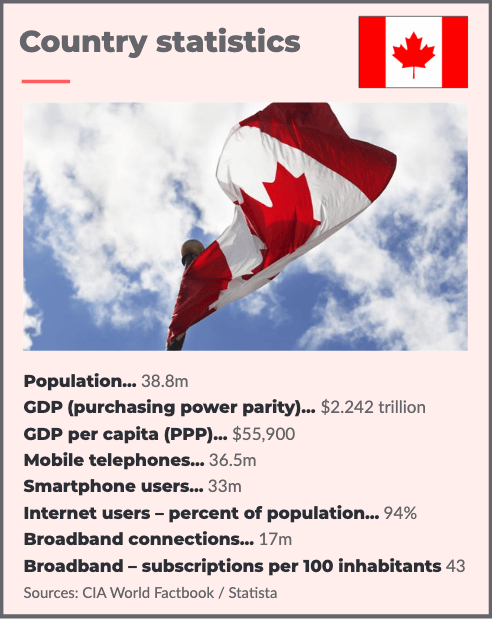
Canada is well-known for its stability, and its reputation in the music industry is no exception. With a 1.5% overall revenue increase in 2024 that upped the country’s earnings to US $660.3m, Canada persists as a reliable global player.
Here are the highlights:
Streaming takes up the lion’s share of the Canadian market, with Spotify dominating paid streaming and YouTube’s free tier with ads allowing for global penetration.
Canada is split into two musical ecosystems: the French market and the English-speaking market.
Centred in Quebec — a city hosting nine out of ten of the country’s population of 22% French-speakers — the French market also serves the outside markets of France, Belgium and Switzerland.
Toronto has historically functioned as the home base of the English-speaking industry, as home to all of the country’s major headquarters and a number of the big indies — though in the digital age, this dominance is waning.
Montreal is influenced by both Francophone and Anglophone tendencies, making it the most advantageous for cross-market reach.
Edmonton is also home to a flourishing underground scene, pioneered by artists like Homeshake, Mac Demarco and rapper Cadence Weapon.
The country music renaissance in Canada is blazing ahead — with US artists like Zach Bryan and Bailey Zimmerman reaching the tops of the Canadian charts. Canadian-based Punjabi pop and hip-hop are also rapidly surging worldwide.
Canada’s live music scene is booming, with many small yet iconic venues going strong — Hugh’s Room in Toronto, The Blacksheep Inn in Wakefield, and Yardbird Suite in Alberta are all well-loved local haunts.
How to break in Canada?
Get festive. Playing secondary and regional Canadian festivals is one of the most effective ways to build early name recognition. “Genre-focused festivals such as Boots & Hearts, VELD, Lasso, All My Friends Fest, and the Winnipeg Folk Festival can serve as market-defining opportunities,” says senior director of digital strategy at Nettwerk John Fielding.
Broadcast your horizons. The Canadian Broadcasting Corporation (CBC) is a key influence, as “the most national media that really gets to every corner of Canada,” says Michael Powell, head of A&R at Arts & Crafts Productions. Notable national radio stations include Bell Media, Cogeco, Rogers, Pattison and Stingray.
Use emotional regioning. Canada is not a one-size-fits-all market by any means. Consider locality-specific campaigns to the same tune of Carsen Grey’s Spotify Global Indigenous Playlist takeover, which took Canadian Indigenous music to a global platform.
For the scoop on budget predictions, top venues, an eye on influencers and more, check out Music Ally’s full Canada Country Profile.
Related Stories