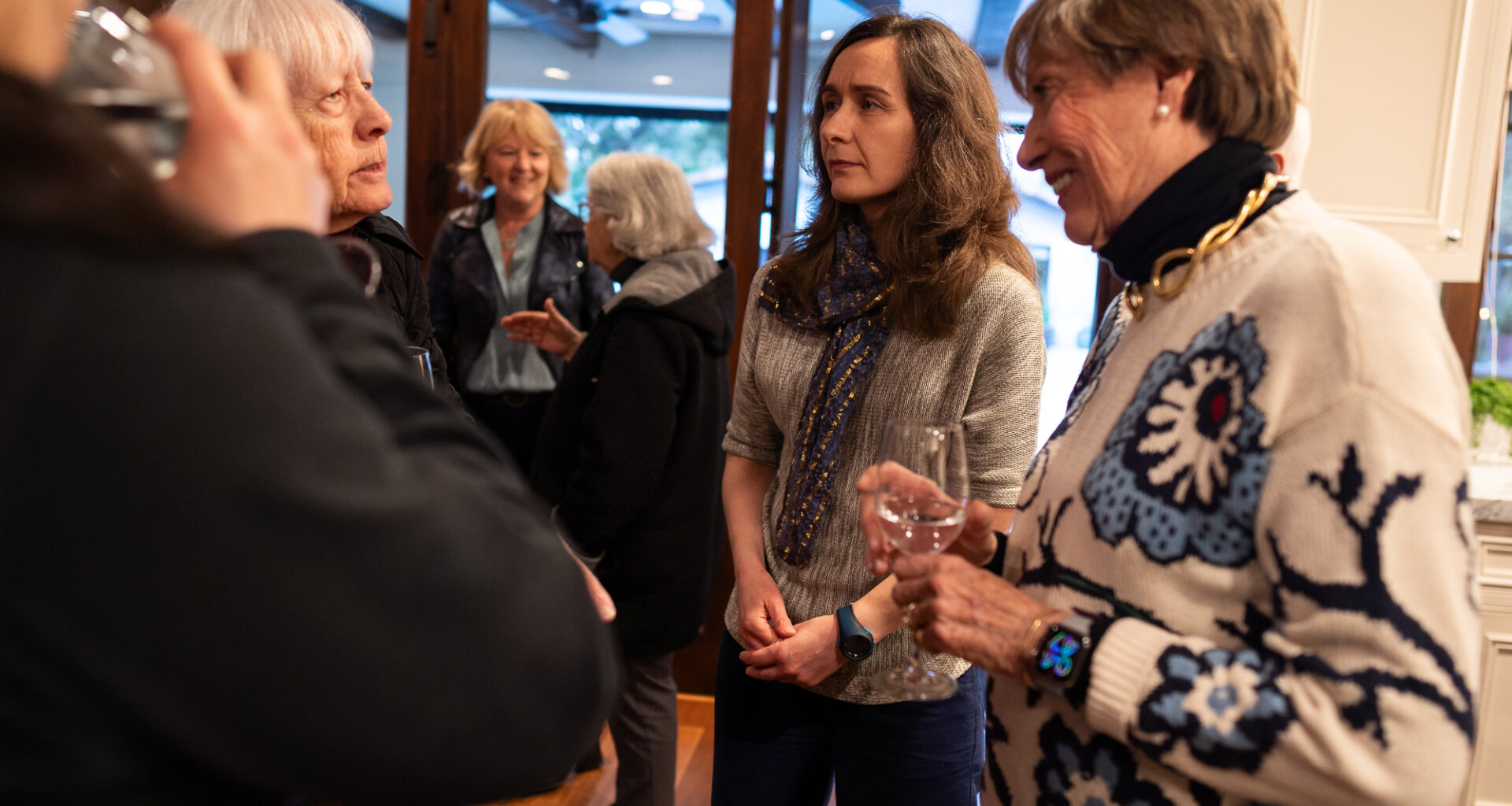
 Kathy Torgersen, right, and Assist Ukraine Director Olga Shpak, second from right, speak with attendees at a fundraiser for Assist Ukraine at Olenka and Robert Villareal’s house in Palo Alto on Jan. 20, 2026. Photo by Seeger Gray.
Palo Alto resident Kathy Torgersen is well known in political circles for her work on electing and supporting progressive candidates seeking higher office.
Over the past three decades, Torgersen has served as congressional director for former U.S. Rep. Anna Eshoo, worked on the political campaign of three-time Palo Alto Mayor Liz Kniss and volunteered with Close the Gap, an effort to get more women elected in state government. Fighting for democracy is very much in her DNA.
Now, Torgersen is immersed in a very different kind of campaign, one that she believes could reshape the world order: the war in Ukraine, which began with a Russian invasion in February 2022. Last June, she found herself as part of a small convoy speeding down the Autobahn in a used, four-wheel-drive Mazda with a manual transmission, a diesel engine and a broken driver’s-side window, heading toward the Ukrainian border. Her mission? To deliver the Mazda and two other similarly rugged and unglamorous vehicles to the Ukrainian soldiers defending their nation from Russia.
Joining her on the 900-mile drive were Palo Alto residents Bruce Swenson, a retired math teacher who had served numerous terms on the board of directors at the Foothill-De Anza Community College District, and his wife, Barbara Swenson, a retired Santa Clara County probation officer.
Like Torgersen, the Swensons are part of a small volunteer army dedicated to raising money and buying supplies for Assist Ukraine, a nonprofit group that works with Ukrainian soldiers to deliver urgently needed equipment. Last February, they hosted a fundraiser at their home that raised about $80,000 to buy generators, laptops, tourniquets and other medical supplies for Ukrainian troops.
Because generators emit noise and heat and are thus vulnerable to drone strikes, Palo Alto’s donors also helped the troops purchase cable that would allow them to position the devices away from the trenches. Like Torgersen, the Swensons said they believe the Ukrainian war is among the most critical conflicts facing the world today.
“We both follow Ukraine closely from an international perspective,” Bruce Swenson said. “We think it’s one of the key issues that NATO and the U.S. are facing in the coming years.”
When Torgersen suggested going on a mission to deliver used vehicles to Ukrainian soldiers, the Swensons eagerly signed up. Rounding up the convoy was Dick Cantu, a Los Gatos resident and fellow fundraiser.
Torgersen’s work on behalf of Ukraine may seem far removed from the type of organizing and fundraising work that is typically required in a political campaign, but she sees both efforts as part of the same fight to protect and defend democracy. In the late 1990s, when working for the relief organization International Rescue Committee, Torgersen lived in Albania and helped assist refugees who were displaced during the war in the Balkans.
When the war in Ukraine began, Torgersen offered to hold fundraisers for the IRC to assist the civilian population under attack. As the war dragged on and settled into the present state, with drones dominating the battlefield and the two armies mired in a violent stalemate, she felt compelled to get involved more directly.
“I felt Ukraine was fighting our war — that they were on the frontline for democracy,” Torgersen said. “Here I was, trying to be a good citizen and trying to work on campaigns of people who I believe will bring good governance to the country and the state and our local government — and I believe Ukraine was on the forefront of really protecting western democracies.”
The June journey wasn’t Torgersen’s first recent venture into Eastern Europe. In late February, she and her husband, Mike, flew to Poland with six giant bags containing 300 tourniquets as well as chest seals, trauma scissors and other supplies. While there, she met Olga Shpak, director of Assist Ukraine, and Anna Husarska, a veteran war correspondent whose portfolio of coverage includes military conflicts in dozens of nations, including the Balkans, Iraq and Somalia, and whose work has appeared in the New Yorker, Washington Post, the New York Times and other publications.
Both women are now heavily involved in procuring emergency supplies for Ukrainian soldiers. Shpak is based in Kharkiv, the second-largest city in Ukraine and a frequent target of Russia’s bombing campaigns. From her vantage point less than 20 miles from the front, Shpak keeps in touch with dozens of brigades that are fighting on the frontlines to learn about their most critical needs. Husarska, a former senior policy adviser at the IRC, uses her extensive contacts to procure automobiles, medical equipment and other supplies for Ukrainian soldiers.
“If you’re a commander in the front, you find out Olga’s number,” Torgersen said. “Word travels fast.”

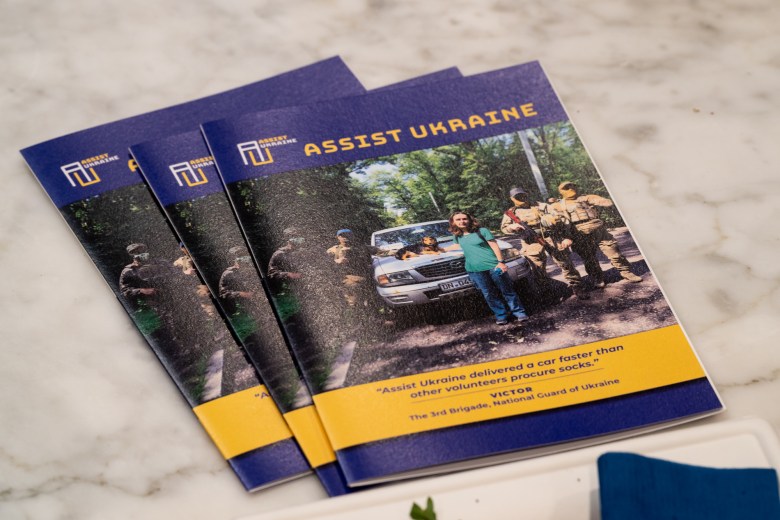 Pamphlets about Assist Ukraine with a photo of executive director Dr. Olga Shpak with a vehicle she delivered to Ukrainian soldiers on a table at a fundraiser for Assist Ukraine at Olenka and Robert Villareal’s house in Palo Alto on Jan. 20, 2026. Photo by Seeger Gray.
Shpak’s nonprofit, Assist Ukraine, purposely avoids dealing with the higher echelons of the Ukrainian government and military, which would necessarily involve additional bureaucracy and delays, Shpak said. It acts like an “emergency organization” that soldiers can count on for a quick response.
“We’re not strategic, we’re tactical,” Shpak said in an interview. “We’re trying to fill the gaps quickly.”
Through their regular correspondence, Torgersen and other Palo Alto volunteers learned about one crucial need: vehicles. The battlefield in Ukraine features what Shpak called a “kill zone,” an area about 30 km (18.6 miles) wide separating the two armies. Because of the preponderance of enemy drones, combat units are generally stationed about 20 km (12.4 miles) away from the kill zone. When soldiers engage in combat tasks and travel within the zone, they have to carry their food, ammunition and other equipment.
Given the nature of the war, the Ukrainians desperately need off-road vehicles that can be used to transport equipment, perform medical evacuations and retrieve the bodies of fallen soldiers, Shpak said.
“If they have to walk 15 km (9.3 miles) carrying 60-70 kg (132.3 to 154.3 pounds), imagine how vulnerable they are as they walk. They can’t run; they can’t hide,” Shpak said.
Because the drones are now ruling the war, the vehicles that the Ukrainian soldiers acquire generally have a short shelf life, she noted. Ukrainians have tried various tactics to avoid drones, including jamming the radio signals that the Russian army was relying on. The Russians responded by ditching radio signals and switching to fiber optic cables that unspool like fishing threads and carry the signal to the drone, she said.
The upgraded drones leave Ukrainians with two unenviable options: jump out of the car or try to outmaneuver the drone by swerving at high speeds. A typical car, Shpak said, only lasts about two weeks on the frontlines.
“The enemy understands that vehicles are important, and they are the primary target for the drones,” she said. “So a lot of vehicles unfortunately become destroyed within weeks after they enter the frontlines, but there is no substitute.”
Learning this, Torgersen resolved to help.
The voyage begins
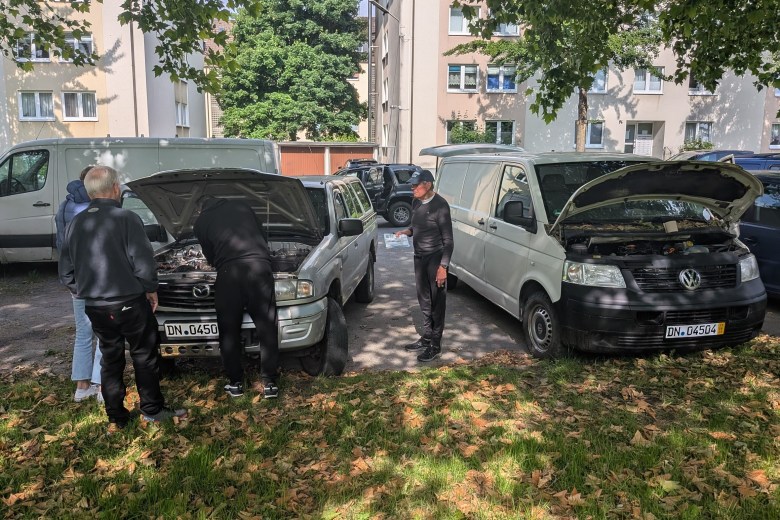 Bruce Swenson, center, stands by during an inspection of the vehicles that he and others were delivering to Ukraine in June 2025. Photo courtesy Bruce and Barbara Swenson
Torgersen and her party knew finding suitable vehicles would be a challenge. To function on the terrain of the battlefield, each vehicle needed to be all-wheel-drive and run on diesel fuel. The demands of the war have largely driven such vehicles into extinction. Ukraine, Germany and Poland have been largely depleted of such vehicles, she said.
The group had some false starts. Initially, a donor in Belgium offered to help the group find several 4WD vehicles in Brussels. Torgersen and Shpak spent six weeks searching for these cars and ultimately found them. But just as they were preparing to send a volunteer to Brussels to buy the cars, they discovered that it was illegal for individuals to export cars from Belgium, Torgersen said. They had to start over.
Barbara Swenson said it took about a month to find suitable vehicles.
“We looked in England and found that we wouldn’t be able to take cars out of the country, we looked in Belgium, where a friend found all these cars but we couldn’t license them and take them out of the country,” she recalled. “We went down a lot of rabbit holes.”
Help came in the form of a young attorney named Igor Yarmechuk, an Assist Ukraine volunteer who was living in Cologne and scouring Europe for vehicles. He informed Torgersen and her group that he found three such vehicles and was ready to buy them, provided someone can pick them up and drive them to Ukraine. A week later, Torgersen, Cantu and Bruce and Barbara Swenson were on their way to Germany to pick up their three-car fleet: a Mazda 4×4, a Jeep Cherokee and a VW Transporter that they dubbed “Bill.”
With Shpak’s help, the group was able to get export plates for the cars, which would expire in six days. Eager to get going, the group had to bring the cars to a mechanic for tests before they hit the road, a stop that took about four hours, Bruce Swenson said.
“It was a whole lot of waiting and waiting,” he said.
After numerous right and wrong turns, the group finally found itself on the Autobahn, passing through the German countryside in janky but rugged vehicles filled with supplies. They would drive 10 hours per day over the next three days, covering about 350 miles each day.
“We had to stay together on the Autobahn and that was very hard because 90% of the cars are huge semis, and they don’t like to be messed with – they don’t want you going around and trying to squeeze in front of them,” Barbara Swenson said. “To get an opening where you can have three cars go around a truck was tough. We wanted to go faster than the trucks, even though we couldn’t go faster than 60 mph.”
The cars, while suitable, had some issues. For one, they were filthy.
“They looked like they hadn’t been washed for 20 years. You couldn’t see out the back window — it was so dirty,” Barbara Swenson said.
The Jeep had only one functioning headlight. And at the end of the first day, Torgersen encountered an inconvenient quirk in the Mazda: Its electric windows were broken and the one on the driver’s side was held up manually with a shim. As she pulled off the Autobahn, she heard a loud “thunk” and watched the window drop into the door slit.
She drove the next 600 miles with the window open.
Lodgings were another challenge during the journey, Barbara Swenson said.
“There aren’t a lot of hotels or motels along the freeway so you have to go into a town and not know what’s in town,” Barbara Swenson said. “One night we waited too long and couldn’t find a place. It was like 10:30 and we were exhausted.”
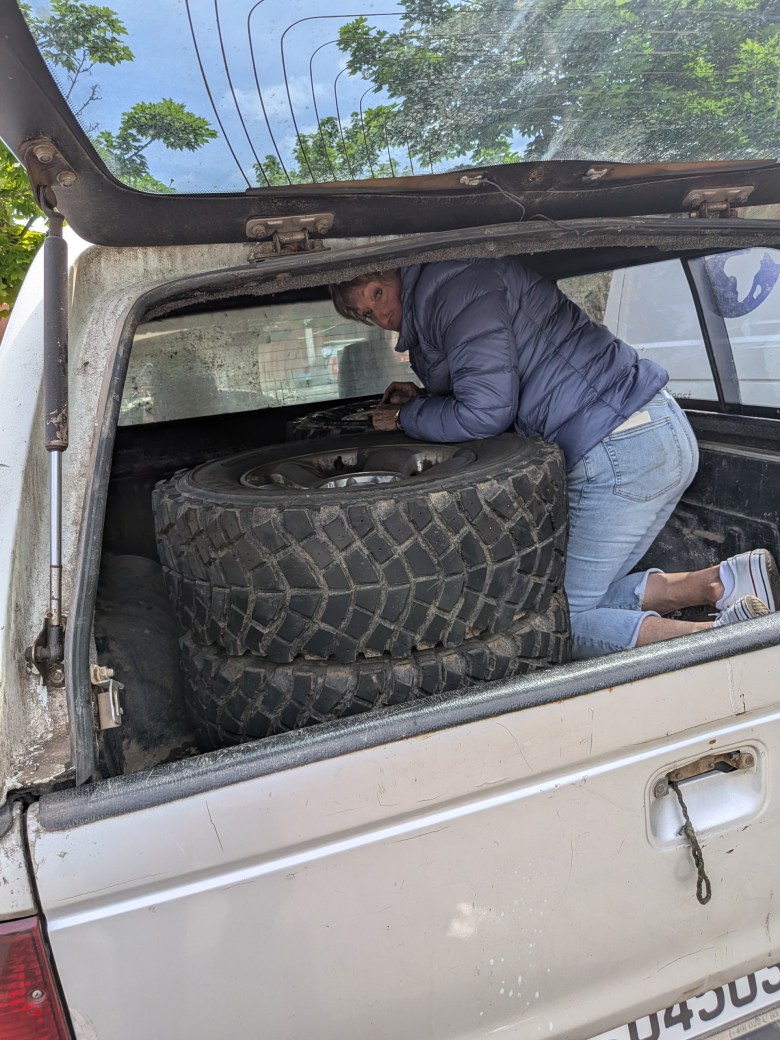 Kathy Torgersen is in the trunk of one of the vehicles that she and other Palo Alto residents were delivering to Ukraine in June 2025. Photo courtesy Bruce and Barbara Swenson
They ultimately stumbled upon a quirky hotel at Leipzig, with huge statues of giraffes in the lobby and life-size flamingos painted on the walls. They grabbed a bite at a local Afghan restaurant, crashed for the night and then took off the following morning to Krakow for a rendezvous with Husarska, who would help them cross the border into Ukraine.
Getting across the border proved to be its own ordeal for a trio of cars loaded with military equipment, according to Torgersen. The convoy’s initial attempt to get through a small border crossing was summarily rebuffed, forcing them to drive for another three hours to a more central crossing at the official Polish border. According to Torgersen, the group waited for several hours as Husarska shuttled between offices, gathering the needed papers and official stamps, Torgersen said. Finally, the group was allowed through customs. The cars passed through a display of incinerated farm machinery, a memorial to the farms that had been devastated during the war. A few hours later, they arrived at Lviv, where they were greeted by Shpak and other volunteers in the scrappy and logistical operation.
“We were feeling relief that we made it through,” Bruce Swenson said. “We were feeling great anticipation about arriving at our destination in Lviv and turning the cars over to the soldiers.
“That turned out to be a very emotional experience. The soldiers were waiting for us there when we arrived. They wanted to just drive the cars and drive off. We insisted on a few photos, then they jumped in the cars and drove them off to the front lines.”
The million dollar idea
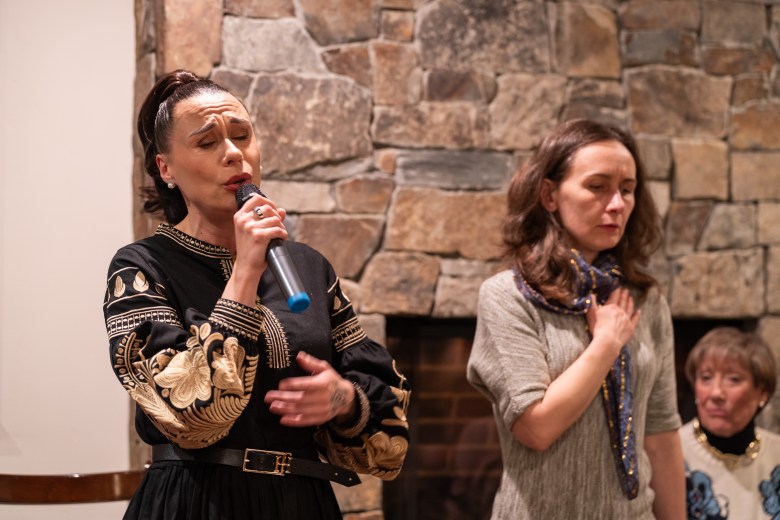 Kateryna Boiko sings the Ukrainian national anthem during a fundraiser for Assist Ukraine at Olenka and Robert Villareal’s house in Palo Alto on Jan. 20, 2026. Photo by Seeger Gray.
Having successfully delivered the vehicles to Ukraine, Torgersen and other allies from Palo Alto are now facing their next challenge: raising $1 million for additional equipment.
The world has changed since Russia’s invasion, with Iran and Greenland now dominating news coverage, and the grinding conflict in Ukraine receding from the headlines. The work of raising money to support the troops has only grown more difficult as fatigue has set in among donors across the world.
Husarska said that in the early phases of the war, it would take her about a week to raise money to buy an SUV in Poland to send to the soldiers.
“Nowadays, it’s three to four months to get the same amount, and we proceed exactly the same way,” she said.
The Ukrainian army also has changed. At the beginning of the war, it consisted of about 260,000 professional soldiers, according to Shpak. Now, it’s about 900,000 soldiers, most of them civilians who have been drafted.
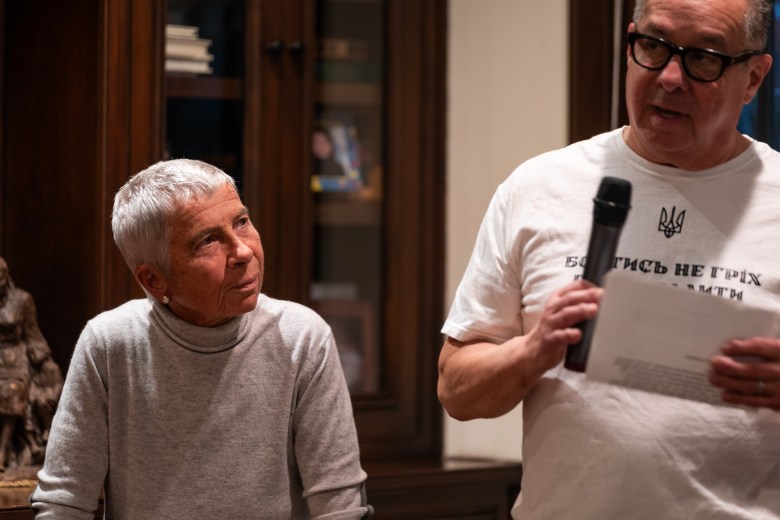 Robert Villareal introduces journalist Anna Husarska at a fundraiser for Assist Ukraine at Olenka and Robert Villareal’s house in Palo Alto on Jan. 20, 2026. Photo by Seeger Gray.
The need for equipment and generators remains as acute as ever, particularly as Russia continues its relentless bombing campaign, much of it directed at energy infrastructure. Assist Ukraine raised $469,017 in 2025, according to Shpak, with 39% allocated for vehicles. The total also included $52,246 for energy equipment and $63,415 for medical equipment.
Her group is hardly the only organization trying to aid Ukraine. But Husarska noted that while many people donate to nonprofits like the IRC, these groups focus exclusively on supporting civilians and have rules that specifically forbid the distribution of military equipment,
“It’s really the defenders who need to be supported,” Husarsksa said. “Yes, we all know that in the U.S. the GIs get everything they need, in Ukraine it’s not like that. If a soldier loses a tourniquet, they will not replace it. We will replace this tourniquet. If their car is bombed, they will probably call Olga, and she will probably call me, and I will search on my WhatsApp who can deliver a car, and we will deliver a car.”
Husarska and Shpak were both in Palo Alto this week, meeting potential donors and speaking to other local supporters of the Ukraine effort. On Jan. 20, they addressed a group of about 50 people at the home of Olenka Villarreal, the founder of the Magical Bridge Foundation, which builds playgrounds for residents with disabilities.
Shpak underscored the need for providing Ukrainian soldiers with power equipment, including drone jammers and generators that ensure a continuous source of electricity in the trenches. Yet getting a damaged generator replaced could take far too long
“This is a 21st century war,” Shpak said. “It’s a mix of trench war and modern, high-end technology. You’ll be dead if you don’t have electricity. You depend on radios, you depend on your tablets with military software that shows the positions of your side and positions of the enemy.”
Assist Ukraine estimates that it would take about $10,000 to buy and repair a used vehicle that is suitable for the front, $2,500 for a cache of medical supplies, including tourniquets, chest seals bandages and hypothermia prevention kits, $1,000 for radios and a pair of Starlinks. Shpak estimates that her organization has dispatched millions of dollars of life-saving supplies to more than 60 brigades fighting at the front.
Torgersen encouraged those in attendance to support these efforts. The war, she noted, is about to enter its fifth year, with no end in sight. Last year, more lives were lost in Ukraine than in 2023 and 2024 combined, she said. During her presentation, Torgersen showed to the crowd a brochure featuring a photo of the car that she drove from Cologne to the Ukrainian border.
 Heart-shaped Ukrainian flag cookies at a fundraiser for Assist Ukraine at Olenka and Robert Villareal’s house in Palo Alto on Jan. 20, 2026. Photo by Seeger Gray.
“What I came to understand on that trip, on that journey, is what those vehicles represent to a soldier,” she said. “This vehicle is a lifeline. It delivers sleeping bags, stoves, generators, first-aid supplies. It’s their Amazon truck. It’s also a bus — it transports soldiers along the line and a lot of their gear and equipment.
“And it’s also an ambulance – it gets them to medics and then to stabilizing hospitals. And finally, it’s a hearse. It returns the soldiers to their families so that they can be buried with honor.”
Attendees offered their own ideas for helping Ukraine, from reaching out to large car manufacturers for assistance to exploring the possibility of bringing autonomous vehicles or ebikes to the war-torn nation. Some pledged support and, as the event concluded, those with Ukrainian background joined in the singing of the Ukrainian anthem, which was led by a singer from Ukraine. Holding their hands to their hearts, they sang in unison, “Shche ne vmerla Ukraina,” which translates to, “Ukraine has not yet perished.”
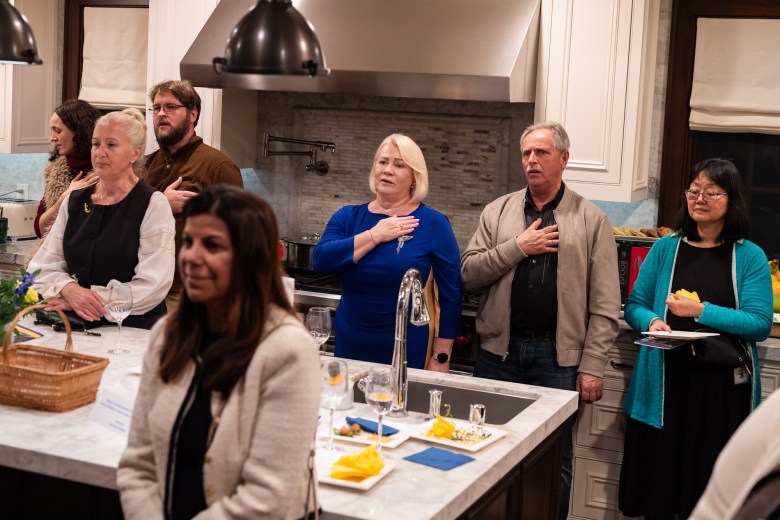 Attendees sing along to the Ukrainian national anthem during a fundraiser for Assist Ukraine at Olenka and Robert Villareal’s house in Palo Alto on Jan. 20, 2026. Photo by Seeger Gray.
Most Popular