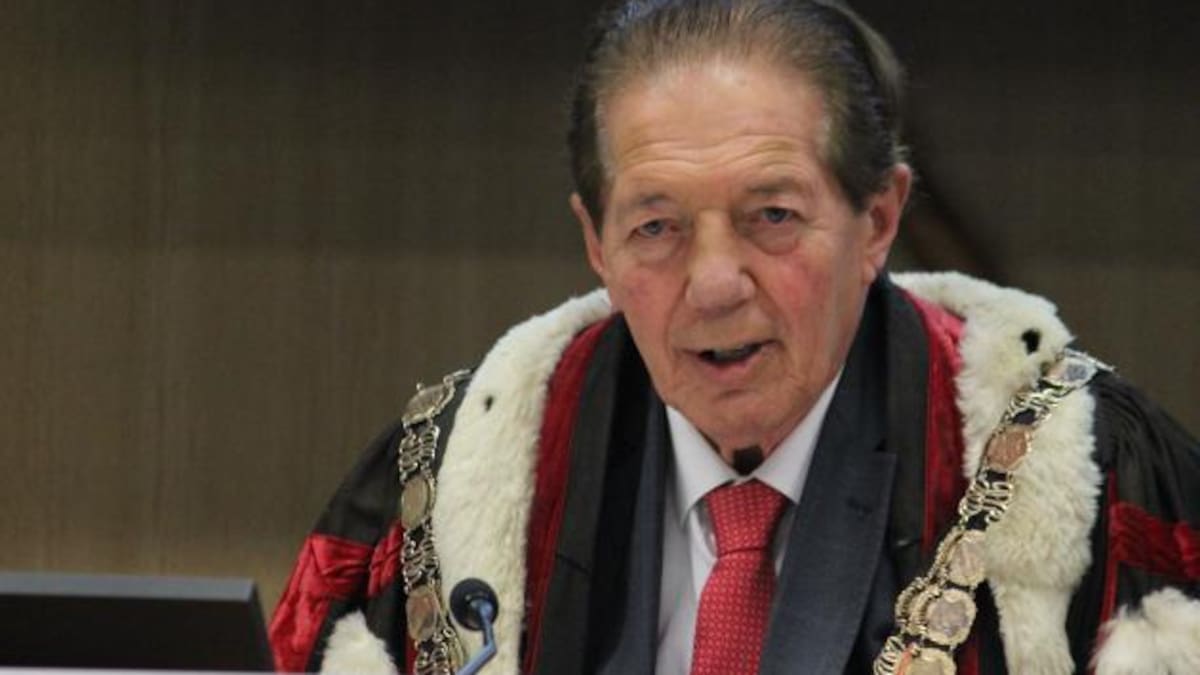
With minutes to go, the main auditorium sat at about half its 1000-seat capacity and council staff began quietly reshuffling attendees from the upper level to fill the lower floor.
Then family and figures from across Shadbolt’s life as New Zealand’s longest-serving mayor took to the stage to share anecdotes and tributes.
Mourners might have expected an upbeat tone, by funeral standards.
During his 27 years in office in Invercargill, Sir Tim championed initiatives aimed at revitalising the region’s economy, including support for the Southern Institute of Technology’s zero-fees scheme to attract students and slow population decline. He oversaw major civic developments, including Stadium Southland and upgrades to the airport and Civic Theatre.
In recognition of his service to local government and the community, he was knighted in 2019, and in 2024 Invercargill Airport’s terminal was named in his honour.
His larger-than-life persona, from breaking the world record for the longest television interview to frequent media appearances, helped put Invercargill on the national map.
But towards the end of the nearly four-hour service, Sir Tim’s partner, Asha Dutt, stood to speak, telling those gathered she intended to “fire a few shots” – on Tim’s behalf.
That proved to be an understatement.
‘Blood on their hands’
“The council of 2019 have blood on their hands,” Dutt would go on to say.
“He walked into that council every day knowing he didn’t have a single friend – and he didn’t.”
Others would “sit around and take shots at him”, she said.
“Can’t you imagine those coward punches to his feelings and to his soul?”
Others had “lived in Tim’s shadow and any chance to step into the limelight was gladly received”, she said.
“I actually asked those people not to attend this service … I feel the hypocrisy of those people sitting here today for the sake of attendance.”
Dutt said it was “the extreme stresses placed upon him” and “the total lack of support” that harmed both his health and hers.
“In the final days, he was told to pack up his office and leave. When we asked for boxes to facilitate this, the reply from the CE, I don’t think I’ll ever forget – ‘we don’t have the budget for boxes’.”
“How he exited his career is a shame on you.”
She left the stage to a standing ovation.
In the days following, headlines flared with current and former Invercargill City councillors coming to their own defence. The council told the Herald boxes were provided to Shadbolt after the 2022 election.
But what really went on in Sir Tim Shadbolt’s final stint as New Zealand’s longest-serving mayor? The Herald spoke to several former council staff who worked closely with Shadbolt during his final term. All requested anonymity due to the sensitivity of the period. Their accounts were consistent.
‘Some showed care and kindness, others did not’
Former deputy mayor, Nobby Clark, who went on to unseat Shadbolt in the 2022 election, said Dutt’s characterisation was unfair.
“Very, very much so,” he said. “That wasn’t true.”
Throughout Shadbolt’s eighth and final term, his mayoralty came under mounting pressure – all the while, conversations about his health swirled.
One former staffer said the suggestion that council staff had acted with malice toward Shadbolt did not reflect their experience.
“I never felt there was any underhanded effort to isolate him or undermine him,” they said.
“My sense was that people were trying to accommodate the situation and protect his dignity as best they could.”
Current councillor Darren Ludlow, who had served alongside Sir Tim for several terms as well as a period as deputy mayor, said “it was clear that Tim was struggling” and that councillors had attempted to restructure how the council operated, in part to support him.
The sentiment was shared by several former council staffers who worked under Sir Tim’s leadership.
One said there was “a lot of scaffolding” around the mayor’s role by that stage.
“His health was quite deteriorated.”
“Operationally, there was a lot of support around the role, and a lot of responsibility for keeping meetings running was carried by the deputy mayor [Clark].”
Ludlow said the council had “certainly tried” to handle the period as well as it realistically could, while acknowledging tensions and frustrations were unavoidable.
Former deputy mayor Toni Biddle, who resigned from the council in 2020 citing the strain of the environment, said the reality of the period was complex.
“I think, to be fair, there is truth on both sides. Sir Tim required support. Some councillors showed him care and kindness, and others did not. That’s the reality,” she said.
“Those involved, including Sir Tim’s partner, will need to own their own actions. At this point, I hope they all allow him to rest in peace with the love and respect he deserves.”
Former staffers said there was deep personal affection for Shadbolt within the organisation, even as the situation became more difficult.
“We all loved Tim. It was sad to see what was happening to him, and we wanted to support him,” one said.
They described an internal culture of trying to protect the mayor’s dignity, while managing the practical realities of a role that was becoming harder for him to perform.
At the same time, they described a council environment that had become increasingly tense and politicised, with frustration often directed at officials rather than elected members.
Biddle said the experience also exposed deeper problems with the system itself.
“I don’t think there’s any actual process or opportunity to work through that if a mayor is unwell or demonstrating signs that they’re unwell.”
‘I’ve just been destroyed’
In a March 2020 Stuff column, Shadbolt publicly described his relationship with councillors and senior officials as fractured, that a “rather awkward black shadow” hung over his dealings with the organisation.
The trigger was a bitter dispute over who should pay his legal costs after he was unsuccessfully sued for defamation over columns he had written while acting as mayor – a battle that ultimately left him saying the council had told him, in effect, “you’re on your own”.
He wrote of councillors “running for cover” near election time, of governance failures around major projects, and of a council culture he believed had become increasingly risk-averse and internally political.
In an interview with the Herald on Sunday, he said he was facing potential bankruptcy over legal bills, amounting to more than $350,000.
“I’ve just been destroyed – a bit of a tragic ending for a comedian really,” he said, admitting he was still working partly because he needed the income.
In October 2020, an independent governance review commissioned by Invercargill City Council after intervention from the Department of Internal Affairs concluded there was “a clear consensus” among interviewees that the mayor was struggling to fulfil significant aspects of his role, creating what the reviewer described as a “leadership void” at the top of the organisation.
The report recorded that multiple councillors and senior staff described confusion, memory issues and the need for the mayor to be closely supported in order to manage meetings – adding that some attempts to shield those difficulties from public view were increasingly failing as concern grew inside the council and across the wider community.
The report touched on concerns about Sir Tim’s memory. Former staffers told the Herald they observed occasions where he would reintroduce himself to long-standing council staff.
Although the review was initially released with senior leadership presenting a united front, Shadbolt, to the shock of many in the room, publicly rejected its conclusions, saying he had been unfairly singled out and accusing some councillors of actively undermining him.
“The council had a response, and his address was different and unexpected,” Ludlow said.
Former staffers told the Herald the unexpected turnaround surprised many, as Sir Tim had disregarded a prepared speech without prior warning.
Clark said councillors would often reach consensus in meetings – including those with Shadbolt present – only to see public statements emerge days later that contradicted what had been agreed.
“That made it really hard to present a sense that things were stable,” he said.
In 2021, Sir Tim publicly revealed he had been diagnosed with muscle tension dysphonia, a condition affecting his voice and was confronting commentary about memory and leadership in council settings.
It was revealed later that year that his driving licence had been suspended.
A 2022 Otago Daily Times report described an incident at a council meeting where he appeared to shut down mid-discussion. In response, he denied he had been asleep.
That same year, the then 74-year-old was once again contesting the mayoralty – but with an increasingly diminished presence.
During his campaign, Sir Tim did not attend any of the major scheduled mayoral debates and his statements to the media were made through text or email.
A former staffer said communication with the mayor increasingly occurred through intermediaries, and that Sir Tim’s partner was often the point of contact for scheduling and correspondence.
“I saw her respond directly to queries sent to his official email,” the staffer said.
“She organised meetings and appearances and handled requests, effectively as if she were his PA.”
At a debate organised by the Southland Business Chamber, a statement was read on Sir Tim’s behalf: “I consider my participation would add direct focus to the delivery of my message rather than the content of my message,” it said.
When the ballot was counted in October 2022, Shadbolt was defeated decisively by his deputy, Nobby Clark, who won 7357 votes to Shadbolt’s 958, ending a long chapter in Invercargill’s civic life.
Despite the tensions of that final term, Ludlow said Shadbolt remained “an icon” to many who worked alongside him, and someone who “never turned people away” when they wanted time or conversation.
Clark echoed that sentiment, describing Shadbolt as “a lovely man” and “a great orator”, whose generosity with the public was part of what made him so enduringly popular.
After losing the mayoralty, Sir Tim withdrew almost entirely from public life.
By late 2024, he was no longer making any public appearances, and attempts by the Herald to contact him directly were unsuccessful.
Dutt had previously confirmed Sir Tim had spent time in respite care at Calvary Hospital and was described by associates as fiercely protective of his privacy.
Those who had known him longest said the retreat was painful to witness.
In a previous interview with the Herald, Sir Bob Harvey described the final phase of Sir Tim’s life as tragic in the classical sense: a man who had once dominated every room now largely unseen.
Gary McCormick said the legal battles and controversies of his final years had taken a visible toll on his health and wellbeing.
Biddle said: “Tim was kind to everyone and that’s what I’ll remember.”
A former staffer said what weighed most heavily on morale was not political conflict, but witnessing the decline of a figure who had long been central to Invercargill’s identity.
“You could still catch glimpses of the person he had been,” they said.
“It was hard watching someone who had been such a pillar of the community fading away.”
Asha Dutt did not provide comment directly for this article. Former ICC chief executive Clare Hadley declined to comment.
Ben Tomsett is a multimedia journalist based in Dunedin. He joined the Herald in 2023.