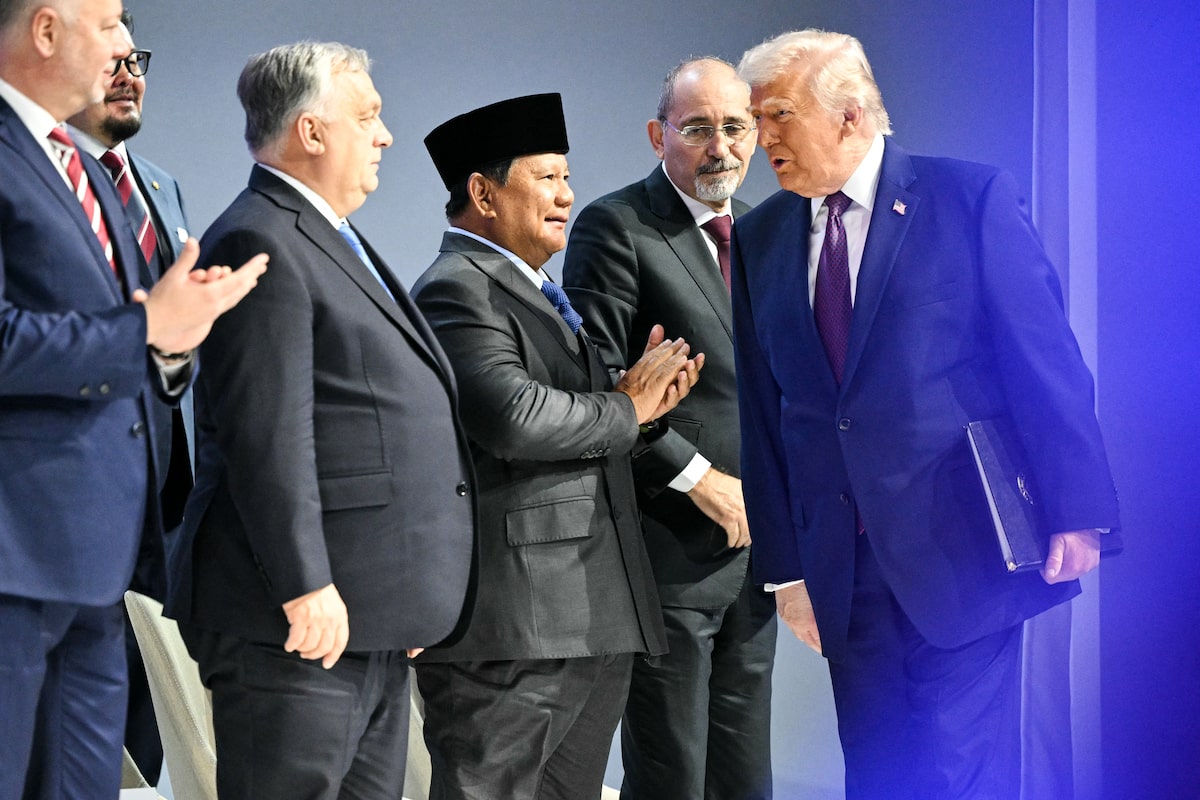
U.S. President Donald Trump walks past Hungary’s Prime Minister Viktor Orban, third from left, Indonesia’s President Prabowo Subianto, centre, and Jordan’s Foreign Minister Ayman Safadi, as he arrives at the ‘Board of Peace’ meeting during the World Economic Forum in Davos on Thursday.MANDEL NGAN/AFP/Getty Images
With Donald Trump threatening, NATO teetering and old global arrangements tottering, the world this week turned to the wisdom of the American rock band Creedence Clearwater Revival.
More than a half-century ago, in 1969, the group provided guidance appropriate for a disoriented world in 2026. The lyrics of the song Proud Mary spoke of the virtues of someone who “never lost one minute of sleepin’/Worryin’ ‘bout the way things might have been.”
The way things might have been are no longer.
Here’s one of the things that might have been had Mr. Trump adopted the form and substance of his predecessors: “We seek to dominate no other nation. We ask no territorial expansion. We oppose imperialism.” That was Franklin Delano Roosevelt, speaking at the Chautauqua Institution in 1936 in remarks known as the “I hate war” speech.
FDR’s comments about the United States having “no predatory ambitions” stand in stark contrast with Mr. Trump’s view that the U.S. must own part of Greenland – which the “framework” that has been developed with NATO Secretary-General Mark Rutte could in part provide.
Opinion: Trump wants to show the world he can take what he wants
One of the elements of a possible agreement – unconfirmed but widely circulated – would indeed give limited swaths of the semi-autonomous territory of Denmark to the U.S. for use as bases or as sites for the Golden Dome missile-defence shield the President hopes to create. The result would confer the patina of sovereignty that Mr. Trump desires, an enhanced version of the American possession of the Panama Canal Zone until it reverted to full Panamanian control in 1979.
The dizzying frenzy of activity that cumulated with the President’s caustic remarks at the World Economic Forum Wednesday and the tentative resolution of the Greenland crisis rocked the NATO alliance that the United States created to fend off aggression.
As Mr. Trump issued his fulminations, the alliance was in the unfamiliar and unappetizing position of trying to address fears of potential aggression from the United States itself. Earlier this month, the countries that depended on American arms and personnel to stave off threats to their sovereignty mustered their own arms and personnel to fend off American threats to their sovereignty.
A standard element of American patriotic folklore is that the military band present at the 1781 British surrender to the revolutionary troops at Yorktown, Va., played The World Turned Upside Down after the final triumph of the Continental Army. The shift in the character of NATO in response to Mr. Trump’s fulminations and aggressions is another instance of the world turning upside down.
Or at least a world turning on a substantially altered axis.
No greater symbol of the change that has roiled international waters – the analogue of the transformations in American political life wrought by the 47th President – exists than in how the countries that for eight decades were staunch American allies have become not mere American skeptics. These countries, including Canada, have begun to thresh a path away from American dependence in military and economic affairs, matching American isolationism with their own efforts that amount to isolating the U.S.
Mr. Trump holds a bilateral meeting with NATO Secretary-General Mark Rutte at the World Economic Forum in Davos on Wednesday.Jonathan Ernst/Reuters
“It is not grandiose,” Bronwen Maddox, the director of the respected British foreign-policy think tank Chatham House, said in a speech Tuesday, “to call this the end of the Western alliance.”
This development is more startling than how Dwight Eisenhower stood aside from Great Britain, France, and Israel during the 1956 Suez crisis, and more disruptive to complex global power balances than deep Canadian and European unease about the United States’ course in Vietnam in the 1960s and 1970s.
The basic structure of Western alliances survived those doubts and challenges. They didn’t strike at the very heart of the architecture of the post-Second World War world. They may have called into question specific American tactics and motives but even in the fraught two decades of U.S. involvement in Southeast Asia, they didn’t challenge the foundation of security agreements and didn’t prompt foreign ministries from Ottawa to Bonn and beyond to look for alternative arrangements.
The Trump preoccupation with his revision of the 1823 Monroe Doctrine, his intervention in Venezuelan affairs, his challenge to Canadian sovereignty, and above all his obsession with Greenland, are disrupting the power profile throughout Europe and across the Western Hemisphere.
Gus Carlson: Long a caricature and waste of time, Davos is finally relevant again
Eight notable moments from Trump’s Davos speech
Part of Mr. Trump’s rationale for a U.S. presence in Greenland is to blunt the potential military power of Russia and China. But Mr. Trump’s alienation from, and in turn his apparent abandonment of, his browbeaten European allies may be provocative in that they might suggest to Russian President Vladimir Putin that there are cracks in European defences and an erosion in Western will.
This is particularly unnerving to the Baltic states, all three of which joined NATO 22 years ago after the collapse of the Soviet bloc. In casting a covetous eye on Greenland, Mr. Trump provided an opening for new outreaches to China such as the one Prime Minister Mark Carney made earlier this month.
There has been much commentary on how Mr. Trump has been emboldened after the capture of Venezuelan president Nicolás Maduro. But a concomitant effect has been the potential emboldening of Mr. Putin and Chinese President Xi Jinping – with implications for Ukraine’s battle against Russian forces (perhaps prompting aggression toward Poland and the Baltic states) and the independence of Taiwan (and maybe other targets in the Pacific) in the face of growing threats from Beijing.
The ironies mount with each hour.
Windmills, crypto, autopen, Venezuela, NATO, Greenland, Joe Biden, Somalia, inflation and more were raised by U.S. President Donald Trump in a 70-minute speech at Davos on Wednesday (Jan. 21). We’ve condensed his remarks into this three-minute supercut.
The United States once was a revolutionary vanguard standing for the ascendancy of a new version of republican government, an unfinished project that promised, if not immediately, produced freedom for all. During the First World War, Woodrow Wilson thrilled much of the world with his insistence that the peace following the 1914-18 conflict entrench the notion of self-determination for nations.
Throughout the Second World War, British Prime Minister Winston Churchill was troubled by Roosevelt’s conviction that the 1939-45 conflict should bring an end to colonialism, never expecting that a successor president would seek a virtual colony himself.
When George Washington dispatched an American force to Canada, he nonetheless insisted, in a Sept. 14, 1775, letter to Colonel Benedict Arnold, not yet an American traitor, “While we are contending for our own liberty, we should be very cautious not to violate the rights of conscience in others, ever considering that God alone is the judge of the hearts of men, and to him only in this case they are answerable.”
Mr. Trump has sent no such missive to his plenipotentiaries dealing with Denmark, Greenland – or Canada.