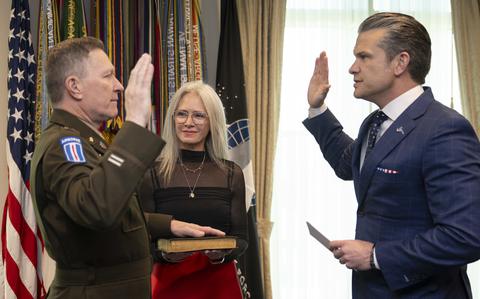
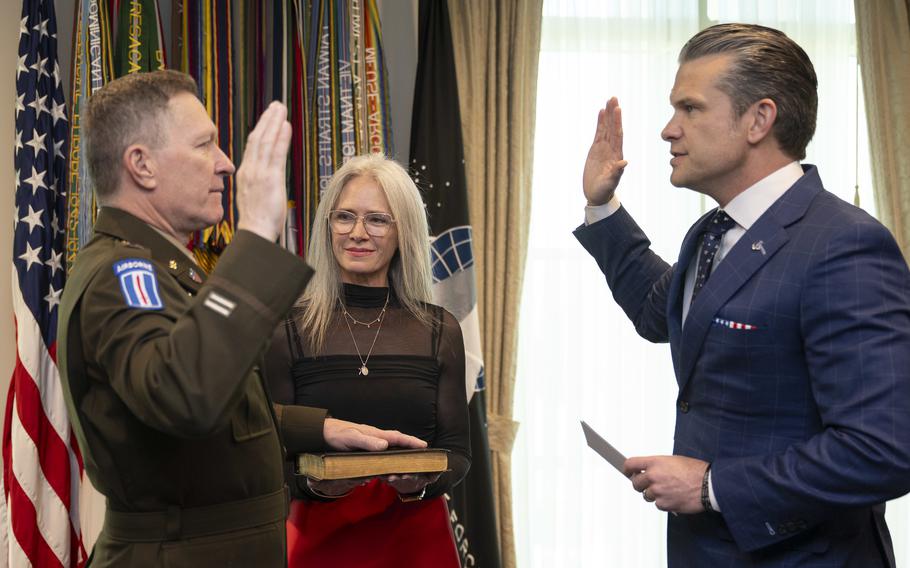
Country music star and Army Reserve soldier Craig Morgan, left, was promoted to the rank of Chief Warrant Officer 2 in a ceremony officiated by Defense Secretary Pete Hegseth at the Pentagon on Thursday, Jan. 16, 2026. (Alexander Kubitza/U.S. Navy)
Country music star and Army Reserve soldier Craig Morgan, 61, is seeing his success in his effort to balance a successful civilian career with military service as he uses his years of experience to contribute to an anti-suicide program with the dozens of Army bands.
Morgan was promoted to the rank of Warrant Officer 2 in a ceremony officiated by Defense Secretary Pete Hegseth at the Pentagon on Jan. 16, more than two years after the star resumed his military career.
The high-profile of the ceremony was not unusual for Morgan, who enlisted again in the Army Reserve in 2023 at a ceremony at the Grand Ole Opry after a prolonged break from his 17 years of service. But it was an honor all the same, he said, to have the senior leader in his command pin his rank.
Morgan originally joined in the Army in 1985 and spent 9½ years in active duty before serving in the Reserve for 6½ years. He left the service to pursue his burgeoning career in music. He has racked up a number of civilian and service-related decorations, including a spot in the U.S. Field Artillery Hall of Fame, the U.S. Army’s Outstanding Civilian Service Medal and the USO Merit Award.
Morgan’s age is not all that unusual in the Reserve, the musician said, or among the warrant officer community. Warrant officers, Morgan said, “are the experts in their field, regardless of the field.”
In his case, that field is music: Morgan serves with the 313th Army Band at Redstone Arsenal, Ala., and contributes to a suicide prevention program that uses music to speak to soldiers. The Prevention Music Initiative ensures soldiers’ wellbeing and also keeps them from being non-deployable, according to Morgan, who emphasized that everyone in the chain of command is committed to taking care of soldiers.
“It’s a soldier-led initiative,” Morgan said. “We’re recording all of the music with soldiers, with military or Army engineers, Army band members, Army vocalists.”
Morgan said he thinks the project “is one of the most critical things we’ve ever done in the music world, especially in the military.” He contributes by using his civilian contacts in the industry to help promote the music to a larger audience.
Fitness, not age
The musician was careful to note that he is not simply back in service because of his musical career but because he is physically fit.
“I hear a lot of people say, ‘Oh, this guy’s too old,’ ” Morgan acknowledged, adding, “Come work out with me. Come participate. Don’t sit on the bench and talk about me.”
Similarly, Morgan said he’s worked with older personnel who “have a lineage of expertise that they bring to the table that the Army should not get rid of,” as long as they remain physically and mentally fit. No one, regardless of age, should be able to stay in the military if they cannot meet fitness standards, he stressed.
Crediting skills gained in the Army
Asked how often service members want to know how he transitioned into a music career, Morgan responded, “every day.”
His advice to them is the same advice he gives to civilians: consult professionals, not simply the opinion of family and friends for validation.
Morgan also said he reminds those serving to appreciate the skills they learn in the military, such as good communication skills.
“I would put any soldier, E4 and below, with four years in service against any college graduate with four years of college, and I promise you they will communicate better. That soldier will,” he said.
As for how he manages his time — between his Army service, maintaining a successful music career, and more recently writing a memoir — Morgan said he put together a great team. Civilians may take the notion for granted or even dismiss it, but Morgan noted that in the military, teamwork is essential.
In both his revived military career and in his civilian career, he said, “I go to the experts.”