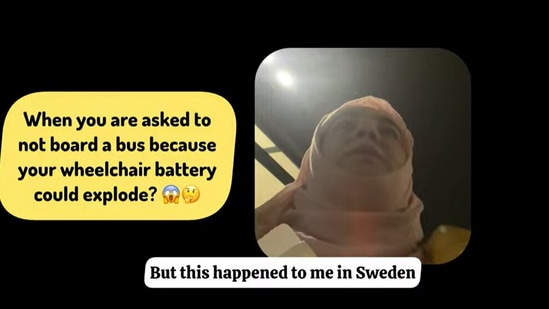
Pakistani entrepreneur and disability rights activist Tanzila Khan shared a video on social media showing how she reacted when a woman in Sweden stopped her from boarding a bus. A fellow commuter attempted to deny her entry to a public bus, citing an unfounded fear that her wheelchair battery was a fire hazard. Khan didn’t lean into anger; instead, she demanded education and evidence, leading her to finally board the bus and even receive an apology from the woman who stopped her.
Tanzila Khan, a Pakistani disability rights activist who faced discrimination in Sweden. (Instagram/@iamtanzilakhan)
“These are not novel situations in the life of a PWD. And when in one, ask for written confirmations and documented company policies. Many time we are dealing with personal bias rather than security protocols,” wrote Tanzila Khan on Instagram.
The video, shared on her YouTube channel, captures her conversation with a woman who stops her from boarding the bus. The woman keeps repeating that she cannot get on the bus, citing that her wheelchair battery would explode.
Khan, though visibly distraught, handles the situation extremely calmly. She counters the woman’s allegation with logic and repeatedly asks her to cite the rule that prohibits her from boarding a bus while using a motorised wheelchair.
Keeping her cool, Khan continues to say that the woman’s remarks were discriminatory.
Khan says, “The wheelchair would just explode? Did it happen recently? So please educate me, did this happen recently?” Insisting that the woman show proof to back her remark.
Finally, she boards the bus with the help of a fellow commuter. She expresses, “I got on the bus, and there were no issues at all.”
Khan reveals that after she got on the bus, the woman who initially stopped her came to her and apologised.
An individual remarked, “Girl. Kudos to you for raising your voice over this unnecessary discrimination. I would have started crying for sure.” Another expressed, “Moments like this are so hard, and I am sure you have been in many such moments. Kudos to you for standing your ground and educating the person about your rights!”
A third commented, “I am so sorry to know this happened. You handled this so gracefully, despite the shock and hurt it may have caused. Did the bus driver deny you boarding?” Khan replied, “No, he actually didn’t because there is no such rule. She was stopping me for what she believed in.”
A fourth wrote, “Whenever someone makes up a new rule barring you from something, the first question you need to ask them is, ‘What is your name? Your full name?” That moment lets them know you are now targeting them as much as they are trying to.” Khan said, “Yes, you are right. For a while, I didn’t even know what I was dealing with.”
According to Storstockholms Lokaltrafik (SL), the public transport organisation in Stockholm County, all buses have “ramps, so that you who use a wheelchair or a walker (frame device) easily can get on and off even at bus stops where there is height difference between the bus floor and the ground.” However, it doesn’t specify the type of wheelchair.